
You are using an out of date browser. It may not display this or other websites correctly.
You should upgrade or use an alternative browser.
You should upgrade or use an alternative browser.
New Consumer Unit
- Thread starter 80bobber
- Start date
We can't really know that from the internet. Testing the existing installation before changing the CU would be the best way to find that out.
Ask the spark who’s doing it?
And don’t get a dual RCD board fitted
And don’t get a dual RCD board fitted
Last edited:
I think many would recommend an RCBO consumer unit nowadays.
If your wiring were to cause problems (that a good electrician should have found first anyway), tripping may then be limited to individual circuits.
If your wiring were to cause problems (that a good electrician should have found first anyway), tripping may then be limited to individual circuits.

- Joined
- 27 Jan 2008
- Messages
- 29,237
- Reaction score
- 3,586
- Location
- Llanfair Caereinion, Nr Welshpool
- Country

I agree with @RandomGrinch the twin RCD consumer unit is being penny wise pound foolish, if the supply to freezer is lost once where a RCBO one would have stopped it being lost, it is worth the extra money.
But the correct method is to measure first, a meter like this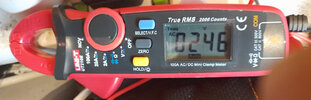 around the meter tails will tell you total back ground leakage, the limit for a 30 mA RCD is 9 mA, but in real terms you want it down to half that. With an up and running system it is so easy to measure, with a dead system we use an insulation tester,
 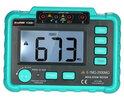 these are not as good, as they use DC to test, and with AC we get inductive and capacitive linking, so there is always some leakage which will not show up when testing with DC, but until either of these meters are used, it is simply guess work.
But the correct method is to measure first, a meter like this
around the meter tails will tell you total back ground leakage, the limit for a 30 mA RCD is 9 mA, but in real terms you want it down to half that. With an up and running system it is so easy to measure, with a dead system we use an insulation tester, these are not as good, as they use DC to test, and with AC we get inductive and capacitive linking, so there is always some leakage which will not show up when testing with DC, but until either of these meters are used, it is simply guess work.
Very likely.Am I likely to have problems with my existing wiring now that the more sensitive RCD is there?
This is how a consumer unit replacement should be done:
1 - Test and inspect the entire installation
2 - Repair all of the problems found
3 - Test again to ensure the repairs didn't introduce more problems
4 - Remove old consumer unit and install new
5 - Test all circuits which will now include results for the RCBOs that were installed in the new one.
6 - Complete installation certificate and building regulations notification as required.
There are people that only do 4 and charge a lot less. If you use them, problems are guaranteed and you will end up paying far more than doing it properly in the first place.
Last edited:
Not just wiring but appliances etc connected to itI am about to replace my old MCB Consumer Unit with a new RCD one. Am I likely to have problems with my existing wiring now that the more sensitive RCD is there?
Provided you don’t have old rubber wiring and loads of DIY additions, any problems should be able to be identified and fixed.
What do you mean?..."I am about to replace" Surely you mean a sparky is about to change the consumer unit and he should test the current installation before fittingI am about to replace my old MCB Consumer Unit with a new RCD one. Am I likely to have problems with my existing wiring now that the more sensitive RCD is there?
Very likely.
This is how a consumer unit replacement should be done:
1 - Test and inspect the entire installation
2 - Repair all of the problems found
3 - Test again to ensure the repairs didn't introduce more problems
4 - Remove old consumer unit and install new
5 - Test all circuits which will now include results for the RCBOs that were installed in the new one.
6 - Complete installation certificate and building regulations notification as required.
There are people that only do 4 and charge a lot less. If you use them, problems are guaranteed and you will end up paying far more than doing it properly in the first place.
Sorry mate but 1- 3 are rarely needed so let’s just make it clear that these are not needed to be done on every CU change
And sure the odd issue pops up during an install but that’s about 1 in 30
I think many would recommend an RCBO consumer unit nowadays.
If your wiring were to cause problems (that a good electrician should have found first anyway), tripping may then be limited to individual circuits.
Only cheap skate sparks install dual boards these days

- Joined
- 11 Jan 2004
- Messages
- 46,874
- Reaction score
- 3,986
- Country
Rarely?Sorry mate but 1- 3 are rarely needed so let’s just make it clear that these are not needed to be done on every CU change
And sure the odd issue pops up during an install but that’s about 1 in 30
How many board changes have you done?

I totally disagree with what you have just said.Sorry mate but 1- 3 are rarely needed so let’s just make it clear that these are not needed to be done on every CU change
And sure the odd issue pops up during an install but that’s about 1 in 30
Flameport is spot on.
Personally I would do a full EICR (or pretty much so) in the first instance, prior to even purchasing the new consumer unit.
Then do corrections, if any - which are quite often needed or advisable anyway.
I would also take a gander at the appliances on site . Example, has the customer got an old WW1 vintage Electric Fire that they intend to use etc etc.
In my view, there is nothing more unprofessional than someone changing a consumer unit then finding problems start to occur .
Last edited:
- Joined
- 27 Jan 2008
- Messages
- 29,237
- Reaction score
- 3,586
- Location
- Llanfair Caereinion, Nr Welshpool
- Country
I agree with @flameport although where the wiring looks to be sound, I can also to some extent when an all RCBO board is fitted understand why one takes a chance. The clamp on meter does mean one has a reasonably good idea of overall leakage before one starts, however for many years my clamp on measured in 10 mA increments the yellow one of the pair shown, 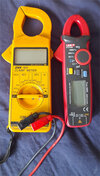 until I got the smaller red one, which will measure in 1 mA increments, it will also measure DC to ensure the 6 mA permitted with a type A RCD is not exceeded, but in real terms due to the way field effect meters need to be zeroed in real terms this is a bit hit and miss.
However I can also see @Murdochcat point, if fitting all RCBO then there is little one can do to reduce earth leakage, the testing is essential when grouping circuits to ensure one circuit is not going to cause others to trip, so before fitting a duel RCD board yes essential, but with an all RCBO board there is little one can do anyway.
My last house I fitted two RCD's and I did loose contents of freezers when it tripped when I was away, so this house had all RCBO one to reduce the chance of tripping, and two as if there is a fault with some thing plugged in, one does not also what to be plunged into darkness, and sockets split side to side, and lights upper and lower, the whole point in having sockets split is so if there is a fault you still have some working sockets, so having both circuits on the same RCD does not make sense.
However saying that in my caravan when I had one, all was on one RCD, but we did have battery back up for lights, and cooking was gas, so by using rechargeable touches which auto switch on with a power cut, one can remove some of the dangers due to RCD's tripping, last house had one at consumer unit, this house one top of stairs.
until I got the smaller red one, which will measure in 1 mA increments, it will also measure DC to ensure the 6 mA permitted with a type A RCD is not exceeded, but in real terms due to the way field effect meters need to be zeroed in real terms this is a bit hit and miss.However I can also see @Murdochcat point, if fitting all RCBO then there is little one can do to reduce earth leakage, the testing is essential when grouping circuits to ensure one circuit is not going to cause others to trip, so before fitting a duel RCD board yes essential, but with an all RCBO board there is little one can do anyway.
My last house I fitted two RCD's and I did loose contents of freezers when it tripped when I was away, so this house had all RCBO one to reduce the chance of tripping, and two as if there is a fault with some thing plugged in, one does not also what to be plunged into darkness, and sockets split side to side, and lights upper and lower, the whole point in having sockets split is so if there is a fault you still have some working sockets, so having both circuits on the same RCD does not make sense.
However saying that in my caravan when I had one, all was on one RCD, but we did have battery back up for lights, and cooking was gas, so by using rechargeable touches which auto switch on with a power cut, one can remove some of the dangers due to RCD's tripping, last house had one at consumer unit, this house one top of stairs.
- Joined
- 28 Apr 2004
- Messages
- 8,446
- Reaction score
- 1,022
- Country
What about an "emergency" CU change, I have had a few of those when there is no time to do an EICR beforehand (pointless anyway) and sort out testing/remedials laterI totally disagree with what you have just said.
Flameport is spot on.
Personally I would do a full EICR (or pretty much so) in the first instance, prior to even purchasing the new consumer unit.
Then do corrections, if any - which are quite often needed or advisable anyway.
I would also take a gander at the appliances on site . Example, has the customer got an old WW1 vintage Electric Fire that they intend to use etc etc.
In my view, there is nothing more unprofessional than someone changing a consumer unit then finding problems start to occur .
No Eric, you do not take a chance, you test appropriately first.
I am not against using a clamp meter they can be quite a useful aid, however a 1mA resolution does not imply 1mA accuracy I`m afraid, still cvarry out appropriate tests with appropriate test gear as per C & G 2391 etc.
Yes I favour RCBOs one per circuit as you suggest - some point out it will not insure your total leakage per installation is not exceeded but neither will no RCD present as per rewireable fuses/plain MCBs either . Like you I would prefer not to fit a dual RCD board and favour RCBOs as stated (and I come from a time when an up front RCD was the single option really).
the "Borrowed Neutral " on lighting is usually the "Old Chestnut" that makes frequent visits upon us but the installation really should be tested first.
Yes caravans usually have a one RCD scenario .- in fact a one and one (one at the supply end and one in the caravan really).
I am not against using a clamp meter they can be quite a useful aid, however a 1mA resolution does not imply 1mA accuracy I`m afraid, still cvarry out appropriate tests with appropriate test gear as per C & G 2391 etc.
Yes I favour RCBOs one per circuit as you suggest - some point out it will not insure your total leakage per installation is not exceeded but neither will no RCD present as per rewireable fuses/plain MCBs either . Like you I would prefer not to fit a dual RCD board and favour RCBOs as stated (and I come from a time when an up front RCD was the single option really).
the "Borrowed Neutral " on lighting is usually the "Old Chestnut" that makes frequent visits upon us but the installation really should be tested first.
Yes caravans usually have a one RCD scenario .- in fact a one and one (one at the supply end and one in the caravan really).
So an "Emergency CU Change" negates testing for safety does it? No - You can always put some temporary lighting and power in if need be then do the testing of the dead existing tomorrow before the CU change.What about an "emergency" CU change, I have had a few of those when there is no time to do an EICR beforehand (pointless anyway) and sort out testing/remedials later

DIYnot Local
Staff member
If you need to find a tradesperson to get your job done, please try our local search below, or if you are doing it yourself you can find suppliers local to you.
Select the supplier or trade you require, enter your location to begin your search.
Please select a service and enter a location to continue...
Are you a trade or supplier? You can create your listing free at DIYnot Local


