Thanks. Bottom right corner.Coax and hdmi cables can run anywhere - there are no zones for these cables.
Where are the other devices going to be positioned?

You are using an out of date browser. It may not display this or other websites correctly.
You should upgrade or use an alternative browser.
You should upgrade or use an alternative browser.
Advice on chasing leads into solid wall for TV
- Thread starter budest
- Start date
Thanks. I was thinking of using at least 38mm trunking with the removable cover that can be clipped on and off to allow the placement of HDMIs etc. Obviously the issue with this is that once in situ they cannot be removed without cutting the ends off and pulling the cable through. But it's unlikely you'd have any reason to remove them once in place.Don't forget to add a couple of cat5 or cat6 cables to the coax/hdmi run. Easier to do it now rather than later!
Coax/hdmi cables ideally need a sweeping bend rather than a tight bend about the radius of a tin of beans is ok. That is achievable in a double back box . Also bear in mind that if you want to put the HDMI cables in trunking the plugs are much bigger than the cable diameter so the conduit needs to be larger especialy if you want multiple hdmi leads or might do in the future.( my TV for instance has 4 HDMI inputs in use)
Is that a newly plastered wall? - New build.Because they're low voltage and don't pose risk of electric shock.
Is that a newly plastered wall?
Is this ground floor or upstairs, and are you certain about the existing wiring going up from the sockets?
What is your floor contruction?
Is this ground floor or upstairs, and are you certain about the existing wiring going up from the sockets? - Sitting room in a house. It's an informed guess to be honest, but I will be removing the faceplates to check for cable direction before starting though. I was initially just going to use a voltage tester but given your comment I will have a closer look.
What is your floor contruction? Concrete screed.
Is the room plaster boarded?
I wish! It would make the job so much easier. It's solid walls in the room.Is the room plaster boarded?
OK, I have worked it out.
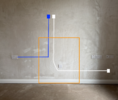
Blue = Spur (easy enough)
White = HDMIs, Ethernet, coax
White Box = White brush faceplate
Orange Box = Fireplace
I will chase along the horizontal white line, fit 38mm conduit with clip off cover. Install leads and bring them out freely behind the fireplace (no chased angles). I will then chase a vertical channel from behind the fireplace to behind the TV and fit another brush faceplate for the cable exit. I will run leads into the vertical conduit and out behind the TV. Test everything. Replace conduit covers and repair walls.
Ho does that sound?
Blue = Spur (easy enough)
White = HDMIs, Ethernet, coax
White Box = White brush faceplate
Orange Box = Fireplace
I will chase along the horizontal white line, fit 38mm conduit with clip off cover. Install leads and bring them out freely behind the fireplace (no chased angles). I will then chase a vertical channel from behind the fireplace to behind the TV and fit another brush faceplate for the cable exit. I will run leads into the vertical conduit and out behind the TV. Test everything. Replace conduit covers and repair walls.
Ho does that sound?
Attachments
- Joined
- 21 Mar 2024
- Messages
- 592
- Reaction score
- 168
- Country

Plaster straight onto blockwork? That's honestly quite surprising/premium for a new build, you won't be complaining when you're fixing your TV there. Double check that it's not dot and dab plasterboard when you take the faceplates off.I wish! It would make the job so much easier. It's solid walls in the room.
If it is wet plaster finish, I wouldn't be chasing anything deeper than 20mm conduit in horizontally - you've maybe got 10mm of plaster before block, another 10mm+ and you're close to weakening the wall.
Plaster straight onto blockwork? That's honestly quite surprising/premium for a new build, you won't be complaining when you're fixing your TV there. Double check that it's not dot and dab plasterboard when you take the faceplates off.
If it is wet plaster finish, I wouldn't be chasing anything deeper than 20mm conduit in horizontally - you've maybe got 10mm of plaster before block, another 10mm+ and you're close to weakening the wall.
Yeah, plaster straight on top of blocks.
"another 10mm+ and you're close to weakening the wall."
You know, I had thought about that, not because I'm an expert (I'm not) but just thinking about it logically, so I'm glad you've brought it up.
I should have been clearer too, the chase will be to accommodate 38mm (wide) trunking which is 25mm deep. But I don't want to risk any structural damage.
- Joined
- 21 Mar 2024
- Messages
- 592
- Reaction score
- 168
- Country
Even that's a bit ropey, 10mm plaster is a guess. They do make a 16mm deep trunking.Yeah, plaster straight on top of blocks.
"another 10mm+ and you're close to weakening the wall."
You know, I had thought about that, not because I'm an expert (I'm not) but just thinking about it logically, so I'm glad you've brought it up.
I should have been clearer too, the chase will be to accommodate 38mm (wide) trunking which is 25mm deep. But I don't want to risk any structural damage.
The other option would be to whip the skirting off and chase the concrete
Looking at the plans, the internal solid walls are 140mm deep, so I am expecting the external walls to be the same with the additional cavity and then final brickwork. If 140mm deep, then I should get away with a 23mm deep chase, right? I'll air on the side of caution though and go to 20mm. As long as I get a single coax and single HDMI into the conduit, I will be happy. Would they both go into a 16mm pipe, do you think?Even that's a bit ropey, 10mm plaster is a guess. They do make a 16mm deep trunking.
The other option would be to whip the skirting off and chase the concrete
I will be taking skirting off to lay flooring but would prefer not to start digging up the new floor.

- Joined
- 18 Apr 2022
- Messages
- 7,200
- Reaction score
- 1,076
- Country
Doesn't that just mean that the regulations contain things which apply to HDMI & coax, etc, not that every regulation applies?
- Joined
- 21 Mar 2024
- Messages
- 592
- Reaction score
- 168
- Country
If that were the case then yes 100%, but for a 38x25mm trunking you'd need to chase out about 26-28mm (which would likely still be OK with 140 thick walls). I'm confident you would get all 4 cables through a 38x16 trunking with the lid off. You might want run a leg down from each box to maximise your bend radius (2 into each).Looking at the plans, the internal solid walls are 140mm deep, so I am expecting the external walls to be the same with the additional cavity and then final brickwork. If 140mm deep, then I should get away with a 23mm deep chase, right? I'll air on the side of caution though and go to 20mm. As long as I get a single coax and single HDMI into the conduit, I will be happy. Would they both go into a 16mm pipe, do you think?
I will be taking skirting off to lay flooring but would prefer not to start digging up the new floor.
Just make sure you're happy with what's going in there, pulling new cables with connectors through's not going to happen, if you're going to use trunking rather than conduit I'd glue the lid on when you're done so a tug of the cables doesn't rip your wall back open.

Personally, I have always understood it this way.Doesn't that just mean that the regulations contain things which apply to HDMI & coax, etc, not that every regulation applies?
A cable is a cable, no matter what voltage and current it carries or is capable of doing thus.
Irrespective of whether it is low voltage (includes "Mains Voltage" or extra low voltage (including signal cables and tv/radio and other communication cables).
Therefore should be run surface or in suitable surface containment or buried to a suitable depth, hopeflly reducing the risk of accidental damage.
I am not overkeen on the 50mm/2" depth being sufficient in all cases for the simple reason that any substantial fixing might employ screws longer than that depth in order to achieve an adequate purchase) but hey ho that is the dimension decided upon by the great and good.
Why would anyone not allow similar rules for any cable purely for any logical reasons?
OK we might not need cables to enjoy the same very basic level of such protections merely for the sake of danger to Persons/Livestock/Property which is always the prime consideration of BS7671 but let us be guided by what (in my humble opinion) is the most powerful reg of all
(Good workmanship and proper materials, throughout!) .
Every cable is a cable is a cable.
- Joined
- 18 Apr 2022
- Messages
- 7,200
- Reaction score
- 1,076
- Country
Personally, I have always understood it this way.
A cable is a cable, no matter what voltage and current it carries or is capable of doing thus.
Irrespective of whether it is low voltage (includes "Mains Voltage" or extra low voltage (including signal cables and tv/radio and other communication cables).
Therefore should be run surface or in suitable surface containment or buried to a suitable depth, hopeflly reducing the risk of accidental damage.
I am not overkeen on the 50mm/2" depth being sufficient in all cases for the simple reason that any substantial fixing might employ screws longer than that depth in order to achieve an adequate purchase) but hey ho that is the dimension decided upon by the great and good.
Why would anyone not allow similar rules for any cable purely for any logical reasons?
OK we might not need cables to enjoy the same very basic level of such protections merely for the sake of danger to Persons/Livestock/Property which is always the prime consideration of BS7671 but let us be guided by what (in my humble opinion) is the most powerful reg of all
(Good workmanship and proper materials, throughout!) .
Every cable is a cable is a cable.
Agree with all that, but as you say, the prime consideration of the regulations could easily mean that the measures required for safety for "electrical" cables are not required for signal ones.
(As an aside, re "substantial fixings", Corefix ones are very long not to get good purchase for significant loads but so that they will work to prevent D&D plasterboard from getting crushed.)

DIYnot Local
Staff member
If you need to find a tradesperson to get your job done, please try our local search below, or if you are doing it yourself you can find suppliers local to you.
Select the supplier or trade you require, enter your location to begin your search.
Please select a service and enter a location to continue...
Are you a trade or supplier? You can create your listing free at DIYnot Local
Similar threads
- Replies
- 12
- Views
- 21K
- Replies
- 7
- Views
- 3K
- Replies
- 8
- Views
- 3K