Which Radiator Make and TRV / Lockshield?

Joined
30 Oct 2003
Messages
486
Reaction score
62
Location
Worcestershire
Country
United Kingdom
Question of two parts:

With the on-going saga of cold / warm rads that a flush didn't fix (probably due to microbore and manifolds being blocked), it was suggested that at least some rads would benefit by being changed. This is a job that I can do myself, I feel.

The bathroom and en-suite will not be changed immediately as they are going to be refitted, so I need only seven new rads.

I am looking at Kartell and Stelrad. Are these the better end of the market? or are the likes of Screwfix any good?

Whilst I am doing this I might as well change the TRV and lockshield on each as we have a bit of a jumble now, and one seems to be faulty. The existing lockshields all have a drain spigot (even those upstairs) so I assume that only one on the ground floor would actually need a drain cock?

Is there a recommended manufacturer for the TRV / lockshield?
 
Consider Henrad from Wickes.
Part of Stelrad group, apparently and thus still made in UK.

TRVs/lockshields Pegler Terrier (or Bulldog rebranded ones) seem OK from my DIY experience of them, and you can get them with a drain-off if you want that feature.

The pro experts will have their own preferences / recommendations, I'm sure.
 
You will be lucky, I have tried a few times to start a discussion about what TRV heads do what with comments like "Life is too short." as the reply.

I was not impressed with Energenie, even the cheapest TRV heads have
1771268261161.png
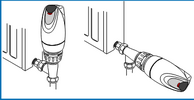
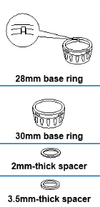
error codes to show range too wide and range too small, the eQ-3 head at £15 has this, so one would hope more expensive models would also have it. Some makes due to length can be rather vulnerable to damage 1771268629784.png1771268629784.png and some are not able to be manually set, one is forced to use an app. There are kits to match them with different bases, 1771268871717.pngsome with more options as to others, but the 30 mm base ring seems to be what most use. I now have Drayton Wiser, which has been working well, but I have only used 4 makes, I at £15 a head would not consider using a manual head, but as to if worth paying more for non-linked heads not so sure. The linked Wiser head means there is no need for any wall thermostats, but having to either bend down or use an app, is not what we all want, the likes of Kasa and Wiser you can combine a wall thermostat or sensor with the TRV head. But size of ones home and design can change if they really help, my last house open plan, I only had TRVs upstairs, one wall thermostat downstairs was enough.

And also heat loss, I see with the graph,
1771269890699.png
my heat loss is low, and not having the heating running overnight is not really a problem. But my first house had same heat loss in a couple of hours, so it needed the thermostat to be programmable.
 
Rads are much of a muchness, but new radiators won't fix pipework issues
Indeed not, but I am thinking of having a look at the pipes myself, so whist drained down I can swap a few over. I think the thinking was that if the rads are corroded, then it would remove the possibility of chunks of corroded material coming away and blocking again.

The lowest point, of every 'pipe drop', needs to be fitted with at least one drain valve, if you want to make draining down easy in the future.
Ah yes, good point. Strange that the upstairs rads have them!

Consider Henrad from Wickes.
I have 3-off Henrads that were replacements in the utility, bathroom and downstairs loo. Two have paint flaking at the bottom and one is quite rusty on the surface already. It may be the dampp atmosphere, but the loo is not overly damp I would say.
 
I had a problem getting the kitchen radiator warm, was not too worried about it, getting the living room warm was more of a problem, the radiators would get hot, but the room still cool.

So I after a lot of messing around blamed the Nest Gen 3 thermostat in the hall, not sure if the Nest or where located, but to move it left me with a supply problem, so I fitted a wireless thermostat in parallel with sensor in the living room, problem of cold living room cured, but also problem with cold kitchen radiator also cured, it was simply not running the central heating for long enough which caused the kitchen not to work.

I am not saying you have the same problem, but also can't rule it out. I assume when the heating ran for longer, TRV heads closed, pushing water through radiators which were a little harder for the water to reach, try the simple first. Turn up the thermostat and allow the TRV heads to control the rooms, and see what happens. If using mechanical heads then somewhere between 2 and 3 is normally around 20°C, see if that works first.
 
I am looking at Kartell and Stelrad. Are these the better end of the market? or are the likes of Screwfix any good?
Prorad are also part of the Strelrad group, but I think their radiators are made in Turkey. They are almost identical to Strelrad radiators - with to my mind a better way to fix the end panels - and are typically a little cheaper. They can be bought online with rapid delivery, which is much easier than having to cart them from Screwfix or similar.
 
I am not saying you have the same problem, but also can't rule it out. I assume when the heating ran for longer, TRV heads closed, pushing water through radiators which were a little harder for the water to reach, try the simple first. Turn up the thermostat and allow the TRV heads to control the rooms, and see what happens. If using mechanical heads then somewhere between 2 and 3 is normally around 20°C, see if that works first.
I have mechanical TRV - one I think is stuck open and the others are OK. I now have a mismatched set that might as well be changed when I change the rads or have the system drained down to sort the blockages
 
I got eQ-3 electronic heads for £15 each, mine were bluetooth, and back in 2019, but still found some deals for electronic heads for £15. The big difference is with electronic heads, one can also set the time. Second advantage actually set in degrees C not some silly *123456. But the electronic head comes from basic, all still set at the TRV, then with bluetooth, then with wifi (normally needs some sort of hub as direct from router is power hungry) and final where it can actually turn boiler on/off from the TRV head.

I have tried to get people to talk about the different makes and models, so we can all compare them, but all I got was sarcastic replies, no one seems to want to talk about how they have worked for them.

What I have found, is I can really speed up the re-warming of the house, but it is not straight forward. If I only have a pair of radiators open, they will clearly heat up faster, but then the boiler will close down as hot water has returned to the boiler, so only want maybe a 10-minute delay before the next one opens, boiler will run for around 20 minutes with radiators closed (heating DHW) so want all radiators required, open within 20 minutes of boiler starting.

I realise my radiators are too small, ideal we want double or more kW radiator output to boiler output, or can't reduce a radiators output without also reducing boiler's output.

This can work out well with a 12 kW boiler and 30 kW of radiators around the house, but with a 35 kW boiler one would need a massive house to sink that amount of energy. I would say my large living room, to reheat, may need 6 kW to do it in a short time, but over 6 kW the radiators would be too big. Only way I could get a larger output would be fan assisted radiators.

So we quickly realise there is on one system suits all, What may work for me, may be complete rubbish for you. And I look at my house with three floors, and a 20 kW boiler, and wonder why there are so many 35 kW boilers fitted, they are either grossly over size, or the house is really massive, far larger than my 5 bedroom house, or they must still have single glazed windows?

Some times we need to step back and just think, every room in my house could be heated with a 2 kW fan heater, so 10 rooms, 20 kW must be over kill. We know the boiler modulates (turns down output) so the return water is cool enough to extract the latent heat from the flue gases, and we know the boiler slowly modulates over time, and once it has been turned off, and back on again, it has to restart this modulating process from scratch, so the less times per day the boiler is switches off and on again the better. So if we can use analogue control that is far better, and the TRV is analogue control, we can get analogue wall thermostats, but in the main they are on/off, so we want the TRV to do most of the controlling.

It will work turning the whole boiler on/off, but we will not gain as much latent heat so it will cost more.
 

If you need to find a tradesperson to get your job done, please try our local search below, or if you are doing it yourself you can find suppliers local to you.

Select the supplier or trade you require, enter your location to begin your search.


Are you a trade or supplier? You can create your listing free at DIYnot Local

 
Back
Top