Doorbell issue

Joined
3 Feb 2024
Messages
4
Reaction score
0
Location
Cambridgeshire Fens
Country
United Kingdom
We live in an old Fenland farmhouse and our back gate, where the post and most deliveries arrive is - in a straight line - about 30 metres from our back door. Unfortunately, there is an old brick-built tractor shed, which we use as a garge/potting shed, directly between the house and the gate which impedes any wireless doorbell signals. I am currently on the third bell kit, a Technet unit with a supposed range of 400 metres, but it still only works intermittently, and more often than not we rely on the dog to hear the postman arrive, much to the ongoing consternation of said postman! It is frustrating to miss deliveries, which then have to be re-arranged or collected from the nearest delivery office, which only opens for 1 hour, on three days when there's a z in the month.

I am wondering if there is any way to enhance or improve the signal so that it will pass through, around or over the shed and actually activate the ringer unit in the house. The only alternative as I see it is to install a wired system on a mains-powered transformer, which would mean digging a trench to lay cable ducting. Given the distance, would I still have any issues with power loss through the bell wire, considering the comparatively low voltage of such a system? There is electrical power in the tractor shed, where a bell transformer could be installed.

Any thoughts?
 
which would mean digging a trench to lay cable ducting.

Would it though? Why do you need to bury the cable?

But you have a building with power in it, with short line of sight to the house, and short line of sight to the gate. Must be a way to link the two inside the building?
 
Would a wireless repeater or range extender on the outside of the shed resolve the problem. Speak to Technet.
 
There not cheap but look at wisebox, you would need 1 in the shed 1 in the house, 1 external bell push and 1 standard bell set up in the house.
Cant quarantee it will work but maybe an option.
Though to be fair you can get the receiver bits etc and transmitter bits and maybe build your own cheaper
 
I am currently on the third bell kit, a Technet unit with a supposed range of 400 metres, but it still only works intermittently,

They offer a range of systems, one self powered push, able to work at 1300 feet. https://tecknet.co.uk/products/tecknet-self-powered-doorbell-with-3-receivers

You could fit two receivers in the house, the other in the shed audible at the gate, for feedback to the postie etc. Generally, the higher the transmitter and receivers are mounted, the better the reliable range, so if you fitted one of the two upstairs, it might work better.
 
I am wondering if there is any way to enhance or improve the signal so that it will pass through, around or over the shed and actually activate the ringer unit in the house.
These doorbells usually work on a frequency of about 433 MHz.

Inside the "bell-push" unit there is usually a printed circuit board with an "antenna" -
being a circuit board "track" connected (soldered) only at one end - usually along the long side of the unit.
Because of the size of the unit in which this "antenna" is located, this antenna is not long enough to be actually resonant at the frequency involved.

If you can open up the bell-push unit and find the connection point of this internal "antenna",
it should be possible to solder a length of wire to this point and allow it to hang down below the installed .unit.
This length of wire should be cut to 133 mm (or, as close as possible to this) to be resonant at 433 MHz..

This may allow the bell-push to transmit a stronger signal.
 
These doorbells usually work on a frequency of about 433 MHz.

Inside the "bell-push" unit there is usually a printed circuit board with an "antenna" -
being a circuit board "track" connected (soldered) only at one end - usually along the long side of the unit.
Because of the size of the unit in which this "antenna" is located, this antenna is not long enough to be actually resonant at the frequency involved.

If you can open up the bell-push unit and find the connection point of this internal "antenna",
it should be possible to solder a length of wire to this point and allow it to hang down below the installed .unit.
This length of wire should be cut to 133 mm (or, as close as possible to this) to be resonant at 433 MHz..

This may allow the bell-push to transmit a stronger signal.
And the same it true for the receiver.
 
What about an extraordinarily loud sounder at the gate end that you can hear from the house?
 
You could also consider an opto/infra red transmitter/receiver pair or even build your own or ask a knowledgeable pal to do it.

If you are just signalling a bog standard ELV bell system just a length of bellwire and not much digging undergrund to worry about, you could even use just one conductor and use the earth around you as the other too.

Come to think about it a piece of taut string and a weighted door knocker has attractions too.
 
Have you confirmed that moving the transmitter so the shed no longer blocks line of sight, resolves the issue?

Given how cheap these things are, I would crack open the transmitter end and stick a better antenna on it. There are plenty available COTS for 433 and 868MHz.
 
If the doorbell uses zigbee, then any zigbee unit in the building between house and gate will relay the signal. I have it with my TRV head in wife's bedroom, which is too far from the boiler, so a plug in socket adaptor on the landing relays the signal.
 
You could also consider an opto/infra red transmitter/receiver pair or even build your own or ask a knowledgeable pal to do it.

If you are just signalling a bog standard ELV bell system just a length of bellwire and not much digging undergrund to worry about, you could even use just one conductor and use the earth around you as the other too.

In one location, I used a Friedland long range system, but ended up modifying it because the range wasn't adequate, in a bank, with the push outdoors, at the door. I installed the bell-push indoors, in the ceiling, with a pair of wires soldered across the internal button, then ran the wire to a second, simple push button at the door outside.
 
I`ve just had another thought too.

Years ago at our local swimming pool I had to replace some shower timers. A push button ("Air Switch") and a length of tubing to an air operated changover switch which then triggered a relay timer to allow the shower to run for a certain preset time once button has been pressed.
All the Electrics of any voltage is therefore at the receiving end and the push button and tubing was purely pnuematic therefore could be run almost anywhere including very wet areas and the only consideration being protection against mechanical damage .
In this case it was from RS Compenents (Electrovalue) but I`m sure other makes were available, even Amazon or Aliexpress might have some cheap versions.
 
I have a Tapo doorbell push,
1774613158290.png
I did not buy it to do that job, but the Tapo and Kasa hubs (Both TP-Link) have a built-in sounder, so when I found I did not need the button to turn lights on/off, in dinning room being used as a bedroom when wife's knee was done, it was a non cost option to reuse as a doorbell push. Not rated for outdoor, but the position is sheltered, and it has worked for a couple of years now. Find it handy it records when pushed.

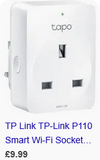
Asking google it says "Most TP-Link Kasa and Tapo smart home products are Wi-Fi-based, not Zigbee. However, specific TP-Link models, such as the Deco M9 Plus (mesh router) and the older SR20 router, act as Zigbee hubs. Newer Tapo devices often use proprietary sub-GHz radio rather than standard Zigbee." so not sure if this means a socket adaptor 1774613689282.pngwill relay the signal or not. However I know the Drayton Wiser is zigbee, maybe they have something? Zigbee is a bit odd, I have a stand alone zigbee hub, and the Wiser hub, and they do not seem to be connected, maybe the way I set it up.

What I hope is someone who knows more than me, can jump in and expand on how zigbee can be used, or if other things do the same relaying signals? I don't know if the building in the way has power, so pointless hunting if there is no power in the building.
 

If you need to find a tradesperson to get your job done, please try our local search below, or if you are doing it yourself you can find suppliers local to you.

Select the supplier or trade you require, enter your location to begin your search.


Are you a trade or supplier? You can create your listing free at DIYnot Local

 
Back
Top