• Looking for a smarter way to manage your heating this winter? We’ve been testing the new Aqara Radiator Thermostat W600 to see how quiet, accurate and easy it is to use around the home. Click here read our review.

Alarms - Mains Wired, Interconnected

Well, I always like to put a heat alarm in a kitchen but on a recent job the customer said she didn’t want one and the BCO said she didn’t need to have one - which I thought was odd because he normally said they had to be fitted
Yes, a little odd - but BCOs aren't necessarily known for their consistency (nor, in some cases, even common sense :-) ).

Smoke alarms in kitchens can obviously be a problem/inconvenience. - so we all tend to use heat alarms there for that reason. However, I imagine that there has to be quite a fire going in a kitchen before a heat alarm operates (they must have a reasonably high 'threshold' - for a few days a couple years ago, it got to 40 degrees or so in our kitchen, so probably higher at ceiling level), by which time I would imagine that enough smoke will have been generated to activate other alarms in the house - so I'm not convinced that heat alarms in kitchens are necessarily as useful as we would like to think. However, they do no harm (and might do good), so we usually fit them.
 
IMHO - no you can not have too many alarms but you might have too few - but yes unless installed in good positions sensibly then false alarms can induce a disconnection attitude in some, so that is also something to avoid./
 
IMHO - no you can not have too many alarms but you might have too few - but yes unless installed in good positions sensibly then false alarms can induce a disconnection attitude in some, so that is also something to avoid.
Quite - that was obviously my point. Over the years I've seen a good few cases in which smoke alarms have clearly been removed or disarmed and when I've asked "why?" have invariably been told that the reason was that they were "driving people mad"! Since that attitude/reaction is 'understandable', we therefore do need to try to do things to minimise the risk of 'people being driven mad'.

Of course, there is also another issue of 'human nature', which we often discuss in relation to RCDs etc. - namely that the existence of any 'safety devices' (whether 'preventers' or 'detectors') can result in come complacency - i.e. some people may, quite probably unconsciously, decide that because they have smoke/heat alarms, they don't have to be so careful about not leaving candles burning overnight,ensuring that gas hobs were switched off and ciggies extinguished before retiring to bed etc. - but ether's not a lot that can be done about that, other than attempts to 'give proper education'!

This thread has reminded me of a question that I want to ask about "mains wired interconnected smo ke/heat alarms2 but, rather than doing the usual 'hijacking', I'll start a new thread.

Kind Regards, John
 
Ok, so after a week of easter hols, feeling a bit more refreshed to make some progress on this one. I am starting from the top floor, as the lower ones are much easier >> Just lift carpets, open floor board and run wires. The Top floor is the difficult one.

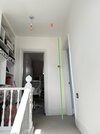
IMG_0413.jpeg
I am looking to install the smoke alarm where the red X is, which is about 300mm from each wall (and then on the same spot on each floor further down). The green line represents a void that I plan to use, which runs all the way into the basement. I do not plan to use the existing lighting circuit, as that is not the same as the downstairs one feeding my other smoke alarms. So planning to run a fresh 3core+CPC from X, to that void and then downstairs to connect to the rest. Ceiling and walls are all lath and plaster, so need to be careful.

Any ideas how I can find the studs/joists?

I tried one of these electric stud finders (with deep mode as well) and also a simple magnetic one, but nothing found. On the lower floors they run front to back. I am a bit concerned that the joist construction around there is somewhat unpredictable. Best case here is that the X is just on the edge of one and I can freely run a cable into the green void, but with my luck it's probably not the case and I need cut many large hols and fiddle somehow though the joists...

And before you ask >> I have loft access, but it's impossible to work from there:
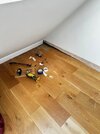
IMG_0234.jpg
I've removed the skirting and cut out one board, hoping this would be a floating laminate floor, but unfortunately the T&G are glued together, so no way of removing them easily..
 
Yes, a little odd - but BCOs aren't necessarily known for their consistency (nor, in some cases, even common sense :) ).

100% correct.

Smoke alarms in kitchens can obviously be a problem/inconvenience. - so we all tend to use heat alarms there for that reason.

Never use a smoke alarm in a kitchen


so I'm not convinced that heat alarms in kitchens are necessarily as useful as we would like to think

Our bedroom is over our kitchen diner - I am sure that the heat alarm would alert us before the fire got through the ceiling
 
Our bedroom is over our kitchen diner - I am sure that the heat alarm would alert us before the fire got through the ceiling
Maybe - but my point was that one needs to have a pretty well established fire before heat alarms are activated - so, particularly if the door to your kitchen-diner is open, whilst you may well be alerted to the fire when in your bedroom above, you might well find that the fire had spread extensively on the ground floor, such that you may find yourself without an easy (if any!) escape route.

Never use a smoke alarm in a kitchen
That's what most of us now say and do. However, the only real downside of a smoke alarm (which will usually be triggered much earlier than a heat detector) is the problem of 'nuisance activations' due to cooking etc. However, provided there is an easy way of temporarily muting the alarm when one has 'burnt the toast', that's no real problem, and arguably an inconvenience worth accepting in return for earlier fire detection?

I suppose it depends upon the extent ro which one is more concerned about 'inconvenience' than about the safety of oneself and one's family.

I have to say that, in the past, I lived with smoke alarms in our kitchen for a good few years and we only very rarely had any 'nuisance activations'. Indeed, I'm not sure that they were always correctly termed "nuisances", since they sometimes alerted us to the fact that the toast was burning, or whatever ;)
 
My property currently has one heat detector in the loft (where I also store my PV batteries)
I know, no longer permitted, but not sure if new rule or clarification. It seems it is not the batteries going on fire which is the worry, but if the house goes on fire, and that sets off the batteries.

I was lucky, they wanted to put them in the loft, and I said no. 7th September 2023 when mine was fitted it was OK to fit in loft, but weeks after the rules changed.
 
Any ideas how I can find the studs/joists?
The normal advice is to use a strong magnet to find screws/nails. Mark the ones you find and you will soon spot the pattern of the joists. This works well for plasterboard; I’ve not tried it for wooden lath and plaster but I guess the laths are nailed to the joists, right? The case where it definitely doesn’t work is expanded metal lath!
 
The normal advice is to use a strong magnet to find screws/nails.
I'm not quite sure how one can dothat - can you explain. There are plenty of 'joist finders' around, but none I've tried have been particularly brilliant.
This works well for plasterboard; I’ve not tried it for wooden lath and plaster but I guess the laths are nailed to the joists, right?
Yep, but nailed on with things like large-ish 'tin tacks', and i imagine not easily detected by 'detectors'.
The case where it definitely doesn’t work is expanded metal lath!
If the method worked at all, guess it might still work if it were expanded aluminium?
 
Hold a screwdriver by the blade. Tap the handle on the ceiling. After a few taps you notice a difference and that’s where the battens/joists are. After a few tries you usually become quite adept at it. Stud locators are often poor value unless very expensive.
 
Hold a screwdriver by the blade. Tap the handle on the ceiling. After a few taps you notice a difference and that’s where the battens/joists are. After a few tries you usually become quite adept at it. Stud locators are often poor value unless very expensive.
Tried, didn't work for me.

To avoid running cables between floors maybe consider RF connections
Why make things simple when you can make them complicated...

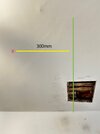
I've cut a hole in my ceiling now...because... why not... the plaster was bloody 40mm thick and the lath screws are super old. Even with no plaster in between my magnetic stud finder did only just about hold on to them.. The centreline of the joist is where the green line is, and the planned location for the fire alarm is just 300mm away, so on theory there is only that one joist to bridge.
IMG_0426.jpg

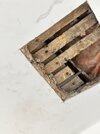
I don't want to notch the bottom part of the joist, and since these are roof joists, cutting holes might also severely impact their stability. Could I just fiddle a cable between those two laths and then cover everything up with some toupret tx110? Or would the cable keep cracking the filler? I probably cannot go over the joist, as the loft is boarded down. How would you run the cable over from the red X to the square hole?

n.b.That white cable you see there is actually going to the light, but it crosses somewhat further down and I don't want to remove any more ceiling.
IMG_0427.jpg
 
I don't want to notch the bottom part of the joist, and since these are roof joists, cutting holes might also severely impact their stability. Could I just fiddle a cable between those two laths and then cover everything up with some toupret tx110? Or would the cable keep cracking the filler? I probably cannot go over the joist, as the loft is boarded down. How would you run the cable over from the red X to the square hole?
No, do it properly and drill a hole in the centreline of the joist. It should be between 0.25 and 0.4x the total span (so not near the end bearings and not bang in the middle). Cut the tongue off the board you need to lift and drill from the top if your ceiling hole isn't useful.
Alternatively, you could just get an extension/long bit and drill up through your boards. It's a bit **** but it's only a loft.
 

If you need to find a tradesperson to get your job done, please try our local search below, or if you are doing it yourself you can find suppliers local to you.

Select the supplier or trade you require, enter your location to begin your search.


Are you a trade or supplier? You can create your listing free at DIYnot Local

 
Back
Top