Balancing a radiator system that only seems to work in reverse ?

Joined
17 Apr 2019
Messages
14
Reaction score
0
Country
United Kingdom
I have 17 rads with TVRs, a Vitoden 111-w boiler fitted last year .
Have been trying desperately to balance my system over three days without much success to be honest . Have had all rad valves and lock shields fully open and know that all rads conduct heat , the issue is balance . I bought myself a temperature gun and started going from the closest rad first closing down the lock shield to get the 10-12 degree balance with the TVR fully open … yes , I do get all the rads to heat or at least get luke warm but cannot seem to get a good balance of real heat out of the rads at all ? If I start setting up the rads in reverse where I close down the TVR and then open the lock shields I get real heat out of the rads ??? It’s Been suggested the flow rate of water from the boiler needs increasing as well as possibly the temp , but not really sure … any ideas ? I got an engineer coming Wednesday for its first service so if I could get some suggestions and then get him to adjust flow rates if that is the answer .

Odd this one
 
What is the total rated output of the 17 boilers?
What boiler (Target) Flowtemp are you balancing with and to what dT?, I see its to 10/12C?
With all 17 rads in service what is the boiler output (if displayed) and what are the boiler flow/return temp, again if displayed?
 
Start by fully closing all the lockshields.

Then open them by half a turn, no more. Do they all start to warm up?
 
To balance a system with TRVs you need to open all the TRVs fully, then adjust the lockshields to achieve the desire temperature drop. Ideally, start with the index radiator, which is the one furthest hydraulically from the boiler. Once balanced adjust the TRVs to the desired room temperatures. With TRVs with 1 to 5 settings, Bedroom on 3, living room / dining room on 4 to 4.5, others as you see fit.
 
Oh dear, it seems no one can agree how? This is not a surprise, as I found what worked in late mothers house did not work with this house, so there is no one method works with all.

I do have a differential thermometer but I have lost the sensors, so I tried to use a thermometer.jpg point and read, this simply did not work, it looked as if it should, but it was no a steady enough reading.

I tried closing closest to boiler up-stairs first, and then opening ¼ turn at a time, feeling the pipes until just a little warmth felt and stopping, it was an improvement, but not ideal.

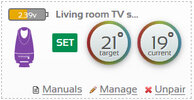
So I used the readings on the TRV heads, Flat Battery TRV.jpg the current should never exceed target, unless there is alternative heating. So I would watch when heating started up, in late mother's house, and if it was to over shoot, close it a little. It took nearly the whole winter to set them all up A1, but it did work.

So now thinking I knew how to do it, tried repeating in this house, and it failed, had to open each lock shield about 2 turns each, I assume the difference was due to this house has an oil non modulating boiler using micro bore, and mother's house a gas modulating boiler using 15 mm pipe work.

My sons first house again a gas modulating boiler, and he left the lock shields wide open and the boiler running 24/7 and it seemed to work A1, until he went on holiday, then it would not start up again. What I think was happening was the first radiator was heating up, and allowing hot water back to the boiler, which in turn caused the boiler to modulate, but with my house, since the boiler does not modulate, wide open would still work.

So maybe better to consider why we balance the radiator, and not just one reason.
1) On start up, it will allow all radiators to get some heat.
2) The radiator will heat up slow enough so the TRV valve can close it fast enough to stop it over shooting.

However, in my house, I have set the TRV heads in sequence, it only needs 10 minutes between them, for it to work, when using electronic TRV heads, much longer and the return hot water will cause the boiler to close down. But a modulating boiler will not react in the same way.

Even gas and oil will react different to each other.

It seems likely your problem is the boiler is modulating, due to hot water returning to boiler, which in turn is messing up your readings.
 
Lukewarm may actually be the goal. Once a system is balanced, each rad only gives off what its room loses, so with the boiler running low and steady they settle at something that feels less than warm to the hand. Judge it by whether every room reaches its temperature, not by touch.

If some rooms don't, going round once from the nearest rad rarely works, as oldbuffer hinted: each lockshield you close pushes water to the others, so the first ones drift. Most people need two or three rounds, rechecking the first rads at the end.

Before that, open every TRV and lockshield fully, run it for an hour and feel each rad top and bottom. One that stays cold at the bottom points to sludge. And check with the engineer (or in the Vitodens settings) whether the boiler's pump runs fast enough: with a higher pump speed the rads can be balanced to a smaller drop, around 5 °C rather than 10-12 °C, which makes them all heat far more evenly. Worth asking about a flush and the magnetic filter too.
 
Before that, open every TRV and lockshield fully, run it for an hour and feel each rad top and bottom.

If you open all the valves fully, the circulating water will take the easiest route. Often this will be the nearest radiators, leaving little or nothing fir the furthest ones.

The fact that some will be cold is to be expected without balancing. It does not prove sludge.

This is why it is better to start the balancing process with all the lockshields nearly closed. There is then no easy route so the circulating water will travel to all rads, and you can identify which are the slowest to heat and give them a little more.
 
I do everything open, then start from the closest, closing to that 5c difference, else closing everything first could hurt the system.
 
Sorry Paul, I got my figures mixed up: I meant your 10-12 °C drop, not 5 °C. I've had heat pump values stuck in my head, and 5 °C is what you'd aim for there. On a condensing boiler like your Vitodens, 10-12 °C is right, because a cold return is what makes it condense.

And fair point from JohnD: with everything open the nearest rads take the easy route, so a cold one at that stage doesn't prove sludge. Starting with the lockshields nearly closed, as he says, is a sound way to do it.

One thing still worth asking the engineer: set the boiler's maximum heating output close to what the house actually loses, so it modulates down and runs steadily instead of cycling.
 

If you need to find a tradesperson to get your job done, please try our local search below, or if you are doing it yourself you can find suppliers local to you.

Select the supplier or trade you require, enter your location to begin your search.


Are you a trade or supplier? You can create your listing free at DIYnot Local

 
Back
Top