As has ben said, 'pearl' LED filament ones are certainly available - and they may possibly be 'the wat forward' in general.I have not used the filament LED, mainly as seen them in Pubs, and could not read the menu. Maybe a special decorative type, but one does need something to defuse the light, a pearl bulb was always better as to a clear glass bulb, never worked out why they were banned.

You are using an out of date browser. It may not display this or other websites correctly.
You should upgrade or use an alternative browser.
You should upgrade or use an alternative browser.
Bulkhead lamp for modern bulbs?
- Thread starter ericmark
- Start date

- Joined
- 18 Apr 2022
- Messages
- 7,490
- Reaction score
- 1,153
- Country

I am sure you can get shorter bulbs, but when a bulb fails, you want to put in what is to hand, not have to go out special to get a bulb,
I'm finding it no problem to standardise on corn bulbs for everything except a couple of floorstanding lights where the bulbs can be seen.

Really? I absolutely struggle to read anything under such bulbs and often find my phone being used by several to read menus.As has ben said, 'pearl' LED filament ones are certainly available - and they may possibly be 'the wat forward' in general.
A little while ago someone pointed me towards this site: https://healthlighting.com/blogs/wellness/best-light-bulbs-for-health

- Joined
- 27 Jan 2008
- Messages
- 29,639
- Reaction score
- 3,665
- Location
- Llanfair Caereinion, Nr Welshpool
- Country
That may well be the case, I will look out for them.As has ben said, 'pearl' LED filament ones are certainly available - and they may possibly be 'the wat forward' in general.
That has been my experience also, but maybe they are made and sold as decorative bulb?Really? I absolutely struggle to read anything under such bulbs and often find my phone being used by several to read menus.
I use three types of bulb.
1) Cheap white light.
2) Cheap smart colour temperature changing and dimming smart bulb.
3) Cheap as above but also colour changing.
The cheap bulb, at 1) typically £2, details here the cost of 2) and 3) that close may as well go for 3) at around £8 all sold by a shop 8 miles away.
Ignoring the 3.4 watt bulb as being far too low of an output for general use, the 7.8 watt version is £3, but when you look at the picture
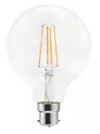 it looks wider than normal. So data sheet tells us width 95 mm the other bulb is 60 mm, it is also longer, so not really an option in many fittings.[/URL]
I want to buy local as that means today, not in a few days time, yes this bulb
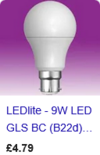 is nowhere near the lumens per watt of the filament bulb, but it does include a built-in PIR.
My phone does not seem to want to focus properly in the low light, but this
- Joined
- 27 Jan 2008
- Messages
- 29,639
- Reaction score
- 3,665
- Location
- Llanfair Caereinion, Nr Welshpool
- Country
I have read it, but, there are some points which need to be raised. Irlen Syndrome requires some to use coloured glasses. I readA little while ago someone pointed me towards this site: https://healthlighting.com/blogs/wellness/best-light-bulbs-for-health
But my family have being using the glasses, and they do work, but not for me.Irlen Syndrome, also known as visual stress or Meares-Irlen syndrome, is a visual perceptual processing disorder where the brain struggles to accurately process visual information, leading to difficulties with reading, light sensitivity, headaches, and concentration. While some sources describe it as a recognized condition with a physiological basis, other sources like Wikipedia note that the existence of the syndrome and its treatment by colored lenses lack robust scientific support and are considered a health fraud by some. Treatment can involve tinted glasses or overlays to help the brain process visual information more effectively.
So it seems we are not all the same, dyslexia also plays a part, and other sight problems we are told this
Unless they were very low power bulbs, I suspect they were not 'pearl' ones?Really? I absolutely struggle to read anything under such bulbs and often find my phone being used by several to read menus.
In any event, even in the days of incandescents (and dimmers!), many pubs and restaurants were notorious for having very low level (I suppose 'mood'!) lighting, which often resulted in the menu-reading problem!

Filament LEDs get over this problem by having the small number of auxiliary components they require located in the BASE.My own experience of LED's, in enclosed fittings, suggests that LED's will not survive for very long, due to poor ability to dissipate the tiny amount of waste heat - unless you modify the enclosure...
The Base and the Base-Holder both act as heat sinks.
Most of the HEAT generated in a LED filament Lamp is in the LEDs themselves
and
NOT in the auxiliary components.
Not banned in Australia,a pearl bulb was always better as to a clear glass bulb, never worked out why they were banned.
although they are often in "short supply".
Of course, you can obtain "paint" for applying a "frost" effect on glass.

I had a customer broke the glass cover on his enclosed 500W T/H fitting on his security light. So he replaced it with handy sheet of Perspex.
Next morning as leaving home by the door he encountered a "Massive Bubble"
Next morning as leaving home by the door he encountered a "Massive Bubble"

In any event, even in the days of incandescents (and dimmers!), many pubs and restaurants were notorious for having very low level (I suppose 'mood'!) lighting, which often resulted in the menu-reading problem!
Yep, absolutely all them around here!
- Joined
- 27 Jan 2008
- Messages
- 29,639
- Reaction score
- 3,665
- Location
- Llanfair Caereinion, Nr Welshpool
- Country
In front of my house, I want carriage lamps as they look nice, but at the back, I just want the lights to work. I did fit carriage lights to the rear, as my wife bought them new, for £2 each, but was left with a problem, how to switch them on and off.
As the picture shows
 there is a reasonable distance from where the car is parked, to the house, what the picture does not show so well, is the drive is steep, and then there are steps either side of the house, to get to the front door, I will often sit down for a rest half way.
There were two I assume 300 watt quartz halogen lamps, which had to be removed when new railings fitted on the veranda, which had a switch at what I assume was intended to be the front door, but to reach it one has to walk past the other door, so only the cats use it today, with a cat flap. There were PIR's on the quartz lamps, but the range of the lamps was well over the range of the PIR, and they would often switch off at the most inappropriate times, plus switch on due to wind or squirrels, so when replacing the lamps looked for some other control method.
So the simple method was to use smart bulbs, which has worked well. But the move from 300 watt to 12 watt, resulted in the light not really being good enough, and not helped by apple tree one side and shed the other side, the shed was falling to bits, and so was the garage behind the car, so I wanted somewhere to store the stuff while they are being dismantled or replaced, hence the new shed.
I needed power for lights inside the shed, and the area in front used for BBQs, so a light outside the shed made sense. This would also bridge the gap where existing lights left dark. But control was now the problem, I want to switch on before getting out of the car, and off when I get to the house, so either a PIR or a smart bulb/switch/socket etc.
I had intended to fit a smart bulb, but the local shop only had small bulbs as SES or GU10, and even with larger bulbs, it seems E27 is now the normal type sold, and the bulkhead lamp used BA22d, so I have a converter, but this makes them even longer, so idea was use a CFL I had in stock, while I worked out what to do.
I could not believe it would not fit, lucky found out before it was fitted, so removed bracket, drilled new holes, and refitted reversed giving me about ¾ inch extra room. But did not stop there, the mounting points were behind the aluminium reflector, so that needed removing and refitting once mounted, and getting the little screw in the hole again when on a stepladder was not easy. Also, the boss where the wires enter from behind, was not level with the feet, so loads of silicon sealant required.
In short, the lamp was very poorly designed, and not designed for modern bulbs, with a plastic rather than glass cover, not sure if it would not melt with a tungsten bulb. It says 60 watt, but would not like to try it with a 60 watt tungsten bulb. It did however have a good quality porcelain bulb holder, not sure why, when the rest is plastic?
Oh, I am glad I have retired and don't have to work with that rubbish every day. It should have been a simple job.
As the picture shows
There were two I assume 300 watt quartz halogen lamps, which had to be removed when new railings fitted on the veranda, which had a switch at what I assume was intended to be the front door, but to reach it one has to walk past the other door, so only the cats use it today, with a cat flap. There were PIR's on the quartz lamps, but the range of the lamps was well over the range of the PIR, and they would often switch off at the most inappropriate times, plus switch on due to wind or squirrels, so when replacing the lamps looked for some other control method.
So the simple method was to use smart bulbs, which has worked well. But the move from 300 watt to 12 watt, resulted in the light not really being good enough, and not helped by apple tree one side and shed the other side, the shed was falling to bits, and so was the garage behind the car, so I wanted somewhere to store the stuff while they are being dismantled or replaced, hence the new shed.
I needed power for lights inside the shed, and the area in front used for BBQs, so a light outside the shed made sense. This would also bridge the gap where existing lights left dark. But control was now the problem, I want to switch on before getting out of the car, and off when I get to the house, so either a PIR or a smart bulb/switch/socket etc.
I had intended to fit a smart bulb, but the local shop only had small bulbs as SES or GU10, and even with larger bulbs, it seems E27 is now the normal type sold, and the bulkhead lamp used BA22d, so I have a converter, but this makes them even longer, so idea was use a CFL I had in stock, while I worked out what to do.
I could not believe it would not fit, lucky found out before it was fitted, so removed bracket, drilled new holes, and refitted reversed giving me about ¾ inch extra room. But did not stop there, the mounting points were behind the aluminium reflector, so that needed removing and refitting once mounted, and getting the little screw in the hole again when on a stepladder was not easy. Also, the boss where the wires enter from behind, was not level with the feet, so loads of silicon sealant required.
In short, the lamp was very poorly designed, and not designed for modern bulbs, with a plastic rather than glass cover, not sure if it would not melt with a tungsten bulb. It says 60 watt, but would not like to try it with a 60 watt tungsten bulb. It did however have a good quality porcelain bulb holder, not sure why, when the rest is plastic?
Oh, I am glad I have retired and don't have to work with that rubbish every day. It should have been a simple job.
Aside from the lantern, lit from dusk until 11pm, on the drive, plus remotely controlled flood lights in the eaves of the house, and a PIR LED, lighting the very dark path up to the back garden, what I found was....
My garage and workshop, have two small doors, with keypad entries. You need enough local light, to be able to press the correct buttons, to get in. We happened to have a two pack of solar pir lights, similar to (but not the same) these - https://www.screwfix.com/p/luceco-prysm-outdoor-led-solar-with-pir-sensor-white-300lm/667cl
I've never been impressed with solar lights, particularly not pir versions, but these two work surprisingly well. They pick me up on the approach, and give a good, bright, spread of light, up, down, left and right. More than enough to see what I am doing, to press the buttons to unlock.
These are the exact ones, but we bought a 2 pack, instead of 4 pack, for around £9. I must say I was sceptical, that they would continue to work through the limited solar of winter, but they did, and provided a good amount of light. One was mounted where it would get good direct sunlight, the other on a wall in constant shade. In normal use, I have never managed to exhaust the internal batteries.
[EDIT] I've just ordered the 4-pack, to add more of them discretely along the drive, ready for the dark nights of winter.
I would suggest a few of those, strategically located along Eric's footpaths, stairs and etc., might well prove better than a single, higher wattage light.
Last edited:
- Joined
- 27 Jan 2008
- Messages
- 29,639
- Reaction score
- 3,665
- Location
- Llanfair Caereinion, Nr Welshpool
- Country
The link does not work, I would assume something like this
 I have used some looking like that in the past, lasted around 2 years, so not bad. But with all lamps it is where to mount them, clearly on a tree, the leaves stop the solar, and the garden is surrounded by trees. So we tried the lights with spikes
 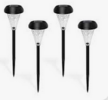 these work well in the summer, but in winter needs something with a PIR so not discharged before we need them.
I suppose all my lights are solar-powered, as have 6 kW of panels on the roof, but what I was looking for was some protection for the lights, and tall enough to light the ground, and the front of the house,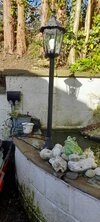 I have a light on the wall of the pond, which is on a pole, and it works well, it did stop working for a time, found the smart bulb had gone faulty, but that was an easy fix.
these work well in the summer, but in winter needs something with a PIR so not discharged before we need them.I suppose all my lights are solar-powered, as have 6 kW of panels on the roof, but what I was looking for was some protection for the lights, and tall enough to light the ground, and the front of the house,
I have a light on the wall of the pond, which is on a pole, and it works well, it did stop working for a time, found the smart bulb had gone faulty, but that was an easy fix.
DIYnot Local
Staff member
If you need to find a tradesperson to get your job done, please try our local search below, or if you are doing it yourself you can find suppliers local to you.
Select the supplier or trade you require, enter your location to begin your search.
Please select a service and enter a location to continue...
Are you a trade or supplier? You can create your listing free at DIYnot Local

