Diy house rewire

32amp rcbo for 2.5mm twin and earth ring for the 2 bed rooms


32amo rcbo for 2.5mm twin and earth ring for the kitchen


32amp 6mm radial run cable running to the cooker switch


6amp rcbo with 1.5mm twin and earth running one way daisy chain bedroom lights


6amp rcbo with 1.5mm twin and earth running one way daisy chain for living room and kitchen and dining room light

No power in living room? No mention of a boiler supply, alarm system?

1.00mm could be used, instead of 1.5mm.
 
No power in living room? No mention of a boiler supply, alarm system?

1.00mm could be used, instead of 1.5mm.
Sorry i missed to say the 2 bedrooms would be on the same ring as the living room

The boiler would be on a fused spur from the ring from one of the kitchen sockets

No alarm system or any other electrical thing such as outdoor lights or sockets

All how it currently already is

One thing i would have to question would be the locations of the double sockets on the 32amp ring for the living room and the 2 bed rooms

im looking at having 4 sockets in living room and 4 in each bedroom which would mean 12 sockets would that be to much and would i be better doing the bedrooms on there own ring and living room and dining room on its own ring

Like i say we are talking a very small 2 bed cottage here with nothing fancy just a like for like replacement to whats in with the addition of the odd socket here and there

As for all this testing i would presume that is to test rcbos are working as they should there is no breaks in the cable and that you havnt managed to wire a earth i ti a live and such

All ceilings are down and all back to the brick so everything can stay exposed to be checked nothing will be ran under the floor its all along the loft joists

I do often think that alot of sparks do make on there is alot more to it really...

But aslong as you get your live in the live earth in the earth neutral in the neutral switch wires and such color shrinked to show any switch live and constant live the correct size cable for the amp circuit and make sure pipe work is earth bonded make sure every thing is to the correct torx and fully all the way in the device and secure

And dont do any thing stupid like twist a join leaving it exposed

Then i cant see where you can go wrong...

Like ive said if it was commerical and you was working on 3 phase and high tec stuff like in a power plant then of course no diy should attempt that but on small domestic houses

Am i being nieve to say that apart from the phisical work and man hours drilling chasing hammering and pulling that there really is not that much to it ?

 
Last edited:
Most complex wiring in my house, is likely the central heating, and most likely error is a supply outside, and cable routes.
I presume you have some sort of central heating system where you have zones and controls in each room if its complex as a standard central heating system wouldnt be complex at all , you genrally have a switch fused spur powering the boiler then a thermostat control feed from the boiler to either a hard wired thermostat or a receiver that works with a wireless thermostat such as a hive
 
im looking at having 4 sockets in living room and 4 in each bedroom which would mean 12 sockets would that be to much and would i be better doing the bedrooms on there own ring and living room and dining room on its own ring

There are no limitations, on the number of sockets on the circuit, but to allow for some redundancy, should a fault develop, split that into two - upstairs and downstairs rings, or perhaps better, one circuit for the front half of the house, one for the rear. You have a 10-way board, make use of it.

Likewise, the boiler circuit, separate that, onto it's own 6amp RCBO - at least then, if the socket circuit develops a fault, you still have your heating working.
 
There are no limitations, on the number of sockets on the circuit, but to allow for some redundancy, should a fault develop, split that into two - upstairs and downstairs rings, or perhaps better, one circuit for the front half of the house, one for the rear. You have a 10-way board, make use of it.

Likewise, the boiler circuit, separate that, onto it's own 6amp RCBO - at least then, if the socket circuit develops a fault, you still have your heating working.
Yeah i get what your saying i think it would be worth while splitting the bedrooms from the living room

Having

Kitchen
Bedroom 1/2
Living room and dining

With the boiler i could do that i suppose but it would mean running a full circuit over to the boiler which is quite away from the board so kind of adding more cost running more cable

If i did do the 6amp rcbo for the boiler would it be a ring using 2.5mm or ring using 1.5mm or a done on a radial

Cheers
 
With the boiler i could do that i suppose but it would mean running a full circuit over to the boiler which is quite away from the board so kind of adding more cost running more cable

If i did do the 6amp rcbo for the boiler would it be a ring using 2.5mm or ring using 1.5mm or a done on a radial

I would hope that wasn't a serious question? A 6amp RCBO, and wired as a simple radial, using 1mm T&E, or 1.5mm. No actual need for 1.5mm, but many people will simply not use 1.00mm, for anything.
 
32amp rcbo for 2.5mm twin and earth ring for the 2 bed rooms
32amo rcbo for 2.5mm twin and earth ring for the kitchen
While that will work, rings are not necessary or even desirable for most circuits. Just how much load do you expect to be plugged in?
Considering that this is 'only a small 2 bed single story cottage'.

ring not to exceed 100 sqaure meter and obv not designed silly like having 5 sockets all on one section of the ring
No requirement for 100m² or any other area, that hasn't been a regulation for decades.
A small 2 bed cottage isn't likely to be anywhere near 100m².

16mm earth bonding coming out to gas meter/boiler/pipes
Too large. Use it if you have it, otherwise 10mm².

6amp rcbo with 1.5mm twin and earth running one way daisy chain bedroom lights
6amp rcbo with 1.5mm twin and earth running one way daisy chain for living room and kitchen and dining room light
1.0mm² is plenty.
1.5mm² is an irrelevant size of no purpose. Some people seem obsessed with it for reasons known only to them.
No requirement to have multiple lighting circuits either, although you can have them if you want.

like is there really more to it that im missing
Kitchen extractor, bathroom extractor, connections for built in/integrated/under the counter appliances
smoke/heat/CO alarms
outside lighting, outside socket(s)
 
I presume you have some sort of central heating system where you have zones and controls in each room if its complex as a standard central heating system wouldnt be complex at all
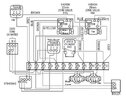
Well maybe, C_Plan_My_House.jpg something like shown, actually that was an early diagram, it has some relays added now.
split that into two - upstairs and downstairs rings
Better split side to side, then with a failure not need for extension leads up/downstairs, the load is more even, and in general less cable used, so lower loop impedance, upstairs and downstairs was done when we only had two RCD's so matched the lights, so lights and sockets never on the same RCD, with the use of RCBO's we can return to side to side.
No requirement for 100m² or any other area, that hasn't been a regulation for decades.
2008 edition referred to historicity, the volt drop is the limit, 5% for sockets and 3% for lights, if we consider load to be 20 amp centre and 12 amp even spread, then with 2.5 mm² it works out at 106 meters of cable. With a loop impedance meter, this is about 0.6 Ω increase of the loop impedance. The old 100m² one would still need to put all sockets either side of a centre wall dividing the rooms.

Design current for circuit Ib is taken as being 26 amps for a ring final when working out the volt drop. But there is no regulation to tell you this.
 

If you need to find a tradesperson to get your job done, please try our local search below, or if you are doing it yourself you can find suppliers local to you.

Select the supplier or trade you require, enter your location to begin your search.


Are you a trade or supplier? You can create your listing free at DIYnot Local

 
Back
Top