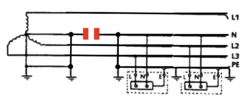
True.If two phases are involved then as per the diagram one house will be undervolted while the other house will be over volted.
If I wanted to 'argue' (in support of the comment I made), I might point out that the above means that there is a 50% probability that any affected house would experience under-voltage and that, combined with the finite possibility of what you mention below, and the finite possibility that only one phase was involved means that, overall, there would be a greater than 50% probability that any particular affected house would experience under-voltage - but whether that would make that situation qualify as the 'most common' scenario would perhaps be debatable (even though literally correct)

Again true. It obviously depends upon the active loads in the two houses, but if they were similar, then that would result in both experiencing under-voltage (both about 200V).If the isolated section of PEN has no path to Ground then the two houses will be in series across a 400 Volt ( 2 phase ) supply.
All the above obviously assumes that only two houses are involved. If there are more than two, it gets a bit more complicated.