• Looking for a smarter way to manage your heating this winter? We’ve been testing the new Aqara Radiator Thermostat W600 to see how quiet, accurate and easy it is to use around the home. Click here read our review.

Do I need an Earth Rod Fitted?

it seems that you've probably been making comments which are not relevant to UK, and which may well confuse people in the UK. To suggest/imply (to readers in the UK) that the only purpose of a local earth electrode in a TT installation is to offer some protection against 'voltage surges/spikes', is really pretty misleading - since it could be taken to imply that there would be no true safety (to human beings) concerns if an installation had no 'earth' at all.

I think that TN-C-S has been around for less than 50 years in UK, I think starting to be implemented significantly in late 1970s and early 1980s. Prior to that, all installations were either TN-S or TT, and a substantial proportion of those (like my TT installation) have not been 'updated' to TN-C-S as of today.
I do not believed that I ever referred to a TT situation.

(It is "interesting" that you refer to previous installations being "updated" to TN-C-S,
which is [perhaps] an indication that other installations, such as yours, were more "primitive".

See https://en.wikipedia.org/wiki/Earthing_systemn
"A big disadvantage of TT systems is that the impedance of the earth path is often so high that it can prevent overcurrent protection devices from breaking the supply sufficiently quickly to meet safety regulation.")


In the original Post was this:-
We currently have a powered shed with its own local RCD and MCB protected fusebox for lights and sockets (which also feeds an outdoor socket a few metres away in the garden).
The shed (and outdoor socket) is currently earthed using the house earth, which is on a TN-S setup, which was commented on (i.e
told it was "not ideal") by the last electrician we had out to do some work.

Is this setup a safety issue, and will it fail the EICR under current standards if I don't get a local earth rod fitted (assuming everything else is OK)?
I have no idea concerning the "Local Regulations" on this point.

However, installing a additional "Earthing Electrode" on the PE of a TN- S system at an "outbuilding"
would (to me) seem to provide the same "local" (low impedance) "surge protection" as that is required on TN-C-S systems
in both Australia and North America,
as is discussed (at length) in the video concerned.

Such precautions may not be considered to be necessary in closely settled urban areas of the UK,
where there may be much other higher infrastructure on which "lightning events" may take place
and
there may be few such "events".

In both Australia and North America
with "wide open spaces"
and
where "lightning events" are not uncommon,
such near-by bonded Earthing Electrodes are necessary and required.
 
I watched some of the video, yes we have shaver sockets with no earth as to supply one item that is safe.

But we need to ensure that multi faults do not mean you have 230 volts between two simultaneously touchable items. To do that, we need to know when there is a fault, and disconnect the equipment when the first fault occurs, there are methods to do this with an IT system, but it is far easier with a TN system.

The TT system does present a problem, and my historic knowledge is not good enough to say how this worked in the 1950's, however I know an earth fault did blow the fuse when I was a boy. The ELCB-v used an earth rod, and that lecturer would have liked that system, as the building was not earthed, bonded yes, but not earthed, so we measured the voltage between earth and the bonding, and if this exceeded 50 volts, it would auto disconnect.

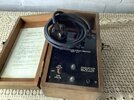
However, my historic knowledge is good enough to know there was a problem with this system, if the bonding became earthed, then the ELCB-v would not work, and I have only seen a picture of the test set Clare ELCB tester3.jpg I have never used one, and as with the ELCB-c which replaced it, the ELCB can fail, so they need testing. Now I do have a tester for the ELCB-c (RCD) RCD tester ramp.jpg so I can ensure my RCBO's work.

So an oven with a mineral insulated element goes faulty, so there are two methods to stop that fault from killing someone, one is to use a RCD to disconnect the oven, and replace the element before using again, the other is to supply the element from an isolation transformer. I know which I would do.

Why do we use earth rods, well there are many answers to that question, including reducing the likelihood of sparks which can set gas on fire. I have worked on a site where that was rather important, and there was an automated system which, if it detected a fire, would divert the gas to a flame stack.

Now all the locals knew that the flame stack was a safety device, and there was no problem to them if it was lit, but holidaymakers in the caravan site were unaware of this. So a thunderstorm, and the lighting triggered a fire detection device, so the gas was diverted and the flame stack lit. And the staff, once sure there was no fire, reset it.

But the tourists poured out of the local caravan site, it was mayhem.

The guy was correct, a small cable connected to a lamp post will do nothing, so the mast for our radio aerial has a 70 mm² earth cable connected to copper within the concrete block which holds the mast up, and the aerial is not connected to the mast electrically.

Earths for lighting strikes are not the same as earths for electrical safety. And he seemed to have little or no idea as to the difference.
 
I do not believed that I ever referred to a TT situation.
I don't think you have. However, when you started this by writing ...
.... the purpose of a local "Earthing Electrode" (Earth Rod) is to provide low IMPEADANCE System Earthing, to "Earth" voltage surges - mostly caused by "lightning events". ... It is not to provide a low RESISTANCE (fault) current path - back to the Source of supply - which is done on the Protective Earth conductor,
I would imagine that many readers (who didn't already understand) will have assumed that you were talking about the purpose of local earth electrodes in general - whereas, as we now know, your comment only really related to high voltage (and high frequency) 'pulses/surges/spikes induced into conductors by lightning.

You go on to admit that ....
Such precautions may not be considered to be necessary in closely settled urban areas of the UK, where there may be much other higher infrastructure on which "lightning events" may take place and there may be few such "events".
In both Australia and North America with "wide open spaces" and where "lightning events" are not uncommon, such near-by bonded Earthing Electrodes are necessary and required.
You therefore seem to agree that those in urban UK (maybe even rural UK) might not feel the need for such protection. Given that you appear to have said such protection is "the reason" for having a local earth electrode, those in the UK who (like me) do not have a TN earth, and who do not feel they need the 'surge protection' could easily take you to be saying that their installation does not need an 'earth' at all - is that what you really believe (or should be suggesting in this "Electrics UK" forum)?
 
Both the video and @FrodoOne both seem to be saying an earth is not required. As to impedance or resistance, I may understand the difference, but this is a forum for DIY, and it is unlikely most readers will know the difference.

I must admit, I also in my youth questioned why we have an earth. If no earth, like the bird on the power line, we would get no shock. However, I came to work on a Robin tunnel boring machine. I realised my error. One line going to earth means the other lines become dangerous.

I would assume the unit was to USA standards, all I can say, is thank goodness not like that over here.
 
Both the video and @FrodoOne both seem to be saying an earth is not required.
Yes, they seem to be implying that no earth (electrode) is required if one does not feel that protection against induced 'voltage spikes' is required - but as for 'no earth required (at all)' I suspect they don't mean that, since they seem to be talking in the context of countries where everyone, or virtually everyone, has a TN earth.

Whatever, as I've said, I don't think the comments are really appropriate in a UK forum, since they could easily mislead.
As to impedance or resistance, I may understand the difference, but this is a forum for DIY, and it is unlikely most readers will know the difference.
Indeed - but the point being made in the video (and reiterated by Frodo) seems to be that lightning-induced spikes/surges/pulses can have very high frequency components - such that, unlike the situation with 50 Hz, the relevant impedance may be considerably higher than resistance.
I must admit, I also in my youth questioned why we have an earth. If no earth, like the bird on the power line, we would get no shock. However, I came to work on a Robin tunnel boring machine. I realised my error. One line going to earth means the other lines become dangerous.
Yes, in most situations one probably does not need any 'earth' -and, indeed, might well be safer without one. However, as you imply, the problem with a floating supply is that if one side somehow acquires a path to earth, the other side then becomes potentially dangerous, with not much one can/could do to mitigate that potential danger.
 
Exporting a TN‑S earth to an outbuilding is generally acceptable provided the CPC is continuous back to the origin, Zs meets the required disconnection times, 30 mA RCD protection is applied where required, and any extraneous‑conductive‑parts are correctly bonded.

Exporting TN‑C‑S (PME) is permitted but needs careful assessment, particularly where extraneous‑conductive‑parts are present or the environment increases shock risk. The concern is that a PEN fault can raise the potential of bonded metalwork. Depending on site conditions, it can be safer to use a local TT system for the outbuilding, ensuring proper RCD protection and keeping the TT earth separate from the PME earth.
 

If you need to find a tradesperson to get your job done, please try our local search below, or if you are doing it yourself you can find suppliers local to you.

Select the supplier or trade you require, enter your location to begin your search.


Are you a trade or supplier? You can create your listing free at DIYnot Local

 
Back
Top