Indeed - but that was largely superseded when 'dual tariff'; meters came along, in which there was time-related switching between the two registers.In the distant past, we had two meters - the usual black peak one, plus a white off-peak one. From memory, the entire supply, was either connected to one meter, or the other - so it was down to us, to have our own system(s) to switch on/off at the correct times.

You are using an out of date browser. It may not display this or other websites correctly.
You should upgrade or use an alternative browser.
You should upgrade or use an alternative browser.
Economy 7 clock wrong
- Thread starter Akustik
- Start date
-
- Tags
- economy 7 smart meter
Glad you agree.I don't think anyone has any disagreement with that
Don't 'shoot the messenger'. I have merely been reporting what appears to be the situation!Which surely has to be wrong. If has been mooted one of those actions changes by an hour but not the other (I hope I understood that correctly) then they could be paying for all of their hot water heating in that first 1½ hours of 'off peak time' at peak rate.
Having said that, there may be a problem in doing anything different if (as is essential to the grid) one is to avoid exactly simultaneous switching of potentially millions of loads. IF (by edict either of themselves, the manufacturers of 'smart meters' or Ofgem) I am right in saying that the registers of a 'smart' meter are constrained to have 'round' 30-minute periods (starting from 00:00 every day, then I can't think of any way of implementing the required staggering of load switching without getting load-switching and billing a bit out-of-synch - can you?

Yes. Add a random delay from 1 to 30 minutes into every meter, didn't someone already suggest that?Glad you agree.
Don't 'shoot the messenger'. I have merely been reporting what appears to be the situation!
Having said that, there may be a problem in doing anything different if (as is essential to the grid) one is to avoid exactly simultaneous switching of potentially millions of loads. IF (by edict either of themselves, the manufacturers of 'smart meters' or Ofgem) I am right in saying that the registers of a 'smart' meter are constrained to have 'round' 30-minute periods (starting from 00:00 every day, then I can't think of any way of implementing the required staggering of load switching without getting load-switching and billing a bit out-of-synch - can you?

Yes. Add a random delay from 1 to 30 minutes into every meter, didn't someone already suggest that?
Me?
As has been said repeatedly, that is, in common sense terms, the obvious 'solution'.Yes. Add a random delay from 1 to 30 minutes into every meter, didn't someone already suggest that?
However, to keep billing correct, exactly the same random alteration would have to be made to both the register-switching times and 'load-switching' times - which, as I said, would not be possible if (as I believe may well be the case) the 30-minutely TOU registers in a 'smart' meter have to start their timings at 00:00

- Joined
- 27 Jan 2008
- Messages
- 29,557
- Reaction score
- 3,638
- Location
- Llanfair Caereinion, Nr Welshpool
- Country

I set my devices to turn on late rather than early, if I look at my own use
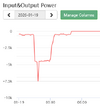 at midnight battery discharged, so there is some grid usage, but I don't start the charge of the batteries until 1:30 am, as I know they will be fully charged by 3:30 am, so since I have off-peak until 5:30 am I have 2 hours leeway.
Now with storage radiators they likely take longer,
at midnight battery discharged, so there is some grid usage, but I don't start the charge of the batteries until 1:30 am, as I know they will be fully charged by 3:30 am, so since I have off-peak until 5:30 am I have 2 hours leeway.Now with storage radiators they likely take longer,
Attachments
- Joined
- 27 Jan 2008
- Messages
- 29,557
- Reaction score
- 3,638
- Location
- Llanfair Caereinion, Nr Welshpool
- Country
I set my devices to turn on late rather than early, if I look at my own use View attachment 405275 at midnight battery discharged, so there is some grid usage, but I don't start the charge of the batteries until 1:30 am, as I know they will be fully charged by 3:30 am, so since I have off-peak until 5:30 am I have 2 hours leeway.
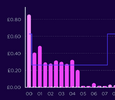
Now with storage radiators they likely take longer, but like with my batteries this shows View attachment 405276 that only 5 hours are required, and they have 7, so no harm in starting the charging of the storage heat battery late, it seems however looking at around 1.35 kWh per day, so peak - off-peak in my case is 31.94-8.50 = 23.44p/kWh extra x 1.35 = 31.644p and a timer able to handle 3 kW costs around £10, so 32 days to pay for its self.
However, need to work out totals first, not sure a single storage heater pays for its self to start with? For every month I get one of these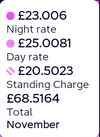
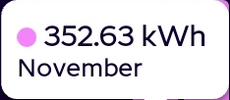 so average 13.616p/kWh so that for me is far lower than the 26.91p/kWh standard rate. For me, the difference is so massive, no real need to do all months, I can easily see the split tariff is better for me.
But with storage heaters, in summer Economy 7 will not save anything. In fact, it will likely cost more, so before spending out on timers, need to be sure it is going to pay. With my heating, I select when I want to heat, and to only heat as and when required.
Now with storage radiators they likely take longer, but like with my batteries this shows View attachment 405276 that only 5 hours are required, and they have 7, so no harm in starting the charging of the storage heat battery late, it seems however looking at around 1.35 kWh per day, so peak - off-peak in my case is 31.94-8.50 = 23.44p/kWh extra x 1.35 = 31.644p and a timer able to handle 3 kW costs around £10, so 32 days to pay for its self.
However, need to work out totals first, not sure a single storage heater pays for its self to start with? For every month I get one of these
so average 13.616p/kWh so that for me is far lower than the 26.91p/kWh standard rate. For me, the difference is so massive, no real need to do all months, I can easily see the split tariff is better for me.But with storage heaters, in summer Economy 7 will not save anything. In fact, it will likely cost more, so before spending out on timers, need to be sure it is going to pay. With my heating, I select when I want to heat, and to only heat as and when required.
Erm are you sure about that?In the distant past, we had two meters - the usual black peak one, plus a white off-peak one. From memory, the entire supply, was either connected to one meter, or the other - so it was down to us, to have our own system(s) to switch on/off at the correct times.
One of my flats had 2 meters when I purchased. At the change of ownership it was decided to change the twin meters. A fitter came out and stated he was not permitted to make the alterations at the 2 CU's (actually both ends of a single CU) as the 4 tails plus earth went through the wall then in trunking. I received a letter stating I had to do some rewiring at the same time as the meter change and included a drawing in advance for the attention of my electrician and they would supply the connector on the day.
On the day the fitter handed over a used Henley and said he had not seen a white meter for a long time.
This was a bit over 20 years ago. I'd been in the meter box to read the 2 meters and AFAIC it was wired as BEFORE with the black and white meters & cutout. I had no form of switching in the house
Why it couldn't have been done like this I don't know
As it happens, when I changed letting agents later; one of their requirements was a single main switch which I was able to reconfigure without too much effort which I wouldn't have been able to do as easily.
I've always done that with my E7 water heating, which needs power for only about 2.5 hours even if the cylinder starts 'cold' (which is very rarely the case - 1 hour or less of heating is more normal) - so I can have it coming on 'hours' after the start of the off-peak period 'to be safe' (and its obviously better to have the heating happening towards the end of the cheap period)!I set my devices to turn on late rather than early ...
What are your Day and Night rates?, if I look at my own use View attachment 405275 at midnight battery discharged, so there is some grid usage, but I don't start the charge of the batteries until 1:30 am, as I know they will be fully charged by 3:30 am, so since I have off-peak until 5:30 am I have 2 hours leeway.
Erm are you sure about that?
Reasonably, but it was 40 years ago.
- Joined
- 27 Jan 2008
- Messages
- 29,557
- Reaction score
- 3,638
- Location
- Llanfair Caereinion, Nr Welshpool
- Country
As I remember, the problem with the white meter was off-peak only used by storage heaters and dedicated immersion heater, when the meters were replaced could also use washing machines etc on off-peak.
If we had figures for Economy 7 it could be worked out, but it only shows the amounts of each as I hover over the graph, this was my problem when I changed supplier, I lost the ability to look back at what had been used, I need a years' data, to work out what I need to pay, to cover the bill with a regular monthly payment.
I have said 31.94p/kWh and 8.50p/kWh and if I did not have off-peak it would be 26.91p/kWh but seems the rates vary area to area, so around 78% peak and 22% off-peak is the cut-off point for me, if less than 22% off-peak being used, I would be better off with a single rate tariff at 26.91p/kWh, my batteries ensure I will always use more off-peak to peak, so for me no question.What are your Day and Night rates?
If we had figures for Economy 7 it could be worked out, but it only shows the amounts of each as I hover over the graph, this was my problem when I changed supplier, I lost the ability to look back at what had been used, I need a years' data, to work out what I need to pay, to cover the bill with a regular monthly payment.
I have said 31.94p/kWh and 8.50p/kWh and if I did not have off-peak it would be 26.91p/kWh but seems the rates vary area to area, so around 78% peak and 22% off-peak is the cut-off point for me, if less than 22% off-peak being used, I would be better off with a single rate tariff at 26.91p/kWh, my batteries ensure I will always use more off-peak to peak, so for me no question.
This seems to be how the UK is divided up on a cost of supply basis. This is todays map, for those on the Octopus Tracker tariff, for which the cost is quite high at the moment... I'm in the highlighted 24.07p per Kwh area.
- Joined
- 27 Jan 2008
- Messages
- 29,557
- Reaction score
- 3,638
- Location
- Llanfair Caereinion, Nr Welshpool
- Country
Once one uses something like tracker, it is a lottery, but even with fixed rates, it's not easy to work out which is the best tariff. Also, do you really want to be swapping tariffs all the time? An internet hunt
With any split tariff, there is a break even point. But using storage radiators is really hard to work out, due to the loses, I remember back in the 70s a block of council houses being built, where it had a central heat store, and a colleague had one of these houses, and he could turn off the heating fans, and the store would stay hot for a week, so there are some very good storage heating systems. But the self-contained radiator I had at work, would struggle to maintain the output for 9 hours. At work, it was OK, by 6 pm did not need it any more, I was going home, but at home, so much is dependent on insulation, I look at my own house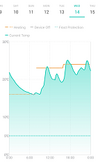 and how the room temperature decays, 7 hours it drops 22°C to 16°C with the heating off, and allowing it to drop saves money for fuel, and the storage radiator will not allow the temperature to drop while waiting for the time when heat is required, so wastes energy.
So to work out how much electric would be used with an oil filled radiator v a storage radiator will vary home to home, there is no fixed figure, also with a child at home all day likely heat wanted all day, but when going out to work, likely heat only want 5 pm to midnight. So many have found the storage radiator does not work for them.
The larger the home, the more heat it retains, so a home with 8 storage radiators will hold the heat in the home even when hardly any heat coming from the radiators, but a home which is small enough to be heated by one radiator is unlikely to retain much heat in the fabric of the building.
Hence, looking at power being used, the question one has to be are storage radiators the way to go? If not, the whole idea of improving the use of off-peak is not worth talking about.
there is far too much variation to say if worth it or not.Economy 7 costs vary by supplier, but it offers cheaper electricity for 7 hours at night (around 8p-19p/kWh) and higher rates during the day (around 28p-35p/kWh)
With any split tariff, there is a break even point. But using storage radiators is really hard to work out, due to the loses, I remember back in the 70s a block of council houses being built, where it had a central heat store, and a colleague had one of these houses, and he could turn off the heating fans, and the store would stay hot for a week, so there are some very good storage heating systems. But the self-contained radiator I had at work, would struggle to maintain the output for 9 hours. At work, it was OK, by 6 pm did not need it any more, I was going home, but at home, so much is dependent on insulation, I look at my own house
and how the room temperature decays, 7 hours it drops 22°C to 16°C with the heating off, and allowing it to drop saves money for fuel, and the storage radiator will not allow the temperature to drop while waiting for the time when heat is required, so wastes energy.So to work out how much electric would be used with an oil filled radiator v a storage radiator will vary home to home, there is no fixed figure, also with a child at home all day likely heat wanted all day, but when going out to work, likely heat only want 5 pm to midnight. So many have found the storage radiator does not work for them.
The larger the home, the more heat it retains, so a home with 8 storage radiators will hold the heat in the home even when hardly any heat coming from the radiators, but a home which is small enough to be heated by one radiator is unlikely to retain much heat in the fabric of the building.
Hence, looking at power being used, the question one has to be are storage radiators the way to go? If not, the whole idea of improving the use of off-peak is not worth talking about.
Once one uses something like tracker, it is a lottery, but even with fixed rates, it's not easy to work out which is the best tariff. Also, do you really want to be swapping tariffs all the time? An internet hunt
I have no solar, no batteries, no electric car - nothing which would make it worthwhile, having off-peak, or a fancy tariff.
What I used to do, pre-tracker, was make use of Money Saving Experts, Cheap Energy Club, to find me a cheap deal, and keep me advised. After being bitten by the disruption of an energy company going bust, I eventually managed to move to Octopus. After a while, and a bit more comparison, I moved to their Tracker.
The Tracker, was the only tariff I could find, which could save me substantial amounts, on the CAP price, but yes it can be a slight gamble... The cost of both E & G, varies day, by day, but fixed for the full 24 hours, the cost set the day before. Sometimes, quite rarely, it can rise above the CAP, but mostly it is well below, which is where the savings are made, but even more can be saved, by simply minimising consumption on the expensive days. Cheap days, are when there is an energy surplus - of wind, and solar.
- Joined
- 27 Jan 2008
- Messages
- 29,557
- Reaction score
- 3,638
- Location
- Llanfair Caereinion, Nr Welshpool
- Country
Thank you for the insight, I also looked at moving tariffs, and also had a supplier fail and was auto transferred to British Gas, which in hindsight, and hindsight is easy, cost me a lot of money, as when they fitted the smart meter, the only gave me one MPAN number, so I could not be paid for my export, but gave me all sorts of incorrect excuses as to why I was not being paid, Moving to Octopus got this all sorted, and I now feel some loyalty to Octopus as a result.I have no solar, no batteries, no electric car - nothing which would make it worthwhile, having off-peak, or a fancy tariff.
However, although we can select when tumble drier, washing machine, and dishwasher runs, so can select to some extent when we use power, when I look at the saving, it is just a few pence, and one has to ask is it worth the effort? This time of year likely the answer is yes, as looking at 31.94p/kWh and 8.50p/kWh, but as summer arrives, we also have the 15p/kWh export rate, and the battery in summer will normally mean no power at 31.94p/kWh is used.
I realise I could keep changing tariff, and for those with Economy 7, I can see a really good case for swapping tariff twice a year, so using standard tariff in the summer months. And I can see how with Flux, I could make more money in the summer, but take my eye off the ball, and it could also lose money. And I just don't want the hassle, and in winter Flux would cost me more.
But I did the research some time ago, and rates have changed, I looked at the time
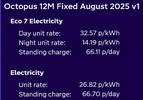 night rate more expensive, but runs for longer, but my battery will charge in 1.5 hours, so for me 5 hours is ample. But EV users, 5 x 7kW = 35 kWh, which for some is not enough, but looking at 50p per night saving using Economy 7 if using the whole 49 kWh, and a likely loss if not using it all, and my son pays 6p/kWh as he got the car from Octopus, together with whole installation.
so it seems for many, even 49 kWh is not enough. The old Renault Kangoo ZE had a 22 kWh battery, and a range it claimed of 120 miles, the person I knew with a Kangoo ZE on a milk round of 68 miles would sometimes not make it home. It would also only charge at 3 kW, so still needed 7 hours to charge it.AI said:The average electric vehicle (EV) battery capacity generally falls in the 50-80 kWh range, with many new models offering between 60-100 kWh for good range, though smaller city cars can have 20-30 kWh and larger SUVs/trucks exceed 100 kWh, with an overall average around 80 kWh in recent years, depending on the market and vehicle type.
I see a problem, no solar at night, and loads of people with solar panels and battery, or EV cars, wanting to charge their batteries, industry using less, so question is how long with cheap energy at night last?

DIYnot Local
Staff member
If you need to find a tradesperson to get your job done, please try our local search below, or if you are doing it yourself you can find suppliers local to you.
Select the supplier or trade you require, enter your location to begin your search.
Please select a service and enter a location to continue...
Are you a trade or supplier? You can create your listing free at DIYnot Local


