
• Looking for a smarter way to manage your heating this winter? We’ve been testing the new Aqara Radiator Thermostat W600 to see how quiet, accurate and easy it is to use around the home. Click here read our review.

High pitched whine that rises and falls for hours after central heating has been on

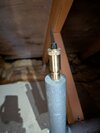
You got me thinking after you mentioned the AAV's Looking at the one at the boiler am i right that the AAV should be on the pressure side of the pump?? if that's the case its on the wrong side. I assume to close them its just a case of screwing the plastic cap in??? it appears that one is closed so whether he just fitted it to bleed the system I've no idea. kind off defeats the purpose of having it??

AAVs can admit air as well as vent it.
As mentioned by another poster.
High up ones are more likely to be worth investigating.
Negative pressure on suction side of pump can pull air in via them.
IIRC you mentioned getting lots of air in the system... It could well be via the AAVs.
 
AAVs can admit air as well as vent it.
As mentioned by another poster.
High up ones are more likely to be worth investigating.
Negative pressure on suction side of pump can pull air in via them.
IIRC you mentioned getting lots of air in the system... It could well be via the AAVs.
I'll close it off but surely a plumber wouldn't fit it on the return line? rather than the pressure side.
 
I would say you shouldn't have any AAVs fitted to an open vented system full stop. In an unvented system it wouldn't matter if it was on the return.
 
Agree there shouldn't be any AAVs on a OV system, maybe thumb screw vents at best/worst, mine is 50+ years old with some rads over 40 years old, also oil fired with a 20 year old Firebird but then I have the RR of systems with a combined Vent and cold feed from day one!.
If not via the AAV then the most likely place is the vent, I would hold or tie a glass/plastic container of water under the vent with the vent end immersed in the water and see does the level change up and down or reduce slowly, the AAV can be checked maybe by tie wrapping a bit of rubber tubing over the open AAV and also sticking that into a glass full of water.
The dedicated vent and cold feed also seems a bit unique, wonder if the original set up was a gravity HW cylinder coil and CH only pumped, I've seen systems with the cold feed like the OPs but the vent was a continuation of the boiler flow pipe.
Only other culprit, if not air ingress, is maybe gases being released due to corrosion?.

Also, pump overrun is pretty unusual in a oil fired system as the boiler contents of ~ 20/25 litres act as a natural buffer and is advantageous not to have one as mine with set point temo of 65C rises to 90C when the roomstat/burner stops firing but with very low heat demands of say 2/3 kW will run for 6 or 7 minutes or more without refiring until the flow temp falls to ~ 57/58C.
 
Last edited:
Agree there shouldn't be any AAVs on a OV system, maybe thumb screw vents at best/worst, mine is 50+ years old with some rads over 40 years old, also oil fired with a 20 year old Firebird but then I have the RR of systems with a combined Vent and cold feed from day one!.
If not via the AAV then the most likely place is the vent, I would hold or tie a glass/plastic container of water under the vent with the vent end immersed in the water and see does the level change up and down or reduce slowly, the AAV can be checked maybe by tie wrapping a bit of rubber tubing over the open AAV and also sticking that into a glass full of water.
The dedicated vent and cold feed also seems a bit unique, wonder if the original set up was a gravity HW cylinder coil and CH only pumped, I've seen systems with the cold feed like the OPs but the vent was a continuation of the boiler flow pipe.
Only other culprit, if not air ingress, is maybe gases being released due to corrosion?.

Also, pump overrun is pretty unusual in a oil fired system as the boiler contents of ~ 20/25 litres act as a natural buffer and is advantageous not to have one as mine with set point temo of 65C rises to 90C when the roomstat/burner stops firing but with very low heat demands of say 2/3 kW will run for 6 or 7 minutes or more without refiring until the flow temp falls to ~ 57/58C.
yep, originally was a gravity fed HW cylinder but that was converted about 15 yrs ago to non vented so we could get rid of the tank. The boilers been there for a good 30yrs. Pulled the hatch off to close the AAV. There is one on the return line but its closed off with the cap. Strangely enough the other one on the pressure side is right where the Tee goes across to the rad where the sound is emitting and its about 500mm up on a straight piece of pipe so I'll crawl in and screw the cap down. what are the chances thats the problem??? fingers crossed as you'll no doubt see they're push fit ones aswell. Those push fit AAV have a fair bit of movement on them. wish he'd used compression. knowing my luck that wont be the problem. Heating was on for 30 mins this morning and 30 mins + after cooldown the noise starts
 

Attachments

  • AAV.jpg
    AAV.jpg
    129.3 KB · Views: 16
Do that vent test with the container for a few hours including the cool down period, if nothing strange, suggest c/o the circ pump to PP III for a day or two.
 
Low head F&E systems are often problematic and should be ditched in favour of sealed system...is the boiler not approved for sealed systems? There must have been a very good reason to not seal it.
AAVs are plain trouble. Replace with manual vents...I use the 1/2 radiator type vent with a 1/2 BSP female coupler.
 
Sealing it might cure the problem, it would be easy to do a simple if temporary mod with the F&E cistern still in place, and require minimal drain down, just install a swing check NR valve on the cold feed where it exits the cistern and immediately below it, tee in and install a 6 or 8L expansion vessel (quite sufficient for 4 rads+system) immediately below it precharged to 0.5bar, but if the boiler does not already have a 2 or 3 bar PRV would need one installing.

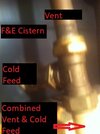
Below is my combined vent and cold feed, I moved the (new, then) cistern into the side when, in 2011, I installed a modest thermal solar system which required a 2 coil cylinder.
 

Attachments

  • Combined (mine) Vent & Cold Feed.JPG
    Combined (mine) Vent & Cold Feed.JPG
    42.3 KB · Views: 12
Low head F&E systems are often problematic and should be ditched in favour of sealed system...is the boiler not approved for sealed systems? There must have been a very good reason to not seal it.
AAVs are plain trouble. Replace with manual vents...I use the 1/2 radiator type vent with a 1/2 BSP female coupler.
the boilers well by its sell by date but i thought id leave it till it goes bang. To be honest I'm surprised the heat exchanger hasn't rusted through. I did pose the question to the plumber if i switch the central heating to sealed system what is the likelihood of it blowing old joints that have been there for decades. Any thoughts??
 
The boiler is probably under ~ 0.35bar head pressure as is so if you installed a good big EV of say 18L, prechrged to 0.35bar and filled to 0.5bar then the final pressure when hot with that small 4 rad system volume will not rise above 0.6/0.65bar, install a 1.0bar PRV, can'e see any problems with that.
 
There are still quite a number of 35 year old Firebird SE boilers around here, I installed a failed EV on one for a neigbour recently, and also a 2 bar PRV to replace the 7, yes 7Bar original, I presume.
 

If you need to find a tradesperson to get your job done, please try our local search below, or if you are doing it yourself you can find suppliers local to you.

Select the supplier or trade you require, enter your location to begin your search.


Are you a trade or supplier? You can create your listing free at DIYnot Local

 
Back
Top