
Intermediate switch, which contacts are switched

Joined
5 Jul 2006
Messages
106
Reaction score
4
Location
Yorkshire
Country
United Kingdom
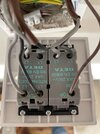
I have this switch as part of a 3 switch system for a lounge light . I’m keen to understand which contacts are made/broken with the operation of the switch. I will use a tester if needs be but wondered if anyone knew from the photo.

Also I’m thinking of changing the switches and doing away with one of the 2 way switches keeping the one at the location where the intermediate is and one other.

From the photo is it possible to identify what wiring I do away with to convert the intermediate to a 2 way paired to the remaining switch and what I may need to do with the abandoned switch

Thanks
 

Attachments

  • IMG_0468.jpeg
    IMG_0468.jpeg
    226.5 KB · Views: 83
Right hand switch - Common to L1/L2. Left hand switch - Straight top to bottom / diagonal top to bottom
 
Without being technical, if you wanted to use the intermediate as a 2 way only, you would:
place the common brown into one of the top terminals, and put the grey in one of the bottom terminals, and the black remaining bottom terminal.
There are variations, I have tried to keep it simple.

Firstly though, you need to check that there aren't any cables you need to keep in the switch that you wish to remove.
 
Before offering advice can we have pics of the other 2 switches wiring, clearly indicating which one you wish to keep and which to 'abandon' and do you have any test kit to identify the cables at the intermediate.
 
Last edited:
I have this switch as part of a 3 switch system for a lounge light . I’m keen to understand which contacts are made/broken with the operation of the switch. I will use a tester if needs be but wondered if anyone knew from the photo.
Use the "Ohms Scale" on the multimeter (which you must have) to check the connections between each of the four terminals when the Intermediate/Crossover switch is in either of its TWO positions.
 
The switch either connects the contacts top to bottom. Or when switched it connects the contacts diagonally. (As per pic)
 
PS - there is another 2 way switching arrangement known sometimes as the "Two Way Hamburger" I`m sure it must have other names too. Not recommended and potentially unsafe but it actually works - do not try this at home though - L and N connected to both switched terminals, often marked as L1 & L2. So, example say L1 of both switches to L1 and L2 of both switches to N, COM of one switch to one lampholder and COM of the other switch to the other lampholder terminal, you could even put intermediate switches between the two way switches in the convention manner to produce and number of switched ways. The result is either both lampholder terminals become either the same polarity or opposite polarities hence it works functionally but they might have two lampholder terminals at L polarity (lamp off) or lampholder terminals reverse polarity (lamp on), both conditions might dangerously startle the unwary therefore definitely something to avoid at all times, but it works!

Might be good if JW does one of his video treats explaining the workings of the "Two Way Hamburger" consideration, I`m sure he would add plenty of warnings about avoiding it though, I`ll bet he dislikes them more than the Ring Final Circuit.
If anyone on this forum knows him they might suggest it to him ;)
 
Last edited:
Except that the Video ought to refer to two-way and intermediate/crossover switches,
for the benefit for those who actually realize that a SPDT switch is two-way switch - not three-way -
(although it has three terminals - as do most UK switches)
and
an Intermediate/Crossover switch is a modified DPDT switch,
with four terminals - (NOT Six.)

(See https://en.wikipedia.org/wiki/Multiway_switching
and
https://commons.wikimedia.org/wiki/File:Crossover-switch-symbol.svg )
 
Yes indeed, I think the USA use "wrong terms" with that kind of thing (no surprise I suppose, they muck everything else up) .
 
Yeah, the Brits and the Yanks use different terms for switches.

What the brits call a one way switch the yanks call a two way switch.

What the brits call a two way switch the yanks call a three way switch

What the brits call an intermediate switch the yanks call a four way switch.
 
What do they call 1 gang, two gang, three gang, four gang, six gang switches plugwash? What would they call a 12 way 1 pole rotary switch or a 2 pole 6 way etc etc? the mind boggles methinks ;).

They still use imperial measurements too, but not proper imperial but their own brand of gallons etc. Although we are still quite imperial at least we adopted SI units so go with the motto "Go metric every inch of the way!" . I will not mention proper billions on this occasion though LOL.

I suppose we should not criticise then too much though, even the one horse power equals 746 watts is some clever guess experimentation with a large guess correction stuck on the end of it and all of us initially believed that electric flowed from +ve to -ve so kept the convention alive once we realised the proper way, glass houses and stones sort of thing.
 
Last edited:
They still use imperial measurements too, but not proper imperial but their own brand of gallons etc.
Well, NO.

They still use the BRITISH measurement system which was in use in 1776. - Winchester Measures -
and
now call them US Customary Measures.
(See https://en.wikipedia.org/wiki/Winchester_measure )

When the UK (and its Colonies) changed to Imperial Measures in 1826 the US did not change.

Before 1930. the British Inch and the US Inch were slightly different in length.
(The US also had a Survey Inch which was very slightly different in length from their Inch.

This has been "phased out" from 1 January 2023.)

"In 1930, the British Standards Institution adopted an inch of exactly 25.4 mm. The American Standards Association followed suit in 1933.
By 1935, industry in 16 countries had adopted the "industrial inch" as it came to be known. "
(See https://en.wikipedia.org/wiki/Inch "
 
Last edited:

If you need to find a tradesperson to get your job done, please try our local search below, or if you are doing it yourself you can find suppliers local to you.

Select the supplier or trade you require, enter your location to begin your search.


Are you a trade or supplier? You can create your listing free at DIYnot Local

 
Back
Top