- Joined
- 21 Mar 2024
- Messages
- 597
- Reaction score
- 171
- Country


I'm just wondering how that would be EICR codedThanks for all your posts - I hope you enjoyed the mental exercise! Here are my (partial?) solutions:
Firstly, of course it would be easy if there were a permanent live a the right switch. There isn't, but one or other of the red strappers will always be live. So if we had a DC supply, we could do this:
View attachment 396496
I spent a while trying to invent an AC version of that, and failed. Even with a few transistors I needed a neutral at the right box to make it work. So that was a dead end.
My other ideas all involve an intermediate (crossover) switch in the right box, as suggested by mikehammer69 in post #7 and drawn up by EFLImpudence in post #20. Here's my version of that circuit:
View attachment 396498
Of course as you've noticed that doesn't quite work; you can control both lights from both ends of the room, but the switch for the original lights at the left side now also toggles the new light.
I have a couple of thoughts about how to fix that. Firstly, you could use a DPDT switch to "undo" the unwanted toggle from that switch:
View attachment 396501
The problem with that, of course, is that you can't buy DPDT switches to use in regular wall switch boxes; some nasty bodge would be required with an un-matching switch.
On the subject of nasty bodges... that leads to my final offering:
View attachment 396502
That works in the sense that all the switches do what you want, and it only uses readily available components. The problem is... well, I hope you can spot it!
At least one manufafturer makes a DP2W euromodule, I think LegrandI have a couple of thoughts about how to fix that. Firstly, you could use a DPDT switch to "undo" the unwanted toggle from that switch:
View attachment 396501
The problem with that, of course, is that you can't buy DPDT switches to use in regular wall switch boxes; some nasty bodge would be required with an un-matching switch.

Looking at number 4 is giving me a headacheThanks for all your posts - I hope you enjoyed the mental exercise! Here are my (partial?) solutions:
Firstly, of course it would be easy if there were a permanent live a the right switch. There isn't, but one or other of the red strappers will always be live. So if we had a DC supply, we could do this:
View attachment 396496
I spent a while trying to invent an AC version of that, and failed. Even with a few transistors I needed a neutral at the right box to make it work. So that was a dead end.
My other ideas all involve an intermediate (crossover) switch in the right box, as suggested by mikehammer69 in post #7 and drawn up by EFLImpudence in post #20. Here's my version of that circuit:
View attachment 396498
Of course as you've noticed that doesn't quite work; you can control both lights from both ends of the room, but the switch for the original lights at the left side now also toggles the new light.
I have a couple of thoughts about how to fix that. Firstly, you could use a DPDT switch to "undo" the unwanted toggle from that switch:
View attachment 396501
The problem with that, of course, is that you can't buy DPDT switches to use in regular wall switch boxes; some nasty bodge would be required with an un-matching switch.
On the subject of nasty bodges... that leads to my final offering:
View attachment 396502
That works in the sense that all the switches do what you want, and it only uses readily available components. The problem is... well, I hope you can spot it!

At least one manufafturer makes a DP2W euromodule, I think Legrand
EDIT: https://www.legrand.com.eg/en/catal...ole-switch-20-ax-250-v-2-modules-white-572048


 www.diynot.com
I remember this method, and nearly contemplated trying to use it for this puzzle,Well if you are proposing switching live and neutral you have made it far too complicated, it seems you have too many wires in your system
View attachment 396527
This method has been fairly common, still exists in some places and uses very standed components
One from 2018
2 way lights again (Oh and why I don't like domestics)
"Got a little 2 way switch job for you Sunray" "More rubbish?" "Customer says they changed a switch and now it doesn't work." This is just how I found it: "I took the broken switch off and forgot how it was connected so I went on-line and couldn't find the same numbers of cables." The hall...
Likewise that was my first thought and half expected it to be OPs too.I remember this method, and nearly contemplated trying to use it for this puzzle,
TrueHow on earth do you expect that to work correctly? Not the sort of solution I'd expect from a longtime spark.


Eric - I reckon that the OP might have just wanted to do a thought experiment so asked for us to rule out relays and Wifi/Bluetooth sort of IT completelyI am sure one can fit a relay at the lights, and use momentary switches, to change the state of the relay.
However, the relay I used to do this was a smart relay, so not permitted. It did not need momentary switched, change of state changed if on or off. And after fitting, I wished I had simply used smart bulbs.
I can't see the point of not using electronics. I remember the control panels of yesteryear, things of beauty, but today a little PLC does it all, easier to install, easier to program, easier to repair, one has to move with the times. How many people remember the hand signals when driving a car, we have moved on.
A latching relay at the lights, would allow use of momentary switches, to change state of the relay.Eric - I reckon that the OP might have just wanted to do a thought experiment so asked for us to rule out relays and Wifi/Bluetooth sort of IT completely
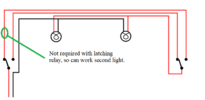 So you have a spare wire which can control the other light. But a latching relay today costs more than a smart relay, so what is the point?
If you need to find a tradesperson to get your job done, please try our local search below, or if you are doing it yourself you can find suppliers local to you.
Select the supplier or trade you require, enter your location to begin your search.
Are you a trade or supplier? You can create your listing free at DIYnot Local

