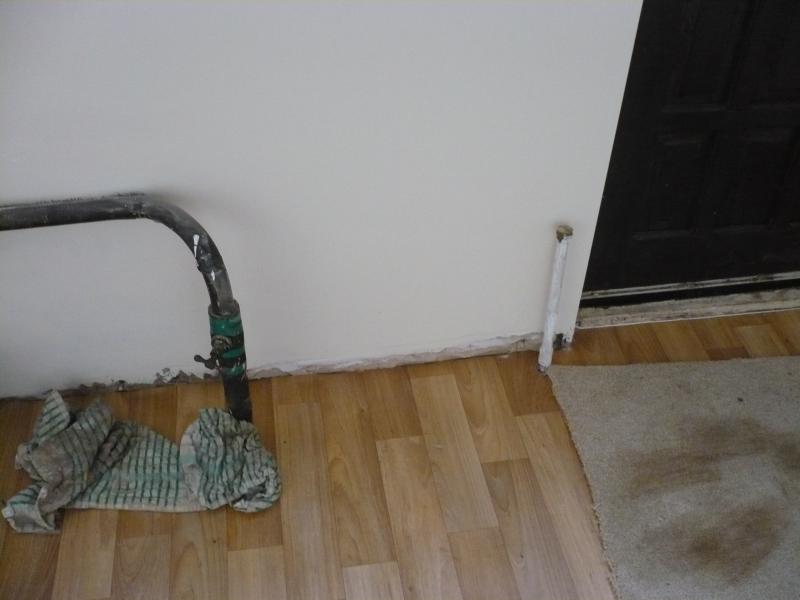
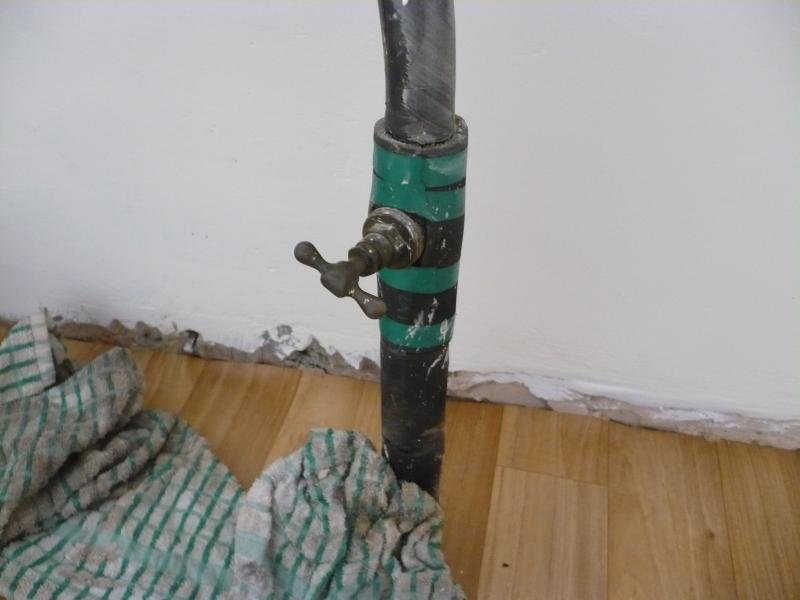
Moving Stop Cock\Water Pipe in Kitchen

Joined
12 Jan 2010
Messages
61
Reaction score
0
Location
Hertfordshire
Country
United Kingdom
We are planning to move the stop cock in our kitchen, the attached images show the location of the stopcock which is directly below a window which will soon become french doors and therefore be in the way.


I have been advised by a plumber that I would need to dig out the rising main to the point of where there is a connection and at that point unscrew the connection and install an MDPE adapter.

I have a few further questions that I hope you can help me with:

1) We live in a 1950's ex council house in Hertfordshire and the kitchen is located at the back of the house. I expect that when I start digging the rising main will head into the house rather than into the garden. Does anyone have any experience with how far I am likely to have to dig to find a connection? The plumber through that 6 foot lengths are likely to have been used. I wouldn't really want to dig up the lounge which is between the kitchen and front of house.

2) Is there any chance this pipe could be lead, I have my doubts as I think the plumber would have told me this.

3) Were houses of this age built with a DPC in the floor? Do I need to worry about that?

4) Can anyone of think of an alternative method? The plumber implied that I might be able to dig down about a foot and then thread the pipe but he thought it would be better to keep digging to get a better connection.

5) Assuming I get the MDPE adapter connected and then the blue MDPE pipe is it then a case of position the pipe and fitting a Stop Tap? I think there are rules about insulating to a certain depth? What about the angle to which you can bend the blue pipe?

Thanks in advance.
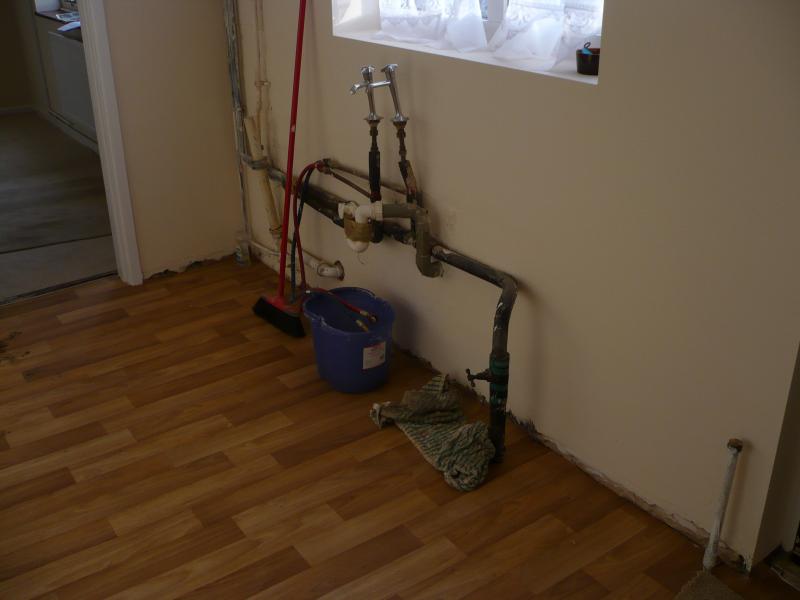
 
What is the pipe coming out of the floor made of?
Assuming its iron,and not lead,if you follow the pipe downwards,you should find an elbow,then its just a case of unscrewing the upstand from the elbow,leaving a female thread,then use a male iron to copper elbow,and you can divert it anyway you like.
I would dig the channel out first though,to stop concrete falling into the pipe
 
So it is ok to use an elbow joint to take the pipe of at 90 degrees?

How deep should I do the channel to the new location?

THanks
 
Replacing ALL mains pipe. Does that imply digging up the old one and directy replacing it? That would mean digging through my lounge....... :roll:
 
If you wanted to go that route,you could dig up outside at the point where the pipe disappears under the house,then bring it up and surface run it inside,leaving the old buried inside pipe still there,but redundant.
 
Is it better to have gradual bends in the pipe (i.e. bending the pipe itself) rather than using specific joints (i.e. 90 degree elbows), or should I do whatever is easiest.

Thanks for all of the replies to this post.
 
I've dug out the rising main by about 1m and haven't come to a bend or a connection point. I'm also thinking that if I do get to a connection point then I will have to make a pretty big hole in the kitchen to get a grip on the pipe.

I've been looking at threads on Philmac Universal Couplings and think that this might be an option. The problem is that the pipe isn't in perfect condition and I am wondering whether the coupling will leak. Does anyone have experience with these couplings on not so perfect galvanised iron pipe?

Or should I keep digging and do the job properly?

Thanks
 
Number of unknowns here:
1. why did you start digging without knowing what was what? stop digging and start thinking.
2. where is your external main stop-valve - on the pavement, or in your garden? eye-ball a line from the shut-off to the house and you have the service run(typically).
3. when you've located the valve, test it for working order. you might need it in a hurry.
4. do you have a suspended floor in the front of the house? if so check where the water supply enters the property.
5. all galv. pipework should be replaced or abandoned if in the ground - sods law is that if you leave it operating in-situ it will leak as soon as you have made good.
6. possibility that a new water service will be reqd.We can talk you thro that.water must enter property at 750mm depth.
 
Thanks for the reply mnb, I could do with some good advice.
Here is a plan of the house:
and a picture of the kitchen:

- I tested the external main stop cock before digging and can confirm that this works.
- The house is a 1950's ex-council and has solid floors, from what I have seen so far the construction is 25cm concrete and then soil.
- Kitchen is at back of house, direct line to external stop cock is through lounge (see plan)
- Slight complication as there is a garage extension which was built in 1992. This also has a water pipe and separate stopcock (see map). This is mounted against the wall next to the outside toilet.

I would quite like to run a new water pipe, the problems I can foresee are:
1) How do shut down the old pipe - if I am going to fit a new pipe I would want to cut this off from outside the front of the house.
2) How do I know find out how the pipe was run to the garage?

Maybe the best (obvious!) idea is to fit a complete new water pipe for the garage and kitchen now. I could run this down from the external stopcock down the side of the house (right side) and then branch up for the garage (with separate stop cock) and then up into the kitchen (with separate stop cock). This would involve digging a channel all the way plus some cutting of concrete in the garage floor (I need the exercise anyway!). At least I know there wouldn't be water leak problems!
What do you think?
 
At the time of the new garage BCO must have been involved, and plans must have been submitted. Doubtful that BCO would have allowed a slab over a galv. service. Inquire at local Blg dept. BCO in question might still remember details, and plans still be on file. All underground services must be shown on plans.

To "shut-down" the service, disconnect at external valve ,and abandon service in ground. Trench new service line in 25-32mm Alky or MDPE.

Remove all above ground galv. and tie existing copper into new supply.

Suggest that stop-valve in garage is an isolator for the outside WC. Shut it off and see what is isolated. The main internal stop valve must isolate all the property ie. be first in line, no previous branch off's.
 
Is there a suitable corner at the front of the house where a stopcock could be boxed in? If you run a new service from the property to the existing boundary stopvalve then the the water authority will connect it, and disconnect the existing service. You could then run the new service through the house, (possibly through the upstairs floor void?) to the rear.
 
erm hate point out a reg but you only allowed touch this pipe if you have passed test for blue card
 

If you need to find a tradesperson to get your job done, please try our local search below, or if you are doing it yourself you can find suppliers local to you.

Select the supplier or trade you require, enter your location to begin your search.


Are you a trade or supplier? You can create your listing free at DIYnot Local

 
Back
Top