• Looking for a smarter way to manage your heating this winter? We’ve been testing the new Aqara Radiator Thermostat W600 to see how quiet, accurate and easy it is to use around the home. Click here read our review.

Neutrals At Switch

now bas if you read my post i simply said it must be confusing being taught by the book in college then imploying this method on site
then you jump in what book i gave an example of books used in college
we dont want to go there was regarding my preference to witch method i employ read the thread again you seem to want to make personal attacks
are you normally this rude to people when you are at arms lenght
i think not maybe one shandy to many before you came online
 
Personally, if I ever used the "loop at switch" method, I'd take a 3core to the ceiling so there was a permanent live available.

What if you wanted to extend and there was only a switched live at the ceiling?

Where would you pick up the live loop from?
 
OK. So you have a new ceiling light to install over a desk & want a local pullcord switch to operate it.

WITHOUT smashing the wall to bits, how do you pick up the live loop?

At least with the "old" 3 plate method, you could find the feed in the ceiling void. With the switch method, it's more complicated.
 
True - wasn't imagining a ceiling switch like that.

However, if the loop does go through the switches, what route does it usually take from one to the next - up the walls and through the ceiling void, or down the walls and under the floor?
 
I used this method recently because looping at the switch cut down on number of runs for a series of rooms where each lamp was to be individually switched (HIDs and MegaMan DORS dimmable GU10s).

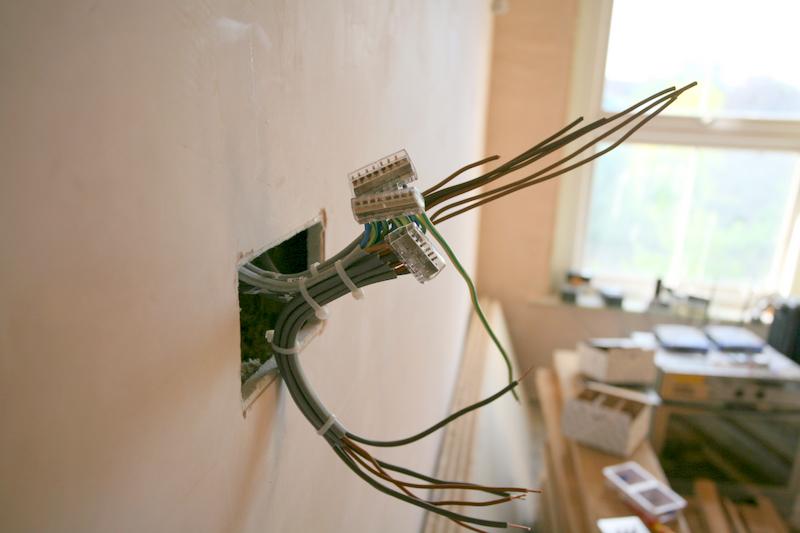
That said, the practicalites of getting everything to fit was tricky, as this picture shows (here there are 6 individually switched), and if the stud wall hadn't had a 150mm cavity, it might have been impossible, without putting lots of strain on the cables...also, extending the circuit would require more effort I agree.


Another question is whether the 'quality' of connections that can be made in this way are better (or worse) than those joints made in the ceiling cavity.

Where a 'proper' junction box are used (Hager ones - 'Ashley' I think they are called are brilliant), I don't think there's anything in it.... but with many light fittings having poor quality termination/ cable support for loop in /out, maybe this is better from a maint/ inspect point of view, what does anyone else think?
 
You obviously can't see from that picture, but all the cables run down clipped to the timber stud supported right up to the backbox.

The blocks terminating neutrals and cpc are then tucked in behind the backbox (which is removable for access to inspect & labeled to that effect).. but given that the cables are then supported both into the backbox and clipped on the way out (30mm of between the last clip and backbox), there is neither any mechanical strain, nor any prospect of them moving i.e. they are are definitely not 'flapping' about.. how else would you have done it?
 
The blocks terminating neutrals and cpc are then tucked in behind the backbox (which is removable for access to inspect & labeled to that effect)..

Is a cavity wall an acceptable enclosure for terminations? :roll:

I think not!

Code 2 for that one and a possible PIR failure......
 
not wanting to be antagonistic (i.e. I'm not disagreeing!).... but for what reason do small 20A junction boxes work any better?

They wouldn't be more accessible surely? is it because the cables would be clamped, or because they are in themselves an enclosure ?

..and to use 4 way boxes would need several of them to do the 6 runs.. the push fit junctions are mechanically acceptable I thought?
 
421.7 Every termination of a live condutor or connection or joint between live conductors shall be contained within an enclosure selected in accordance with Regulation 526.5
 
Presumably 526.5 doesn't allow you to select an enclosure made from wood and plasterboard...
 
OK, so now I am confused... :?

Combustibility? surely that can't be a criteria... accessibility, designed for purpose I can understand....

...if it were, then arguably this partition (6x3 studwork, 150mm rockwool filled cavities and 15mm Fermacell board (which together are rated at 1hr 30mins for fire(even 12.5mm plasterboard is 30 mins) must be a better than a plastic box....

Or am I missing the obvious here ?
 

If you need to find a tradesperson to get your job done, please try our local search below, or if you are doing it yourself you can find suppliers local to you.

Select the supplier or trade you require, enter your location to begin your search.


Are you a trade or supplier? You can create your listing free at DIYnot Local

 
Back
Top