Oven separate hob

Joined
22 Dec 2019
Messages
6
Reaction score
0
Country
United Kingdom
I have an existing hard wire for free standing cooker, has its own circuit to consumer unit, 10mm cable,, that will now be used for the electric hob,, can I spur off that to service my oven 16amp oven that's going in a different part of the kitchen, the cable is going up between ceiling and floorboards, and along rafters for about 1mtr, using 6mm twin & earth, maintenance free junction box, is this ok,
 
You could but what maintenance free junction box will you use for 2 x 10mms and 1x 6mm?

Could you not fit a duel outlet plate and wire from that somehow?
 
You could but what maintenance free junction box will you use for 2 x 10mms and 1x 6mm?

Could you not fit a duel outlet plate and wire from that somehow?
I was going to use one of them wagobox 32amp connectors,
 
Well if it fits into the standard cooker calc by load and you are sure that the connectors will fit and carry the max current (depending on hob power rating which you haven`t mentioned yet) the it will do.
Using the dual outlet plate that Pete has mentioned (provid it remains accessible) might be an easier option though.
 
Well if it fits into the standard cooker calc by load and you are sure that the connectors will fit and carry the max current (depending on hob power rating which you haven`t mentioned yet) the it will do.
Using the dual outlet plate that Pete has mentioned (provid it remains accessible) might be an easier option though.
Hob burner range 1.4 to 3kw 32 amp
 
Seriously don’t like them. Dual outlet plate is far better imho

What is the mcb rating?
Are you saying connect it via dual outlet plate, and run the wire across to the oven, which would mean running cable between upper flooring, and along and down to oven, length of about 5mtrs
 
I was going to use one of them wagobox 32amp connectors,
Not really suitable in this situation. In any case, I'll bet the 10mm cable has a bigger MCB than 32amp?
Are you saying connect it via dual outlet plate, and run the wire across to the oven, which would mean running cable between upper flooring, and along and down to oven, length of about 5mtrs
ah well, you have to do whatever you have to.
that's the fun of electrics, sometimes.
 
Not really suitable in this situation. In any case, I'll bet the 10mm cable has a bigger MCB than 32amp?
So long as the MCB and cable combination are correct for 1/ short circuit & 2/ Earth fault (unless reliance on an RCD) & 3/ Overload (if required) then no problem. That would likely apply to the 10.00mm cable but any spur off to say 2.5 would need addressing say by fusing down.

So yes , as Taylor says, it needs considering, with a 32A MCB it will probably be OK but anything bigger needs addressing.
 
You will need an wagoXL box and I don't think any wagos go upto 10mm....could be wrong.
That’s thd practical problem with using Wago here. You won’t get a 10mm conductor in!
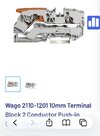
Wago do make a 10mm connector, the 2110 but that’s a DIN rail mounted jobby.
IMG_6890.jpeg
Dual appliance connector plate is the solution. Assuming it will be accessible…
 
One should not reduce the current carrying capacity of the installed cable without adding some overcurrent device, so if original cable 10 mm² then the extension also should be 10 mm².

There is a problem with cooker supplies, it is clear that a cooker should not be supplied with a 100 amp overload device, but it seems manufacturers don't actually give a maximum supply size in their installation instructions, they often give a minium size, but not maximum. So traditionally we used a 32 amp overload device for cookers, and it does not really matter if the oven and hob are combined or not, in the main for domestic installations 32 amps is enough.

But we have seen 45 amp overloads used, as to if the wiring in an oven can take 45 amps, we have no idea, we are reasonably sure the hob can take that current, but not the oven.

Due to other side of the channel using 16 amp sockets, there are a lot of ovens rated over the 3 kW that our 13 amp fuse will allow, and our fused connection units (FCU) will only take up to a 13 amp fuse, so if the oven is over 3 kW then either a dedicated supply is required, or a supply protected at no more than 32 amps, as we have no idea if the oven is safe with a larger supply, the manufacturers simply don't tell us.

The chances of anything going wrong which would not trip a RCD is slim, so having an oven and hob from a duel outlet and a 45 amp MCB/RCBO it unlikely to cause a problem, and I am sure it has been done many many times. However without looking at the appliances and doing a risk assessment, it would be wrong to suggest connecting a 16 amp oven to a 45 amp supply, or to reduce the cable size without fitting an overload.

 
One should not reduce the current carrying capacity of the installed cable without adding some overcurrent device, so if original cable 10 mm² then the extension also should be 10 mm².
Even if the added cable is sufficient for the existing overcurrent device?
 
Even if the added cable is sufficient for the existing overcurrent device?
Unless BS7671 has changed yes. This was something which was raised many times in collage all those years ago, it says current carrying capacity not cable size, so where a cable goes through insulation it would need heavier cable, which is not going to happen.

You could see the flaws, as clearly one should not be planning for people following not keeping to the rules. They should view the original installation certificate before adding to the system, but we know if we see a 10 mm² cable at the CU it is easy to assume it is 10 mm² throughout it length, only when as found with this house, at the CU we see brown and blue and at the cooker we see red and black do we realise there must be a joint.

I would love to see 16 amp FCU designed for this situation, but not sold in the UK. We are left with the mini CU option, which could take the din rail connectors, but it is where to mount the CU?
 

If you need to find a tradesperson to get your job done, please try our local search below, or if you are doing it yourself you can find suppliers local to you.

Select the supplier or trade you require, enter your location to begin your search.


Are you a trade or supplier? You can create your listing free at DIYnot Local

 
Back
Top