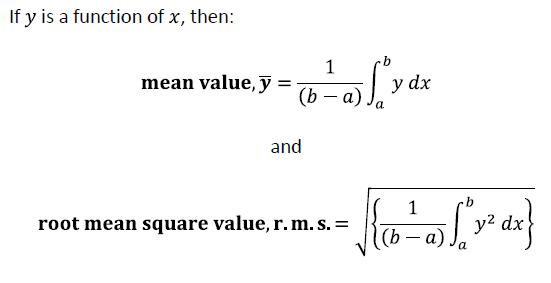
No. It's (Peak x Duration) ÷ π/2 ... which, as I said, will give you mean (i.e. peak * 2/π

, not RMS.
Ah - my mistake - I thought it was.
I actually manipulated the expression a bit to make it consistent with the way you had expressed your (incorrect) version, and that actually made it look/sound a lot more complicated than it is. ... If one works in radians, the area under a sine wave between 0° and 180° (i.e. 0 and π radians) actually works out simply as 2*V(peak). To get the mean, you just divide that area/integral by the interval (i.e. π radians), giving the mean as (2/π
*V(peak) - which is, of course, the figure we are familiar with.
My suggestion about using a 'scope didn't need one with a log axis - any old analogue one with a grid overlay would do ...
True - that's a functional equivalent of one with a log scale!
- my (mistaken) idea that a visual estimate of the area under the curve would be close enough to RMS for the original purpose.
I guess it depends upon how close you want to be. As I've said, if you visually assess the area under a half cycle (or quarter cycle,if you want) of a sinewave and divide that by the duration of that half cycle, you'll get mean voltage.
IF it's a true sine wave, at about 0.637*V(peak), that's not all that far off RMS [0.707*V(peak)]. However, the catch obviously is that if it is not a sine wave, mean and RMS could be much further apart. However, you could then use your 'log overlay' to estimate the area under the V² curve, and use that to get a true estimate of RMS (for
any waveform) if you wanted.
Of course, we now have meters and scopes that actually do the integration under the V² curve 'numerically' ('digitally'), and hence calculate true RMS for any waveform - but the principle is exactly the same as your scope, 'log overlay' and eyes (and a division and square root calculation).
Kind Regards, John