• Looking for a smarter way to manage your heating this winter? We’ve been testing the new Aqara Radiator Thermostat W600 to see how quiet, accurate and easy it is to use around the home. Click here read our review.

Tado for S-plan system with an immersion heater

Joined
22 Sep 2015
Messages
50
Reaction score
0
Country
United Kingdom
Hi all. I want to install tado V3.

I think I have an s-plan system which comprises:
  • Worcester Bosch Greenstar 30cdi (gas)
  • Hot water tank with immersion heater
  • 2 motorised zone valves (2 port each). One for CH and one for HW.
  • Honeywell ST6400C controller that everything is wired to
  • Honeywell wired thermostat to turn on CH
If you're familiar with Tado and smart heating in general, my questions are:
  • Do I need wired or wireless (plus hot water controller) kit? Ideally I'd replace the entire Honeywell controller so go for wireless, but there are an insane numbers of wires currently that I know is not going to be straightforward as the tado guides show. Im confident if I go for the wired kit, I leave the Honeywell controller all the same, but replace the thermostat giving remote control ability. Won't get rid of old controller sadly and be able to set hot water schedules directly from my phone
  • Is there any way to keep the immersion heater live using tado. Tado controller only supports 3amp. Somehow the current Honeywell controller I think controls the immersion heater too
  • If I got for wireless and attempt to use the hot water control unit, should I get UK or EU version for best control of the boiler? Reading other posts, I'm confused if I need to use to use (EMS?, HT-BUS, relay On/off). I'm fairly sure it's not opentherm compatible
  • Is there any reason to go for the X instead of V3. I don't care about matter support or app features. Just in terms of installation/boiler configuration

Lots of questions. Here is the main wiring board where everything comes into and then goes to the ST6400C. Any help with wiring this to tado..what stays, what goes would be greatly appreciated.


Cheers
 
Last edited:
1754857382818.png
Can't see how the ST6300 could control the immersion heated, as contacts are not rated high enough. The diagram in this case Y Plan
1754857592480.png
seems to show a standard connection, the centre of the one shown here,
Thermostat back plate.jpg
is standard for Hive, and Wiser, so those two would be a simple swap, the main reason I rejected Tado when I was looking for a new thermostat was a lack of good instructions, that has been rectified now, but there are a few versions and not sure which you are looking at but this
1754858308131.png
seems reasonably standard, and all you need to do is find the cable going to old thermostat and link it out.

What is more important is to work out how the unit works and will this suit what you want. I made a mistake, I went for Nest Gen 3, which did not connect to the TRV heads as expected, so I have added Wiser, the hub can take demands for heat from up to 9 devices, and this is dependent on your home as to how many you need.

I looked a geo-fencing and was sold on the idea, however it did not work as expected. Not tried with Wiser which uses IFTTT, as does 3 of my TRV heads, I tried with Nest Gen 3, and it was a complete flop. What I would want is for it to activate when I am 6 miles from home, as the local town is 8 miles away, but it does not allow one to set distance, it waits until the local cell site has picked up by your phone, so one is nearly home, so may as well turn it on as you walk through the door.

Yes, I can manually turn on the heating, but in the main that defeats the whole idea. So after all the work fitting Wi-Fi connected thermostat, it still needs manual control.
I have used the temperature reported in my living room, to decide if to turn my AC on before starting off home, mainly as there is limited room for the condensate, and I don't want the bottle to overflow. The boiler is a little small for this house, so I do set times on the TRV heads, so that the rooms are heated is sequence, so that rooms first used when I get home are heated first, and there is no real way to do that with geo-fencing with most systems, however reading the Tado stuff on the internet it says
Tado° geofencing uses your smartphone's location to determine when you leave and return home, switching your heating system to Away or Home mode accordingly. While the exact distance isn't explicitly set by the user, tado° defaults to a 400m radius around your home for detecting departure, according to a tado° Community discussion. Upon returning, tado° assumes you'll need about an hour to travel the last 40km, which influences when it starts preheating your home. You can customize the Away settings, including preheating levels (Eco, Balance, Comfort) and minimum away temperature.
This seems very good.
 
Is there any way to keep the immersion heater live using tado. Tado controller only supports 3amp. Somehow the current Honeywell controller I think controls the immersion heater too.
Usually the immersion is completely separate from the heating system. The gas heating system should be protected by a 3A fuse (usually in a fused connection unit) but the immersion is usually wired directly to a 20A MCB in the consumer unit. The idea is that the two systems are totally separate in that the immersion is only there as an emergency back up to the gas heating system. [Unless you are on an off-peak electricity tariff, electric immersion heaters will cost 3 times as much to heat the cylinder compared to using a gas boiler]

Also the Honeywell products I am familiar with are only rated 3 or 5A anyway.
 
 
Can't see how the ST6300 could control the immersion heated, as contacts are not rated high enough.
OK understood and agrees with @stem below.

reasonably standard, and all you need to do is find the cable going to old thermostat and link it out.
So to be clear, do I leave the junction box in place with all cables terminated as is, and simply swap the wires coming in from the ST6400C to wires coming from tado in to the "programmer" block?
Actually thinking about it, I think I take the wires currently going into the ST6400C and terminate them in tado, not having to touch the junction box at all. Well except for tidying up that mess.

This seems very good.
I have tado previously, and I didn't find myself using the geofencing as it didn't work that well. My usecase was quite limited, so I might have to try it again this coming winter.
 
Last edited:
Usually the immersion is completely separate from the heating system. The gas heating system should be protected by a 3A fuse (usually in a fused connection unit) but the immersion is usually wired directly to a 20A MCB in the consumer unit. The idea is that the two systems are totally separate in that the immersion is only there as an emergency back up to the gas heating system. [Unless you are on an off-peak electricity tariff, electric immersion heaters will cost 3 times as much to heat the cylinder compared to using a gas boiler]

Also the Honeywell products I am familiar with are only rated 3 or 5A anyway.
That makes sense. So how does the immersion heater activate in conjunction with the hot water from the boiler? There is thermostat on the unvented cylinder. Does it just recognise when the water is not hot enough and come on?
I assumed the Honeywell system was controlling the immersion heater because as you can see from the attached photo, there is a "cyl stat" termination, but that must then just be for power
 
The HW cylinder is heated by the boiler, the immersion is for when the boiler is not working and is normally manually operated.
 
The HW cylinder is heated by the boiler, the immersion is for when the boiler is not working and is normally manually operated.
I'll double check the immersion heater when I get home and confirm if it is manual or thermostatic. I was just curious how these systems avoid having the expensive immersion heater coming on, when the boiler is suitably providing hot water. If it's manual then it's a moot point I guess.
 
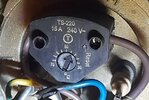
My old immersion heater thermostat. Tank-thermostat.jpg I is actually both a thermostat and cut-out, you can just read where it says Reset.

In the main, boiler and immersion have priority depending on the thermostat setting. Setting the immersion lower than the boiler setting, will mean it will only work when the boiler is not running.

Replacing the programmer with the Tado base, and turning the old thermostat up full, all will work. But better if the old thermostat is bridged out at the wiring centre, and it is removed.
 
I'll double check the immersion heater when I get home and confirm if it is manual or thermostatic. I was just curious how these systems avoid having the expensive immersion heater coming on, when the boiler is suitably providing hot water. If it's manual then it's a moot point I guess.
The immersion will have a built in thermostat set to 60c. The immersion should be connected to a switched fused spur and normally this is turned off.
 
So how does the immersion heater activate in conjunction with the hot water from the boiler? There is thermostat on the unvented cylinder. Does it just recognise when the water is not hot enough and come on?
I usually explain it in the concept of a living room that can be heated by a radiator connected to a boiler, and an electric fire installed in a fireplace. Both devices will be able to heat the same room but are totally independent of each other and have their own completely separate controls.

Likewise, the boiler and the immersion heater can heat the same cylinder full of hot water but are totally independent of each other.

I assumed the Honeywell system was controlling the immersion heater because as you can see from the attached photo, there is a "cyl stat" termination.
That connection is for the cylinder thermostat that will control the temperature of the hot water when it is being heated by the boiler.

In the picture below, the green square is the cylinder thermostat controlling the heating of the hot water by the boiler, and the red square is the immersion heater which has its own independent thermostat under the cover as per the picture posted above by @ericmark

5678.jpg
 
Many years ago, my daughter has a new house, and I in error advised she turned the thermostat for the DHW down to save money, what did happen was the immersion heated the water instead. Giving her a high electric bill.

Not an easy thing to work out, for years after that, I thought electric costs more than gas to heat DHW, likely it does when the central heating is running, but not when central heating is not running due to cost of heating a cold boiler, but amount of DHW used, and the pipe runs can also affect which is cheaper.

I do believe Tado is good, and now in summer is the time to change it. Loads of time to correct mistakes. But I have lived now in 4 centrally heated houses, and each one has changed my views as to how heating and DHW needs to be controlled, first was hot air, so really down to three, and one can hardly believe how different.

Two were rather old fashion houses, with doors down-stairs, one was open-plan, and with the open plan, all the TRV's did was stop bedrooms overheating, but with the homes with doors, there was a problem getting the boiler to run as and when required, and the problem still exists with this house.

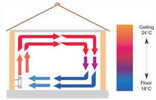
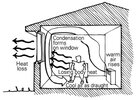
The problem is the height of the thermostatic control, we see pictures circulation.jpgcirculation2.jpgbut, most of the books were written before we had better quality double glazing, linked TRV heads, and condensing boilers which must, to work, modulate (able to turn down output) so many of the old ideas no longer work.

The main problem is, it is natural to answer questions based on one's own house. My experience setting lock shield valves, taught me there is no one method, in the two houses with doors, the settings are completely different. Likely as one uses micro bore and is oil fired, and the other 15 mm pipe work, and gas fired, but it means what works for me, may not work for you, so explaining why is important, not just a do this, because this is the way we have always done it.

The Worcester Bosch Greenstar installed in my mother's house, had no option for any ebus controls, but it seems latter versions did, however they had to use Worcester Bosch own wall thermostat, and did not connect to TRV heads, so were limited as to where they could be used. The installers were a load of cowboys, as they connected a power shower to a combi-boiler, and fitted an external by-pass valve when one already fitted in the boiler, they also removed all the hard-wiring to the wall thermostat, and fitted a non-programmable type, although to be fair, good quality.

Both mother's house and this house, what did become apparent was one wall thermostat did not work, wind direction, sun through windows, etc, mean the same room is not always the coldest, so in both cases we ended up with multi-wall thermostats in parallel. But the open-plan house worked fine with a single wall thermostat.

The idea of linked TRV heads, sounds good, but again in practice there are problems, when heating is running they work A1, but since radiators against the outside wall, tend to fire up the boiler when not really required.

I was lucky, as when wiring up the central heating, I had no thoughts about solar panels, but since all from the same FCU (fused connection unit) it was easy to all battery back up to the boiler. Also as a result of solar panels, my electric costs vary through the day, get paid 15p/kWh for export, so using solar power means not paid for it, so calculate at it costing 15p/kWh, off-peak is cheaper at 8.5p/kWh, and peak at 30.17p/kWh so the best option to heat water is a time clock so heated from 00:30 to 05:30, but I use an Iboost+ so uses solar as well, I made a mistake, but what it does mean, electric heating of DHW is for me cheaper to using oil. Other people may have a different system so that oil/gas is cheaper, but one has to consider what may happen in the future.

You can't find out what it cost in p/kWh for gas and oil, as the shorter the burn time, the higher the losses, so for one family gas/oil may be cheaper, and for another family in the same house, electric could be cheaper. But in real terms, once losses are considered, likely not much in the cost, at 12 kWh per week that I use, likely less than £2 per week, hardly worth worrying about.

Because I have the iboost+ I know what the electric costs, without it, I would be guessing.
 
Update: I don't think it's tado. I put the old programmer back, turned on for heating. Relay clicked in programmer, zone valve engaged but nothing from the boiler.

Now I'm truly lost :/


Hello gents. Finally had time to install the tado, or at least attempt it yesterday.
I followed the steps in the app precisely so I hope I've done everything right.

I had some success as initially heating worked and hot water too, but this evening hot water was not working.

When I tested it yesterday boiler fired and pumps were moving hot water around the system. Now when I try heating it hot water nothing seems to be working so not sure if my test yesterday was valid or just hot water from the cylinder was used.

I'm obviously going to have to put old programmer back in to at least get hot water working, or hopefully try and fix forward.

Any help appreciated.

Current state with tado.

Set hot water to permanently on. Relay in tado recover clicks, and boiler turns on. LED for flame illuminates, temperature displayed increases rapidly, but soon after flame led switches off. Not long after the boiler goes back into stand by.
Also no pipes in and out of boiler are warming up.

I tried to turn CH heating on, and where yesterday pump was kicking in and zone valves too, now I don't think the pump is doing anything (but light is on for it). I did hear the zone valve turn on/off though.

In case it's relevant, the pump (Grundfos ups3) is showing green, orange, orange, on 1,2,3. I think that's the pump curve setting and not necessarily a fault.

Before I put old Honeywell programmer back tomorrow, any steps to follow to see what the issue is?
There are obviously many components so trying to narrow down.

Thanks

p.s. Ironically, I don't think the immersion heater is working . There are two wires coming from the hot water cylinder, one to a fused spur and the other to the wiring centre. I turned on the fused spur thinking that should trigger the immersion heater, but the red light on the spur didn't come on. That's a problem for a different day but would have been useful
 
Last edited:
Just one final thing worth noting before I turn in, I noticed the Bianco zv22 motorised valves obviously click when the thermostat clicks and I think I can hear the valve turning but I noticed the valve is quite old and that the lever on the back moves slightly but is quite loose when I wiggle it.
It's basically half way between MAN and AUTO. I tried moving it slowly to AUTO but didn't notice a difference.

It would be a mighty coincidence if this valve failed at the same time I swapped to tado, but not impossible.

Ironically, the mess of wires and lack of labelling means I'm not certain how to turn on the immersion heater too ensure there is at least hot water tomorrow.

I'll post complete set of pictures in the morning for anyone that fancies telling me what's gone wrong and what to check, before I test with the old thermostat back in.
 
Last edited:

If you need to find a tradesperson to get your job done, please try our local search below, or if you are doing it yourself you can find suppliers local to you.

Select the supplier or trade you require, enter your location to begin your search.


Are you a trade or supplier? You can create your listing free at DIYnot Local

 
Back
Top