
Who needs a neutral?

I don't even think you'd get that, given the cold resistance of a lamp is lower than with it hot.
Then the rod resistance makes the maths too difficult to be bothered to do :lol:

It's possible that the inrush current for a filament lamp lasts for such a very small time that it wouldn't trouble the RCD otherwise we would have been fitting type D MCBs for all those banks of GLS lamps !
 
I did a job where a light had had N & E reversed at a hidden joint box. It was a TT supply with no RCD and the light was working fine.
As I said, that doesn't surprise me. Even without parallel paths to earth, a half-decent earth rod will probably allow at least 100W of incandescent lights without a seriously obvious reduction in brightness.

Kind Regards, John
 
It's possible that the inrush current for a filament lamp lasts for such a very small time that it wouldn't trouble the RCD otherwise we would have been fitting type D MCBs for all those banks of GLS lamps !
That seems fairly likely. As you say, it certainly seems to be the case with MCBs - although I'm sure we've all experienced MCB trips at the moment of lamp death (often at switch on), I've certainly never experienced (or heard of) it happening at 'normal switch on' (i.e. with no lamps dying), even when quite appreciable numbers of incandescents have been switched on simultaneously.

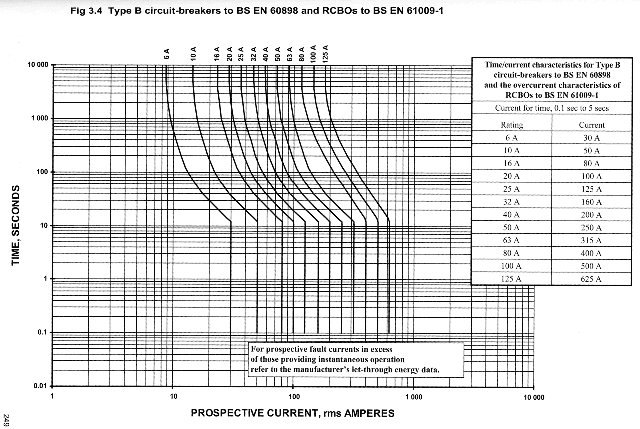
As I wrote recently, one thing that I (and I suspect most others) am ignorant about is the behaviour of both RCDs and MCBs in terms of the duration of overcurrent (or L/N imbalance) required to operate the device. One imagines that, as the duration gets increasingly (very) short, the magnitude of required overcurrent/imbalance for tripping will gradually increase, until one eventually reaches the point at which the duration is so short that no probable magnitude of current will trip the device. I presume that the manufacturers have such graphs, but I don't recall ever having seen any. ...and nor do I have any precise idea about the duration of the warm-up duration of a filament lamp.

Kind Regards, John
 
As I wrote recently, one thing that I (and I suspect most others) am ignorant about is the behaviour of both RCDs and MCBs in terms of the duration of overcurrent (or L/N imbalance) required to operate the device. One imagines that, as the duration gets increasingly (very) short, the magnitude of required overcurrent/imbalance for tripping will gradually increase, until one eventually reaches the point at which the duration is so short that no probable magnitude of current will trip the device. I presume that the manufacturers have such graphs, but I don't recall ever having seen any.

What, you mean like this?

640px-Curve-MCBTypeB.png
 
And experiment two right there :lol:
No point in even thinking of trying it with my TT system. Even if I remove the MPB (yes, I know :-) ), the Ze is still around 0.35Ω, presumably thanks to incidental parallel paths from CPCs to earth. The experiment would therefore prove nothing (other than that a 100W lamp lights to virtually full brightness when connected beween L & E with a very low Zs - OR maybe that 23-25mA is enough to trip one of my 30mA RCDs!)

Kind Regards, John
 
What, you mean like this?
No, not really - I'm sure we all have dreams about that graph :-)

In the present context, we're only interested in the magnetic tripping - i.e. the 'vertical' part of the curves at 5*In. The x-axis of that graph is for 'persistent' fault currents. The assumption is that, for very short duration fault currents, that would shift to the right.

What I was talking about was a graph of magnitude of fault current required for a magnetic trip to occur against the duration of that fault current.

Kind Regards, John
 
It's possible that the inrush current for a filament lamp lasts for such a very small time that it wouldn't trouble the RCD otherwise we would have been fitting type D MCBs for all those banks of GLS lamps !
That seems fairly likely. As you say, it certainly seems to be the case with MCBs - although I'm sure we've all experienced MCB trips at the moment of lamp death (often at switch on), I've certainly never experienced (or heard of) it happening at 'normal switch on' (i.e. with no lamps dying), even when quite appreciable numbers of incandescents have been switched on simultaneously.

It can and does happen with halogen lamps. I do a lot of work in theatres, and we do not normally fit B type circuit breakers as they are too easy to trip with a cold halogen lamp.

We have on occasion had to use D type circuit breakers to supply dimmers which have a quantity of halogen lamps connected to them.
 
It can and does happen with halogen lamps. I do a lot of work in theatres, and we do not normally fit B type circuit breakers as they are too easy to trip with a cold halogen lamp. We have on occasion had to use D type circuit breakers to supply dimmers which have a quantity of halogen lamps connected to them.
Fair enough. That makes sense, and I know even less about the warm-up behaviour of halogens than I do about GLS lamps!

Kind Regards, John
 

If you need to find a tradesperson to get your job done, please try our local search below, or if you are doing it yourself you can find suppliers local to you.

Select the supplier or trade you require, enter your location to begin your search.


Are you a trade or supplier? You can create your listing free at DIYnot Local

 
Back
Top