I'm not being funny or obtuse here, and I realise it would probably be impractical, but would it be illegal to replace the socket and plugs with US or German equivalents?
it certainly wouldn't comply with regs, as, as far as I'm aware, the german sockets are not shuttered as our sockets are, which is a requirement.
More importantly, you'd have an unfused socket with an unfused plug, both rated at 16A but supplied by a circuit protected by either a 30A fuse or 32A MCB.
It's come up before (in the context of having a 32A "commando" socket on an RFC), and the regs only allow 2.5mm cable protected by a 32A MCB in the specific situation of an RFC supplying only BS1363 accessories. Though to be pedantic, the regs also allow paralelling of cables under specific circumstances that wouldn't apply here.
And the fact that they need fusing, which opens up the possibility of people putting the wrong fuses in and creates more places where dodgy contacts can lead to overheating.
I'm sort of on the fence on that argument.
Yes, you can argue that having a fuse in the plug means someone can put the wrong size fuse in - but bear in mind that the largest they can possibly fit is 13A, short of using a bit of foil or 1/4" bolt.
On the other hand, it does mean we can have appliances with smaller cables which is often a serious consideration. For example, I have an old 15W soldering iron that is not much thicker in the handle than a decent bit of 16A cable ! Other examples that come to mind might be personal grooming tools - shavers, curling tongs, and the like where a heavy cable would really interfere with normal use. Put another way, if you omit the fuse, then you can never have any appliance with a cable not rated for 16A. I rather think that many appliances do in fact have smaller cables, which rather leads to the question - what is protecting it ?
You would think that, logically, all countries would eventually adopt this pattern, although I can't see that ever happening!
I can't either, because fused plugs would not be needed were it not for our craze for ring finals, and nobody else is going to introduce those. Logically it is we who should move to 16A radials and CEE 7/7 plugs & sockets.
And there have been "discussions" across Europe for decades on this very subject. The impression I get from reading between the lines is that every country takes the position of "great, we should have one standard across all of Europe - but obviously it should be ours as ours is better"

But since some countries (eg Italy) can't even get down to one standard plug ...
There is also the issue of handling larger loads. Take for example the kitchen at work. Here there are 2 double sockets (totally inadequate !) which are most likely in an RFC. They are almost exclusively used by larger loads - kettles, toasters, microwave. In principal, we could have loads going that would overload the circuit and trip the breaker, in practice one of the sockets is tied up with the fridges, leaving 3 sockets free to perm any 3 out of 3 kettles, two toasters, and a microwave. To handle that with 16A unfused plugs would require 4 radial circuits and 4 MCBs in the distribution board - it wouldn't be acceptable to have two 16A sockets on one 16A MCB as it would be too easy to overload the circuit and trip the breaker - nuisance tripping, bad design, etc, etc. The only alternative would be to have individually fused sockets - and then we're back to fused connections, although the fuse is in the socket instead of the plug (all the drawbacks )can fit the wrong fuse/bit of bolt) and none of the benefits (can't use thinner cable on low wattage appliances)).
I would have to agree with those who point out that our BS1363 plug is far from ideal - especially in terms of it being over sized for small loads, especially where an earth isn't used.
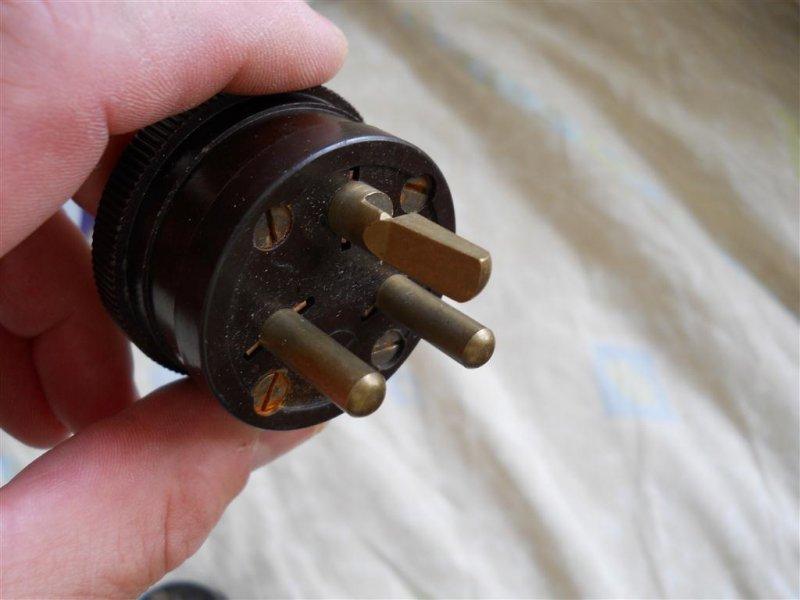
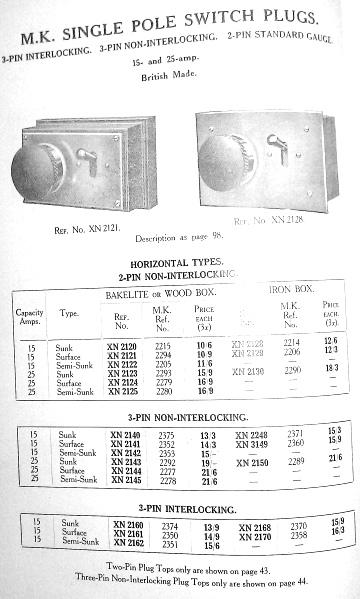
http://www.fam-oud.nl/~plugsocket/DormanSmith1.html
Ahh, the good old D&S plug. I recall that when I started as an apprentice in teh shipyard, that was almost all that was used internally. It was said that they kept using them as they weren't used elsewhere and so there was no point nicking the plugs.
On the other hand, it was also said that there were few houses in the town that didn't have D&S sockets so they could use plugs nicked from the yard