Are recessed power sockets available in the UK

The Wiki article states that the old BS546 plug is still permitted in the UK.
If they are shuttered.


Certainly, our current 3-pin plugs and sockets seem to be the best in the world with the one drawback (to me at least) that they are sometimes more difficult to insert and remove from the socket.
And the drawback of the design of where the cable enters the plug leads to them lying pins-up, which causes injury if you tread on them and prevents outlets from being shrouded, which would be a useful safety feature.

And the fact that they need fusing, which opens up the possibility of people putting the wrong fuses in and creates more places where dodgy contacts can lead to overheating.


You would think that, logically, all countries would eventually adopt this pattern, although I can't see that ever happening!
I can't either, because fused plugs would not be needed were it not for our craze for ring finals, and nobody else is going to introduce those. Logically it is we who should move to 16A radials and CEE 7/7 plugs & sockets.


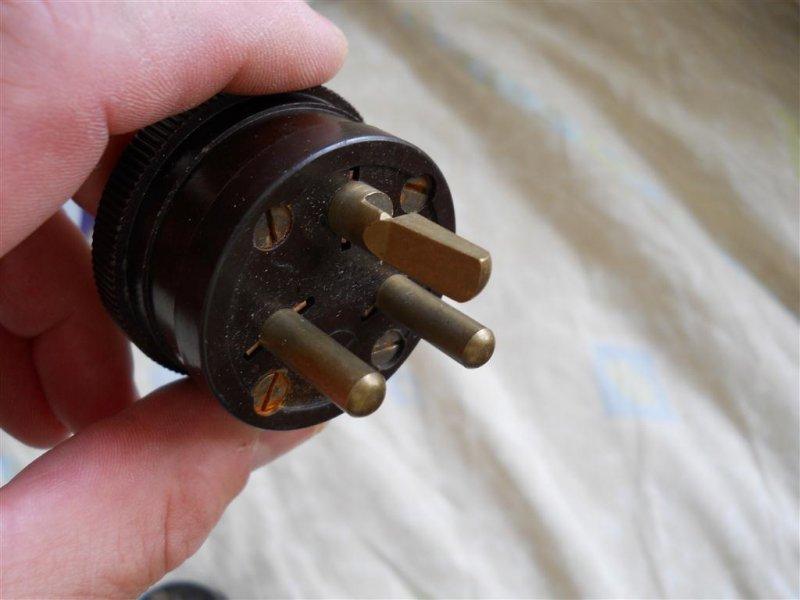
Does anyone have any idea what these could have been?
http://www.fam-oud.nl/~plugsocket/DormanSmith1.html
 
Thanks BAS. These are the nearest I've seen, but not quite the same. The earth pins had a more defined wedge, becoming much narrower at the end. Also, there was definitely a cut-out on the earth pin for a retaining flange, and I don't remember the line pin being in the form of a fuse. The switch on our sockets was also much longer, being circular and made of bakelite, and screwed on to a threaded brass pin. Still, I suppose there would have been a number of variations.

Just out of interest, what's wrong with ring-main circuits? Also, if we had only 16A radials, wouldn't it be possible to plug in items that need fusing down to, say, 3A?
 
Just out of interest, what's wrong with ring-main circuits?
They can fail in ways which are undetectable in normal use but make them immediately dangerous, and they are so easily made dangerous by modifications done by unskilled people.


Also, if we had only 16A radials, wouldn't it be possible to plug in items that need fusing down to, say, 3A?
There should be no such thing. Plug fuses are there to protect the cable to the appliance, nothing else.
 
I'm not being funny or obtuse here, and I realise it would probably be impractical, but would it be illegal to replace the socket and plugs with US or German equivalents?
it certainly wouldn't comply with regs, as, as far as I'm aware, the german sockets are not shuttered as our sockets are, which is a requirement.
More importantly, you'd have an unfused socket with an unfused plug, both rated at 16A but supplied by a circuit protected by either a 30A fuse or 32A MCB.

It's come up before (in the context of having a 32A "commando" socket on an RFC), and the regs only allow 2.5mm cable protected by a 32A MCB in the specific situation of an RFC supplying only BS1363 accessories. Though to be pedantic, the regs also allow paralelling of cables under specific circumstances that wouldn't apply here.


And the fact that they need fusing, which opens up the possibility of people putting the wrong fuses in and creates more places where dodgy contacts can lead to overheating.
I'm sort of on the fence on that argument.
Yes, you can argue that having a fuse in the plug means someone can put the wrong size fuse in - but bear in mind that the largest they can possibly fit is 13A, short of using a bit of foil or 1/4" bolt.
On the other hand, it does mean we can have appliances with smaller cables which is often a serious consideration. For example, I have an old 15W soldering iron that is not much thicker in the handle than a decent bit of 16A cable ! Other examples that come to mind might be personal grooming tools - shavers, curling tongs, and the like where a heavy cable would really interfere with normal use. Put another way, if you omit the fuse, then you can never have any appliance with a cable not rated for 16A. I rather think that many appliances do in fact have smaller cables, which rather leads to the question - what is protecting it ?

You would think that, logically, all countries would eventually adopt this pattern, although I can't see that ever happening!
I can't either, because fused plugs would not be needed were it not for our craze for ring finals, and nobody else is going to introduce those. Logically it is we who should move to 16A radials and CEE 7/7 plugs & sockets.
And there have been "discussions" across Europe for decades on this very subject. The impression I get from reading between the lines is that every country takes the position of "great, we should have one standard across all of Europe - but obviously it should be ours as ours is better" :roll:
But since some countries (eg Italy) can't even get down to one standard plug ...

There is also the issue of handling larger loads. Take for example the kitchen at work. Here there are 2 double sockets (totally inadequate !) which are most likely in an RFC. They are almost exclusively used by larger loads - kettles, toasters, microwave. In principal, we could have loads going that would overload the circuit and trip the breaker, in practice one of the sockets is tied up with the fridges, leaving 3 sockets free to perm any 3 out of 3 kettles, two toasters, and a microwave. To handle that with 16A unfused plugs would require 4 radial circuits and 4 MCBs in the distribution board - it wouldn't be acceptable to have two 16A sockets on one 16A MCB as it would be too easy to overload the circuit and trip the breaker - nuisance tripping, bad design, etc, etc. The only alternative would be to have individually fused sockets - and then we're back to fused connections, although the fuse is in the socket instead of the plug (all the drawbacks )can fit the wrong fuse/bit of bolt) and none of the benefits (can't use thinner cable on low wattage appliances)).

I would have to agree with those who point out that our BS1363 plug is far from ideal - especially in terms of it being over sized for small loads, especially where an earth isn't used.

http://www.fam-oud.nl/~plugsocket/DormanSmith1.html
Ahh, the good old D&S plug. I recall that when I started as an apprentice in teh shipyard, that was almost all that was used internally. It was said that they kept using them as they weren't used elsewhere and so there was no point nicking the plugs.

On the other hand, it was also said that there were few houses in the town that didn't have D&S sockets so they could use plugs nicked from the yard :roll:

 
And there have been "discussions" across Europe for decades on this very subject. The impression I get from reading between the lines is that every country takes the position of "great, we should have one standard across all of Europe - but obviously it should be ours as ours is better" :roll:
The impression I get is that europe has pretty much standadised on CEE 7/7 plugs* for earthed appliances and that we were one of the few holdouts (switzerland being another)

But since some countries (eg Italy) can't even get down to one standard plug ...
Afaict italy is still a horrible mess sockets wise but afaict they allow sale of equipment with CEE 7/7 plugs and they have hybrid sockets available.

* Which can be used with both french and german style sockets.
 
Ring Finals have their uses as do radials.
They both have their relative drawbacks too.
Rings are tried and tested.
However, if we had never had rings till now then I`m certain no one would advocate them today.

You can see why the continentals don't like them.

Mind you they would not accept our good old Red/Yellow/Blue with Black as N.
Now we've capitulated and accepted the Killer colours they , apparently, admit RYB was better then Brown/Black/Grey (I have not found anyone who likes them)
 
And there have been "discussions" across Europe for decades on this very subject. The impression I get from reading between the lines is that every country takes the position of "great, we should have one standard across all of Europe - but obviously it should be ours as ours is better" :roll:
The impression I get is that europe has pretty much standadised on CEE 7/7 plugs* for earthed appliances and that we were one of the few holdouts (switzerland being another)
But that doesn't mean there is actually one standard for sockets. The French and German sockets (as specified in their national standards) are different - the CEE7/7 is a plug designed to work around the differences. In other situations, the requirement to have some form of multi-function device to accommodate multiple differing <somethings> tends to be called a bodge. It sounds very much like some manufacturer (or group thereof) simply looked at the problem, came up with a bodge to reduce their stockholding requirements, and it became a de-facto standard which later became written down as a CEE standard.

And lets face it, the CEE7/7 plug is barely smaller than our 13A plug, requires more room between the wall and furniture to allow for it's cable, and by being unfused mandates that no appliance (no matter how low it's power requirements) can have a suitable small flex*. In addition, with these unfused connections, you severely limit the power of devices you can plug in and/or require vastly increase the amount of cabling required and ways in the distribution board.

* Unless we turn round and say all our thinking on fusing to the size of cable is wrong.
 
The impression I get from reading between the lines is that every country takes the position of "great, we should have one standard across all of Europe - but obviously it should be ours as ours is better" :roll:

Of course, WE know that OUR standards are the best! As someone said earlier, our plugs and sockets are 'the ONLY ones that tick all four boxes'.

Obviously, despite all the attempts by Brussels to force us into complying with the many rules they impose upon us (whether we want them or not), Europe is no nearer to being unified with respect to electrical power supply systems and many other things for that matter, and I don't think they ever will be.

I believe we should stop pandering to the wishes of other countries and revert to our 3-phase red, yellow, blue, and our domestic red, black and green. What on earth was wrong with them? Easily identifiable and everyone knew where they were.

Also, if we reverted to radial circuits, wouldn't we end up needing to have different sized sockets for different amperages, as before, along with separate MCBs/fuses rated for each type of socket? I'd much prefer things as they are and, as for putting the wrong fuse into a plug, appliances state which fuse-type they require and fuses are clearly marked by number and colour. I think someone would have to be pretty thick or downright obtuse to put the wrong one in.

Then again....!
 
and by being unfused mandates that no appliance (no matter how low it's power requirements) can have a suitable small flex*. In addition, with these unfused connections, you severely limit the power of devices you can plug in and/or require vastly increase the amount of cabling required and ways in the distribution board.

* Unless we turn round and say all our thinking on fusing to the size of cable is wrong.
I'm not sure I understand your meaning.

If fuses are not related to the size of the cable - to what, then?
 
Thanks BAS. These are the nearest I've seen, but not quite the same. The earth pins had a more defined wedge, becoming much narrower at the end. Also, there was definitely a cut-out on the earth pin for a retaining flange, and I don't remember the line pin being in the form of a fuse. The switch on our sockets was also much longer, being circular and made of bakelite, and screwed on to a threaded brass pin. Still, I suppose there would have been a number of variations.

I've been searching all over the internet (I'm like a dog with a bone).

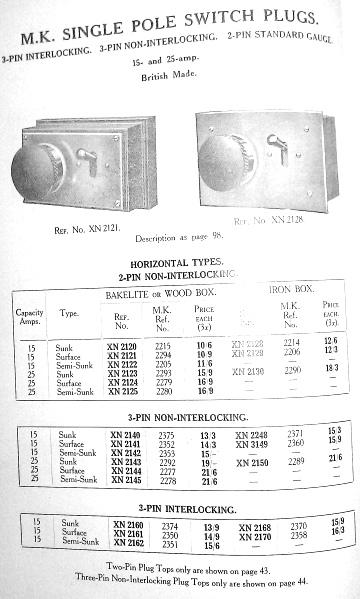
This is the one:
and this, I think, is how it looked externally:
Any idea of vintage? I'd say almost certainly pre-war and, at a guess, suggest they may have been designed for DC because of the safety feature to prevent pulling the plug when turned on.
 
* Unless we turn round and say all our thinking on fusing to the size of cable is wrong.
Note that BS1363 does not require the fuse rating to be lower than the rating of the flex. For 0.5mm flex it says a 3A fuse should be used unless this poses a problem with inrush currents in which case a 5A fuse should be used. For all other flex sizes it lists it says a 13A fuse is fine.

In the rest of europe they seem perfectly happy to put 0.5mm flex on unfused plugs.
 
As long as a B16 provides adequate fault protection for the flex, where's the problem?
 
Any idea of vintage? I'd say almost certainly pre-war and, at a guess, suggest they may have been designed for DC because of the safety feature to prevent pulling the plug when turned on.

I've never seen one of them in all my career! Looking at the design and materials I think its likely to be from between 1920 and 1940 ish, but it is very unusual as BS 546 would have been the standard plug / socket by this time.
 
Any idea of vintage? I'd say almost certainly pre-war and, at a guess, suggest they may have been designed for DC because of the safety feature to prevent pulling the plug when turned on.

I've never seen one of them in all my career! Looking at the design and materials I think its likely to be from between 1920 and 1940 ish, but it is very unusual as BS 546 would have been the standard plug / socket by this time.
 
Any idea of vintage? I'd say almost certainly pre-war and, at a guess, suggest they may have been designed for DC because of the safety feature to prevent pulling the plug when turned on.

I've never seen one of them in all my career! Looking at the design and materials I think its likely to be from between 1920 and 1940 ish, but it is very unusual as BS 546 would have been the standard plug / socket by this time.
 

If you need to find a tradesperson to get your job done, please try our local search below, or if you are doing it yourself you can find suppliers local to you.

Select the supplier or trade you require, enter your location to begin your search.


Are you a trade or supplier? You can create your listing free at DIYnot Local

 
Back
Top