Reasoning is sound but what is your point?I still struggle to get my head around the benefits of biomass and end up going back and forth. I would really appreciate a proper discussion. This is a simplified model I started thinking about this afternoon. I have been panned by several posters including @Brigadier and @noseall for questioning the benefits of biomass. So, I would be interested in contributions from all sides.
I have read that a newly planted oak tree takes one hundred years to reach its full carbon sequestrating ability. So, let's assume that over those first hundred years it averages 50% of its ability. Which means that, in those first hundred years, a new oak tree will only absorb fifty years worth of carbon.
If we look at a single healthy oak tree in a forest in Canada. It is 200 years old. For the first hundred years of its life it absorbed fifty years worth of carbon. And in the second half of its life it absorbed the full hundred. So, it has 150 years worth of carbon stored.
We then cut it down and burn it at Drax. This releases 150 years worth of stored carbon into the atmosphere.
If a new oak tree is planted to replace it, then it will slowly start to grow and begin absorbing carbon. After 100 years, it will have absorbed 50 years worth of carbon from the atmosphere.
But when we burnt the tree in the first place, we released 150 years worth of carbon. And if we had left the tree alone, by this point, it would have absorbed another 100 years worth of carbon.
So, it seems to me that by cutting the tree down and burning it, at a point 100 years later, we have increased the amount of CO2 in the atmosphere by 250 years worth. And the new tree has only reduced that by 50 years worth. That means overall there is an increase of 200 years worth of carbon in the atmosphere from the burning of this healthy mature tree.
Does my reasoning appear sound?

You are using an out of date browser. It may not display this or other websites correctly.
You should upgrade or use an alternative browser.
You should upgrade or use an alternative browser.
Climate Change
- Thread starter Highway Man
- Start date

No - there is a theory that oil is abiotic and constantly produced by the earth itself - no dinosaur’s were harmed in its making.Millions of years I would guess.
It is process deep within the crust and seeps up through fissures similar to magma and then gets trapped and "pools up" Oil will not run out but if we use it too fast then the earth wont be able to keep up with the replenishment of it.
Reasoning is sound but what is your point?
I am trying to understand to what extent wood pellet biomass from virgin forests is carbon neutral in the short, medium and long term.
No - there is a theory that oil is abiotic and constantly produced by the earth itself - no dinosaur’s were harmed in its making.
It is process deep within the crust and seeps up through fissures similar to magma and then gets trapped and "pools up" Oil will not run out but if we use it too fast then the earth wont be able to keep up with the replenishment of it.
I had not heard of that.
The theory has been around for at last 100s of yearsI had not heard of that.
Last edited:

- Joined
- 17 Aug 2010
- Messages
- 5,058
- Reaction score
- 2,100
- Country

total and utter nonsense - oil was formed from organic life, plankton and algae (and dead fish) , the seas needed to dry out, and cover the reamains of this decaying organic life (thats why when exploring for oil, a promising sign is finding salt deposits, because it may be under that)The theory has been around for at last 100 years
the process takes about 200 million years - which is an unimaginable period of time
Tell that to Nasa who have found oil on titan and other planetstotal and utter nonsense - oil was formed from organic life, plankton and algae (and dead fish) , the seas needed to dry out, and cover the reamains of this decaying organic life (thats why when exploring for oil, a promising sign is finding salt deposits, because it may be under that)
the process takes about 200 million years - which is an unimaginable period of time
- Joined
- 17 Aug 2010
- Messages
- 5,058
- Reaction score
- 2,100
- Country
that is an entirely different type of oil (if it is an oil as we know oil) to what we have here on earth - if there was enough methane in our atmosphere to make that sort of hydrocarbon, we would all be deadTell that to Nasa who have found oil on titan and other planets
that is an entirely different type of oil (if it is an oil as we know oil) to what we have here on earth - if there was enough methane in our atmosphere to make that sort of hydrocarbon, we would all be dead
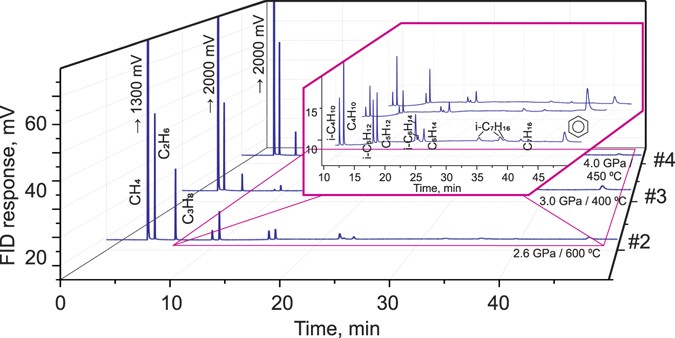
The lower pT limit of deep hydrocarbon synthesis by CaCO3 aqueous reduction - Scientific Reports
The deep abiogenic synthesis of hydrocarbons is possible under the conditions of the asthenosphere. We have found that this process can also occur under the mineral and thermobaric conditions of subducting slabs. We have investigated the abiogenic synthesis of hydrocarbon systems at pressures of...
 www.nature.com

Titan's Surface Organics Surpass Oil Reserves on Earth - NASA Science
Titan's Surface Organics Surpass Oil Reserves on Earth
 science.nasa.gov

- Joined
- 30 May 2022
- Messages
- 1,546
- Reaction score
- 1,083
- Country
I was reading an article a few days ago where the 97% of scientists who know which side their bread is buttered, now believe that the earths natural wobble is being exaggerated because water covering some land masses is drying up due to climate change.
Like when a car wheel isn't balanced properly if a weight is removed, the whole thing goes out of equilibrium.
Like when a car wheel isn't balanced properly if a weight is removed, the whole thing goes out of equilibrium.
Apart from what you writing being utter drivel in the first place, it also makes no sense.
Meaning that your statement
Cannot logically follow (not in any timescale that is worth a dry toss, anyway).
Honestly, reality is far more interesting than any of the made - up 'oss shoite that you gorge on.
if we use it too fast then the earth wont be able to keep up with the replenishment of it.
Meaning that your statement
Oil will not run out
Cannot logically follow (not in any timescale that is worth a dry toss, anyway).
Honestly, reality is far more interesting than any of the made - up 'oss shoite that you gorge on.
I was reading an article a few days ago where the 97% of scientists who know which side their bread is buttered, now believe that the earths natural wobble is being exaggerated because water covering some land masses is drying up due to climate change.
Like when a car wheel isn't balanced properly if a weight is removed, the whole thing goes out of equilibrium.
If the mass of water on the Earth was not so triflingly insignificant, your tyre analogy would have the running over of an ant shaking the steering wheel out of your hands.
Its not his analogy though - its the latest climate rubbish.If the mass of water on the Earth was not so triflingly insignificant, your tyre analogy would have the running over of an ant shaking the steering wheel out of your hands.
Its not his analogy though - its the latest climate rubbish.
My point was that, of all the effects we should be concerned about, an effectively immeasurable effect ain't one of them.
Its not his analogy though - its the latest climate rubbish.
The analogy is massively exaggerated. It is not really a wobble. But the story itself is interesting. Apparently, in the past couple of decades, enormous amounts of water have moved from the land to the oceans and this has caused a tiny shift in the earth's axis.


