• Looking for a smarter way to manage your heating this winter? We’ve been testing the new Aqara Radiator Thermostat W600 to see how quiet, accurate and easy it is to use around the home. Click here read our review.

Do I need an Earth Rod Fitted?

I've still got a bonding connection on my gas pipe
For the pipe inside the property yes needs bonding, but outside the property there should be an isolating block, so the PME earth does not connect to any substantial amount of gas pipe which is in the ground, as there is a limit to how much current can go through the metal gas pipe before it ruptures, and there have been fires due to the PME earth being connected to the wrong side of the isolation block.
 
I was just concerned that if my earth now relies on the neutral conductor in places I might be at risk if that conductor broke.
Yes,but as I said,your TN-S earth had always been reliant on the cable sheath (which, as you say,will have gradually been rotting), so I don't see that your new situation should be any worse than it has always been, should it?
 
Well yes, possibly, in a TN-S system with random bits of TN-C-S, and properties with incoming metal parts bonded to earth. (Although I was unaware that the "M" in PME didn't actually mean "multiple") because there's a big difference between what happens if N ls lost in a TN-S system compared to what happens in TN-C-S.
 
Well yes, possibly, in a TN-S system with random bits of TN-C-S, and properties with incoming metal parts bonded to earth. (Although I was unaware that the "M" in PME didn't actually mean "multiple") ...
So was I (unaware) - as I said,I had always assumed that the "M" meant 'several', if not 'Many' - until westie told us that the M was often only 1 (in addition to the one at the transformer).
because there's a big difference between what happens if N ls lost in a TN-S system compared to what happens in TN-C-S.
True - but I was thinking/talking about the risk' of your installation not having any earth (which is now no greater {probably less} than it ever has been), rather than the other possible consequences of a CNE fault in a distribution cable.
 
until westie told us
Oh, we miss him, he was a fountain of information, was sad to hear he had died.

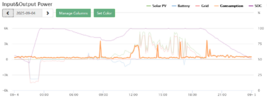
I was surprised to see how little electric we use. 1757066218828.png With 50 volt as the limit, so 50/13 = 3.8 Ω, to ensure under normal use the broken PEN voltage does not go out of range, but most earth rods will be more like 60 Ω, so once drawing 1 amp we would be out of range, so what is the point?
 
but most earth rods will be more like 60 Ω, so once drawing 1 amp we would be out of range, so what is the point?
As discussed in Post #26,
the purpose of a local "Earthing Electrode" (Earth Rod) is to provide low IMPEADANCE System Earthing,
to "Earth" voltage surges - mostly caused by "lightning events".
It is not to provide a low RESISTANCE (fault) current path - back to the Source of supply - which is done on the Protective Earth conductor,
connected to the earthed Neutral at one point.

With a TN-C-S system, the Earthing Electrode connections to the Neutral does produce a Protective Multiple Earth (PME) system
since the Neutral is connected to an Earthing Electrode at each premises
and often at many of the supply "poles".

In Australia, this called a Multiple Earthed Neutral (MEN) system
and
in North America, it is called a Multiply Grounded Neutral (MGN) system.
 
the purpose of a local "Earthing Electrode" (Earth Rod) is to provide low IMPEADANCE System Earthing, to "Earth" voltage surges - mostly caused by "lightning events".
I don't really understand how a local earthing electrode helps in relation to 'voltage surges'. Perhaps you could explain?
It is not to provide a low RESISTANCE (fault) current path - back to the Source of supply - which is done on the Protective Earth conductor,
connected to the earthed Neutral at one point.
If, like me, one has a TT installation, apart from any incidental paths to dearth which may (but not necessarily) be present, the only 'earth' (alternative path back to neutral of transformer),albeit of relatively high impedance and resistance.

[ I don't really understand why people talk about resistance, rather than impedance, of earth electrodes, even those they will be very similar (at 50 Hz) - it is impedance which matters and, if one measures it, one usually (always?) measures using AC ]
With a TN-C-S system, the Earthing Electrode connections to the Neutral does produce a Protective Multiple Earth (PME) system
Maybe that's acceptable in your country (and maybe some other countries), but my understanding is that in the UK one can only have TN-C-S (i.e.installation 'earth' derived from the N) if the distribution cable itself has 'multiple' earths (albeit M=2 is apparently acceptable!) - i.e.one cannot count consumer's local earth electrodes as contributing to the 'M' of PME.
 
See Post #26
Are you suggesting that I need to watch (potentially all of) a 73-minute video to get a response to the simple comment/question I posted? If so, whilst I will look at kt if I ever have time, I certainly don't at present have the time, and may never have it!

In the meantime, is it not possible for you (or someone) to give me a clue, in a sentence or three, as to how having a local earth electrode might help in terms of 'voltage surges' - which you seem to have have suggested is "the purpose" of having a local earth electrode?
 
Are you suggesting that I need to watch (potentially all of) a 73-minute video to get a response to the simple comment/question I posted?
You could do worse!

However, in that Post I did write:-
"These are discussed in this video, starting at 21:00
and the reasons for System Grounding are discussed starting at 23:00.

Note that at (at 27:00) he states
"The (System) Grounding Electrode conductors shouldn't be any longer than necessary and unnecessary bends and loops should be avoided"
- to ensure minimum IMPEDANCE.

Also note that (at 31:30) with an "outbuilding",
an additional Grounding Electrode (not there connected to the Neutral) is required
so that the System Grounding electrical conductor is as short as possible and, hence, of low impedance."

which is only about 12 minutes!

In the meantime, is it not possible for you (or someone) to give me a clue, in a sentence or three, as to how having a local earth electrode might help in terms of 'voltage surges' - which you seem to have have suggested is "the purpose" of having a local earth electrode?
This is contained in the Video between 25:45 and 38:30.
Can you afford the 3 minutes (or so) involved to watch that much?
 
.... and the reasons for System Grounding are discussed starting at 23:00.
Note that at (at 27:00) he states
"The (System) Grounding Electrode conductors shouldn't be any longer than necessary and unnecessary bends and loops should be avoided"
- to ensure minimum IMPEDANCE.
OK, but that seems to be referring to a lightning protection system, not necessarily anything to do with an electrical installation.

Do you not have TT electrical installations (in which the local earth electrode may be the installation's only 'earth') in your country?
.... This is contained in the Video between 25:45 and 38:30. ... Can you afford the 3 minutes (or so) involved to watch that much?
Indeed I can - 3 minutes is very different from 73 minutes, but you did not previously give me that guidance! However, as above, I suspect that I may find myself listening to material about lightning protection systems, not the 'earthing' of an electrical installation.

 
OK, but that seems to be referring to a lightning protection system, not necessarily anything to do with an electrical installation.

Do you not have TT electrical installations (in which the local earth electrode may be the installation's only 'earth') in your country?

Indeed I can - 3 minutes is very different from 73 minutes, but you did not previously give me that guidance! However, as above, I suspect that I may find myself listening to material about lightning protection systems, not the 'earthing' of an electrical installation.
Although the quoted times actually indicate thirteen minutes, and not merely three.
 
OK, but that seems to be referring to a lightning protection system, not necessarily anything to do with an electrical installation.
It is specifically stated (elsewhere in the video that this is not protection against a Lightning STRIKE.
It is a protection against the "discharge" caused by a lightning "Event" in the area.
Do you not have TT electrical installations (in which the local earth electrode may be the installation's only 'earth') in your country?
As far as I am aware : - NO.
Virtually all Domestic/Commercial installations are TN-C-S
 
It is specifically stated (elsewhere in the video that this is not protection against a Lightning STRIKE.
I didn't ever suggest that it was.
As far as I am aware : - NO. .... Virtually all Domestic/Commercial installations are TN-C-S
In that case, it seems that you've probably been making comments which are not relevant to UK, and which may well confuse people in the UK. To suggest/imply (to readers in the UK) that the only purpose of a local earth electrode in a TT installation is to offer some protection against 'voltage surges/spikes', is really pretty misleading - since it could be taken to imply that there would be no true safety (to human beings) concerns if an installation had no 'earth' at all.

I think that TN-C-S has been around for less than 50 years in UK, I think starting to be implemented significantly in late 1970s and early 1980s. Prior to that, all installations were either TN-S or TT, and a substantial proportion of those (like my TT installation) have not been 'updated' to TN-C-S as of today.
 

If you need to find a tradesperson to get your job done, please try our local search below, or if you are doing it yourself you can find suppliers local to you.

Select the supplier or trade you require, enter your location to begin your search.


Are you a trade or supplier? You can create your listing free at DIYnot Local

 
Back
Top