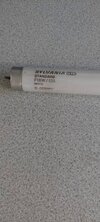
Flourescent tube for kitchen lighting.

Joined
6 Feb 2012
Messages
105
Reaction score
9
Country
United Kingdom
Replaced the below tube with

1 x LAP G13 T8 LED Tube 1350lm 9W 604mm (2') (327HA)

From Screwfix.

The replacement came with a starter for which the fitting doesn't look to have a home for.

Having installed the tube it only lights to half power and flickers on and off full power.

Looks like we bought the wrong tube despite our research saying it was the correct bulb.

Anyone know the correct tube to buy?

Thanks in advance.

Danny.
 

Attachments

  • sylvania.jpg
    sylvania.jpg
    43.1 KB · Views: 9
You bought a led tube. Has Loads of LED lights inside. That won't work although you can buy bulbs and some bits to convert light but not worth it.
You need the older gas filled tube that's started to be discontinued.

Is it just the old style £4 ISH fluoresce tube?
2 foot tube?
 
You have to match and setup correctly and from memory there’s differences in them

They are another electrical gadgetry that manufacturers keep pumping out

Best option is usually new led fitting
 
You have to match and setup correctly and from memory there’s differences in them ... They are another electrical gadgetry that manufacturers keep pumping out
Alltrue.
Best option is usually new led fitting
Perhaps 'best' in terms of simplicity, but not in terms of cost or 'the environment'.

We have been increasingly living with a 'throw away culture', which the environment is not too keen about!
 
I've just looked at B&Q. Screwfix and Toolstation website and a T8 fluorescent tubes are not available. So discontinued by looks of it.
 
What you bought is probably for magnetic ballast and starter type fitting

I think new starter and one end of new lamp are solid links to provide 230v at one end to power new led lamp

Think the electronic ballast type fitting you probably have needs the internals ripping out to manually supply the 230v

If so I wouldn’t do any more risk of short circuit if you get it wrong
 
Last edited:
Fluorescent tubes have been banned. (Despite being energy-efficient).

Fittings without "starters" have electronic ballasts that need removal/by-passing to work with some rewiring of the fitting.
Fittings with "starters" use magnetic inductor ballasts that can remain in situ with the supplied starter-replacement fuse unit.

Was there not a full instruction leaflet supplied with the tube detailing this and how to do it?

(Apparently there are two types of LED replacements... L & N at one end of the tube and L & N at opposite ends. So not necessarily straightforward to know which is which. :eek: )

Google also suggests that using on an electronic ballast might damage the LED tube... too late for this warning though!
 
Ya he has T8 and electronic ballast by the look of it so not compatible as is

Now that you mention it I think there was a few setups with these gadgets
 
Last edited:
LED tube wiring 2.png
Basic wiring above. With the starter as below, but starter is only a fuse, not really required.
LED tube wiring.jpg
In the main LED replacement tubes for fluorescent lamps only work with magnetic ballasts, exception is some 2D fittings, so there are versions that will work, but rare.
 
One of issues with them was old or dirty covers in sheds especially

Even with a clean you’re still losing light compared to new fittings
 
The main problem with fluorescent lights was the tight voltage range. Over the years we have seen voltage optimisers come and go to try and adjust the voltage.

I was working on the building of Sizewell 'B' and we had a ring of tunnels to put temporary lighting in. So the boss got some 110 volt 58 watt fluorescent fittings, and we did a quick calculation. Around ½ an amp each, 16 amp supply, so should power 32, but to be on safe side, we went with 25 on each string.

It tripped the MCB after ½ an hour, so we went to investigate, clamp-on ammeter was showing 20 amps, no wonder it tripped.

So next was some workshop tests, the units were really 230 volts, and it used an auto transformer to step up the supply voltage, this was marked 127-0-110 so we moved the input from 110 to 127 on the first 20 in the string, and this cured the problem.

The current dropped from 0.8 amps to 0.6 amps, so total dropped from 20 amps to 15 amps, and at 230 volts this is what the voltage optimiser did.

But then we moved from magnetic ballast to electronic. This adjusted for volt drop, and set the voltage just right, so a 58 watt tube was now using 56 watt, and it also improved the output and how long the tubes lasted, so with the same tube, the lumen per watt jumped from around 75-80 to 95-100 which when LED first came out, they could not equal. We were seeing LED lamps between 60 and 120 lumen per watt, the main problem was the way we had wired our homes.

AC can transfer using capacitive and inductive linking, so a DC lamps for a caravan could be 110 lumens per watt, but the AC lamp would flash unless some power is allowed to drain without lighting the lamp. So this anti-flash leakage is the same for a 2 watt or a 20 watt lamp, so the higher the wattage the better the lumens per watt. So a 22 watt LED fluorescent tube replacement can give 110 lumens per watt, where the fluorescent was only 100 lumens per watt. If the ballast is removed, otherwise the ballast uses some power, so the LED is only 95 lumens per watt.

But the LED has to allow for this waste of energy, so instead of 58 watt rated and around 5500 lumens, they are 22 watt and 2200 lumens. With the ballast 25 watt and 2200 lumens.

But, one often we used 58 watt fluorescent lamps to get the spread of light, and we did not need the 5500 lumens and can get away with 2200 lumens.

And to use a fluorescent fitting, with a LED lamp, means easy to replace the lamp when it fails. Oh, and with an electronic ballast LED and Fluorescent tubes last about the same time.

Designing a LED tube with a switch mode power supply built in so it can run between 130 and 250 volts is easy enough, but to design one to work on the output of another switch mode power supply, at kHz, is not so easy, so the electronic ballast has to be removed.

 
Even with a magnetic ballast, taking the ballast out makes the lamp more efficient
To convert his fitting then you would remove electronic ballast and wire the ends in series

Either way lamp is fitted there’s no short circuit

Is the starter actually a fuse or a solid link

If it’s a fuse it’s going to be required which means you can’t safely convert it there
 

If you need to find a tradesperson to get your job done, please try our local search below, or if you are doing it yourself you can find suppliers local to you.

Select the supplier or trade you require, enter your location to begin your search.


Are you a trade or supplier? You can create your listing free at DIYnot Local

 
Back
Top