5 amp socket on a 6 amp circuit

Joined
31 Mar 2006
Messages
20,030
Reaction score
1,396
Location
Leeds
Country
United Kingdom
Slightly strange question.

I've got some 5A sockets to install in a theatre. Each socket will be on it's own dedicated circuit, but here's the problem.

As 5A circuit breakers are not readily availible these days, I'm going to have to use either a 6A circuit breaker (preferred) or a 5A cartridge fuse (not ideal)

The socket will often be running at the full 5A, and there is the possiblility to overload it.

What do people think to this?
 
Not sure if they are still about, but Klik wall sockets are 6amp and fit on architrave boxes, I used them in my conservatory
 
Because it's in a theatre. The dimmers have 5A sockets on them. There are lots of 5A plugs which plug into the dimmers to distribute power to where ever it is required in the building.

They are wanting some non-dimmed sockets to allow other pieces of equipment such as discharge lighting to be plugged into the same sockets.

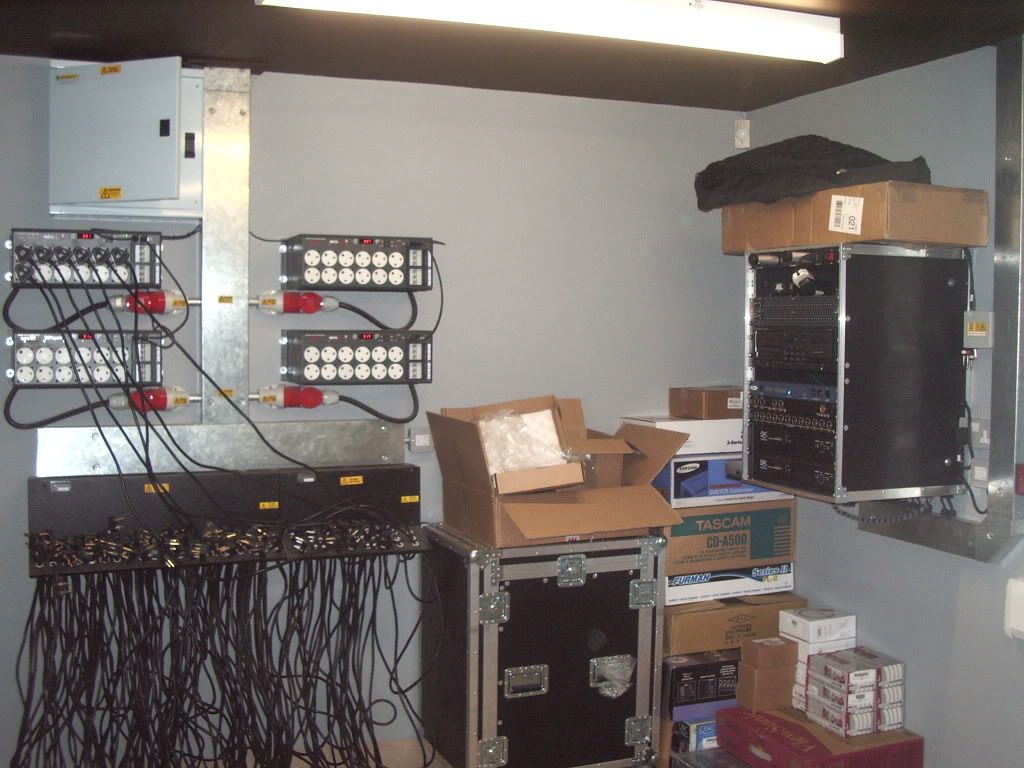
Imagine this but with 5A sockets instead of 15A

IMGP2917.jpg
 
Are they essentially TP extension leads?! 2 sockets per phase for each MCB, what size breaker is in there?
 
They are in their simplest form SP extention leads. The flexes terminatein the black box behind the plugs and then fixed wiring goes to sockets all over the theatre.

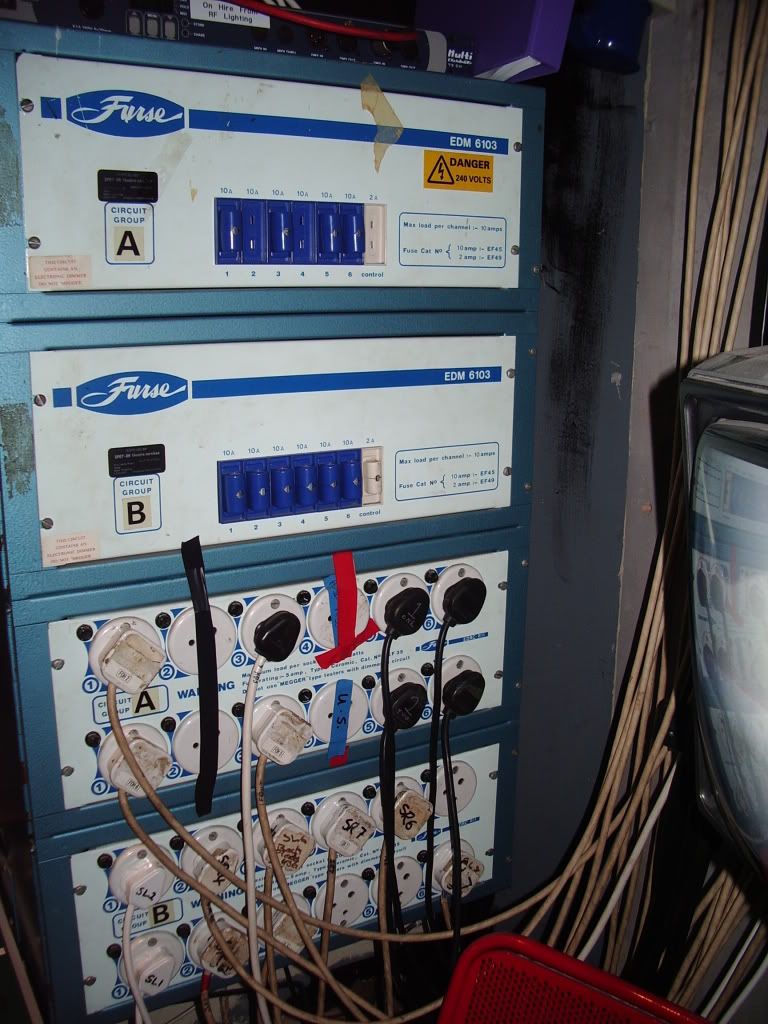
On these dimmers, they are fed with TP supplying 2 pairs of sockets per phase. Each pair of sockets are fused at 10A on these dimmers.
 
Ah, I see now, I was actually referring to the dimmers when I said TP extension leads! So, on each of those dimmers can you control the levels on each individual socket outlet? Not seen that set up before. (sorry OP for unrelated queries!)
 
I'm going to say, I can't see it being an issue

Lets suppose that you had an installation where the 5A BS546 sockets were supplied from MK grid fuse modules with 5A fuses to BS1362, the current range for these is 1.6xIn must not cause operation within 30mins, and 1.9xIn must operate within 30mins, so for 5A fuses that is a window of 8A - 9.5A.

Now if we take a breaker instead, the current which must not cause operation is 1.15xIn, and 1.45 must cause it to operate within an hour, which gives a window of 6.9A-8.7A

So arguably the 6A breaker gives no worse protection than the 5A plugtop fuse.

I'm also sure that if we supplied these sockets were supplied by re-wireable fuses, we wouldn't be saying its wrong and the 0.725 factor should be applied to the socket as well as the cable..

You've just got to hope that the person following behind you doing an EICR follows the same logic...
 
Because it's in a theatre. The dimmers have 5A sockets on them. There are lots of 5A plugs which plug into the dimmers to distribute power to where ever it is required in the building.

They are wanting some non-dimmed sockets to allow other pieces of equipment such as discharge lighting to be plugged into the same sockets.

If 5A sockets are used for dimmers then 13A or 16A should be used for non-dimmer to avoid the possibility of a discharge lamp etc being plugged into a dimmer circuit (which could break the dimmer; dimmers aren't cheap)

Try asking on Blue Room for more technical info (or check their wiki)
http://www.blue-room.org.uk/index.php?act=idx
 
my theatre scrapped all the 5A plugs and sockets years ago and uses 15A for everything. From what I've seen, others did the same.

Now I remember it, each channel (used to be) on a 16A MCB so I suppose we were thinking like Adam. Although the old lighting man used to reckon a 5A plug was safe to 15A, and a 15A plug was safe to 30A.

Our lanterns are now using halogen lamps now which IIRC means they actually draw less power than the old huge filament bulbs. I don't do it any more.

None of which helps, of course :lol:

I suppose you will want the Electrical and Power forum http://www.blue-room.org.uk/index.php?showforum=44 rather than lighting.
 
Ah, I see now, I was actually referring to the dimmers when I said TP extension leads! So, on each of those dimmers can you control the levels on each individual socket outlet? Not seen that set up before. (sorry OP for unrelated queries!)

Each of the dimmers in the pic are 6 channel dimmers with a pair of sockets per channel. The level of each channel is individually controlled.

Adam, my thinking was that it'll be fine too, but it's in a council owned building so I am trying to keep it as comliant as possible.

John, we are slowly trying to move away from 5A plugs to 15A & 16A but it takes time, and the group don't have huge amounts of money. We have so far replaced all the IWBs above stage with 15A and rewired all the circuits too with capacity for 15A circuits, but are still stuck with 5A dimmers.

OwainDIYer, unfortunately we are stuck with what we have got and whilst running in dedicated non dim circuits would be great, it's not possible at the moment, so we have to just patch the outgoing circuits to non dim supplies at the control room.
 
Apart from the question of the wisdom of doing hard power on the same style outlets as dimmed power (somebody IS going to connect that moving light to a dimmer channel and it isnt going to like it!) I dont see the 5A sockets on 6A breaker being an issue. Those pins on a 5A plug are good for way way more than 5A.

In fact..... I'm certain that there was on old reg that allowed muliple 5A sockets to be on a 10A or 15A circuit back in the 50's before the ring final came along.

Keep on Rockin!
 
Hi,

Seens the fact that most of the older racks Strans Tempus/Permus and many others use BS88 fuses, 5A fuses would be best option but would mean some one can load it with a 5A or higher. Uless your using the Din Rail type.

MCB's are the best option

Have you thought of Kilk sockets?
 
We've got an old furse dimmer with 5A sockets on, and the cables plugging into it are on 5A plugs. We want to be able to send non dim power down some of these cables.

Fursedimmer-2.jpg


How would I plug a 5A plug into a klik socket?
 

If you need to find a tradesperson to get your job done, please try our local search below, or if you are doing it yourself you can find suppliers local to you.

Select the supplier or trade you require, enter your location to begin your search.


Are you a trade or supplier? You can create your listing free at DIYnot Local

 
Back
Top