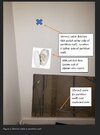
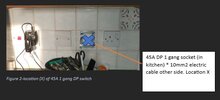
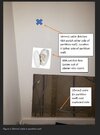
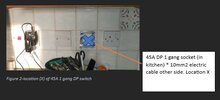
I am not a fan of not putting an isolator for an appliance such as a kitchen cooker.
Preferably not far from and easily recognisable as being for use of the appliance.
Whilst not putting it too near to be of affect of burns by users stretching over to use it I reckon if within 2m it will often be clear-ish to most users with not too much risk for anyone deciding a quick reliable method of doing so with some urgency if need arises.
Inside a cupboard could slow most users down because they might be unaware of it it it might be surrounded by clutter such as pots and pans.
Some suggest such cupboards are "not part of the kitchen fabric" like walls etc surely are but I would be hesitant to regard them as less than permanent in most realistic.
Against my resistant of not having one at all because the consumer unit DP switch could be useful instead, I think in most situations not the best idea because it is often in another location (room or cupboard) often surrounded by clutter and sometimes difficult to locate the actual MCB alone for that one circuit which might result in a full power cut off in low light conditions.
Having said that, I did such on one installation with because the CU was on the opposing wall at eye level and easily recognisable by viewing both at once.
Being able to cut power to that one appliance on its own, rapidly and with certainty , if it ablaze or flooded with liquids (water or oil) , is the main concern.
They way you propose to achieve your installation is unnecessary and OTT in time and money as others have mentioned.
Unless it is quite unusual usage way off the normal scale then a 32A bog standard circuit (and not incorporating a socket on the CCU (not the common DP switch plus onboard socket usually for a kettle of 10A max for a few minutes but calculated as 5A for discrimination calculation purposes) you do the bog stand cooker calc and it holds good for many such an appliance - or appliances total load, 6.0 mm would be more than adequate for any imaginal use and 10.0 would almost always be more than you require.
13KW upwards towards 20KW even with just 4.0 T & E could be considered OK - yes I always used 6.0 not 4.0 because of historical use of rewireable fuses before MCBs were common usage. You would need an unusually long cable run to actually really need 6.0. anyway.
So, unless you have an unreasonably long run, constant 24/7/365 usage, high KW total of massive cauldrons of boiling rice on the go I would just do the bog standard cooker calc which has stood the test of time.
Tell us the cable run, the total KW and if your voltage is much over 240V (yes 240 not the 230V declared voltage but do tell us that if you prefer to use it) and I would be surprised if anyone offers any cautions to you.
Preferably not far from and easily recognisable as being for use of the appliance.
Whilst not putting it too near to be of affect of burns by users stretching over to use it I reckon if within 2m it will often be clear-ish to most users with not too much risk for anyone deciding a quick reliable method of doing so with some urgency if need arises.
Inside a cupboard could slow most users down because they might be unaware of it it it might be surrounded by clutter such as pots and pans.
Some suggest such cupboards are "not part of the kitchen fabric" like walls etc surely are but I would be hesitant to regard them as less than permanent in most realistic.
Against my resistant of not having one at all because the consumer unit DP switch could be useful instead, I think in most situations not the best idea because it is often in another location (room or cupboard) often surrounded by clutter and sometimes difficult to locate the actual MCB alone for that one circuit which might result in a full power cut off in low light conditions.
Having said that, I did such on one installation with because the CU was on the opposing wall at eye level and easily recognisable by viewing both at once.
Being able to cut power to that one appliance on its own, rapidly and with certainty , if it ablaze or flooded with liquids (water or oil) , is the main concern.
They way you propose to achieve your installation is unnecessary and OTT in time and money as others have mentioned.
Unless it is quite unusual usage way off the normal scale then a 32A bog standard circuit (and not incorporating a socket on the CCU (not the common DP switch plus onboard socket usually for a kettle of 10A max for a few minutes but calculated as 5A for discrimination calculation purposes) you do the bog stand cooker calc and it holds good for many such an appliance - or appliances total load, 6.0 mm would be more than adequate for any imaginal use and 10.0 would almost always be more than you require.
13KW upwards towards 20KW even with just 4.0 T & E could be considered OK - yes I always used 6.0 not 4.0 because of historical use of rewireable fuses before MCBs were common usage. You would need an unusually long cable run to actually really need 6.0. anyway.
So, unless you have an unreasonably long run, constant 24/7/365 usage, high KW total of massive cauldrons of boiling rice on the go I would just do the bog standard cooker calc which has stood the test of time.
Tell us the cable run, the total KW and if your voltage is much over 240V (yes 240 not the 230V declared voltage but do tell us that if you prefer to use it) and I would be surprised if anyone offers any cautions to you.