Climate Change

With the possible exception of the DMF, many petrol engines have all the items you list. In addition, petrol engines also have an ignition system with all the necessary components for that. So not sure how you can say diesel is more complex.
diesel cars really do have highly complex, high precision fuel systems

Have a look at the fuel injectors, for a petrol car maybe a set for is £80 for a diesel it’s more like £800

Or look at the fuel pump, a common rail diesel fuel pump will operate at around 3000 psi.


But both diesel and petrol engines are now becoming far less reliable, people buying new or a car under say 6 years old need to research the brand and model really really carefully. Have a look at the Jaguar Ingenium engine or any of the wet belts engines in Fords including vans. And don’t even think about a Range Rover or Discovery….it will be at garage more than it will be with its owner.
 
OMG this is notch lecturing people that
The moderators should ban people who persist in post misinformation, this is a forum about Diy and is thus all about facts.
 
Last edited:
Feeling scammed yet ?
you are the one scammed Old Bean

you think just because plants can do better with a co2 enriched atmosphere in a greenhouse, itso also true in the earths atmosphere.

wot a muppet
 
Aveatry, gas112 and Lirefighter like to post climate myths and falsehoods

to save time having to debunk them, here is a list of the most common ones

if Aveatry, gas112, Lirefighter have any not on the list, please can you post them so we can debunk those all together as well

it saves time having to deal with the drip feed ot lies from these numptys

#CodeMythQuick rebuttal
56mwpMedieval Warm Period was warmerGlobally averaged temperature now is higher than global temperature in medieval times.
31liaWe're coming out of the Little Ice-ageScientists have determined that the factors which caused the Little Ice Age cooling are not currently causing global warming.
15coldIt's freaking cold!A local cold day has nothing to do with the long-term trend of increasing global temperatures.
6tempTemp record is unreliableThe warming trend is the same in rural and urban areas, measured by thermometers and satellites.
20uhiIt's Urban Heat Island effectUrban and rural regions show the same warming trend.
38troposphereSatellites show no warming in the troposphereThe most recent satellite data show that the earth as a whole is warming.
45pastco2CO2 was higher in the pastClimate has changed along with CO2 levels through geological time.
120plantCO2 is plant foodThe effects of enhanced CO2 on terrestrial plants are variable and complex and dependent on numerous factors
127traceCO2 is just a trace gasMany substances are dangerous even in trace amounts; what really matters is the total amount of CO2 in the atmosphere.
11lagCO2 lags temperatureCO2 didn't initiate warming from past ice ages but it did amplify the warming.
31greenhouseIncreasing CO2 has little to no effectThe strong CO2 effect has been observed by many different measurements.
43correlateThere's no correlation between CO2 and temperatureThere is long-term correlation between CO2 and global temperature; other effects are short-term.
81970sIce age predicted in the 70sThe vast majority of climate papers in the 1970s predicted warming.
5modelModels are unreliableModels successfully reproduce temperatures since 1900 globally, by land, in the air and the ocean.
2pastClimate's changed beforeClimate reacts to whatever forces it to change at the time; humans are now the dominant forcing.
207uahUAH atmospheric temperatures prove climate models are wrongThe most likely explanation for UAH data warming less than expected is that the UAH data set is biased low.
143cloudClouds provide negative feedbackEvidence is building that net cloud feedback is likely positive and unlikely to be strongly negative.
14cosmicIt's cosmic raysCosmic rays show no trend over the last 30 years & have had little impact on recent global warming.
191cernCERN CLOUD experiment proved cosmic rays are causing global warmingof one out of four requirements necessary to blame global warming on cosmic rays, and two of the other requirements have already failed.
1sunIt's the sunIn the last 35 years of global warming, sun and climate have been going in opposite directions
1719341934 - hottest year on record1934 was one of the hottest years in the US, not globally.
240wildfiresWildfires are not caused by global warmingGlobal warming worsens wildfires by creating drier conditions with more fuel for fires to spread further and faster.
16hurricaneHurricanes aren't linked to global warmingThere is increasing evidence that hurricanes are getting stronger due to global warming.
37bearPolar bear numbers are increasingPolar bears are in danger of extinction as well as many other species.
185gbrGreat Barrier Reef is in good shapeEvidence clearly shows that both ocean warming and acidification due to human CO2 emissions are damaging the Great Barrier Reef
 
Aveatry will be able to see "urban islands" is one of those common myths on the list


The Urban Heat Island Effect (UHI) is a phenomenon whereby the concentration of structures and waste heat from human activity (most notably air conditioners and internal combustion engines) results in a slightly warmer envelope of air over urbanised areas when compared to surrounding rural areas. It has been suggested that UHI has significantly influenced temperature records over the 20th century with rapid growth of urban environments.

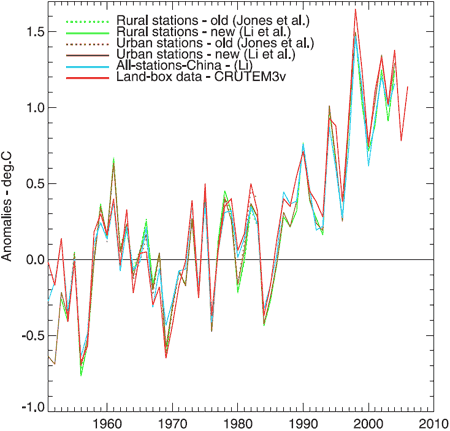
Scientists have been very careful to ensure that UHI is not influencing the temperature trends. To address this concern, they have compared the data from remote stations (sites that are nowhere near human activity) to more urban sites. Likewise, investigators have also looked at sites across rural and urban China, which has experienced rapid growth in urbanisation over the past 30 years and is therefore very likely to show UHI. The difference between ideal rural sites compared to urban sites in temperature trends has been very small:


jones_china.gif


Figure 1. Annual average temperature anomalies. Jones et al (dotted green and brown) is a dataset of 42 rural and 42 urban sites. Li et al (solid green and brown) is an adjusted dataset of 42 rural and 40 urban sites. Li (blue) is a non-adjusted set of 728 stations, urban and rural. CRUTEM3v (red) is a land-only data set (Brohan et al., 2006). This plot uses the 1954–83 base period.

Another way to explore the UHI would be to look at where the majority of warming has occurred across the globe. The UHI should match where most people live. However, if you look at the 2006 global temperature anomaly (figure 2.), you find that the greatest difference in temperatures for the long term averages where across Russia, Alaska, far north Canada and Greenland and not where major urbanisation has occurred.
 
Back
Top