Fluorescent tube - is tube faulty or is it the starter?

Joined
27 Oct 2009
Messages
97
Reaction score
4
Location
Birmingham
Country
United Kingdom
The rule of thumb with fluorescents was the way most went to try out replacement.
3 main components being the starter, the tube and the choke.
So, first try a new starter is the cheapest, easiest option, then if still no then try a new tube, then if that doesnt work it is probably the choke, in that case its often easier and cheaper to replace the whole fitting which often came supplied with a new tube.
Of course we have moved on from that and nowadays LED battens are all the rage and fluoros are more expensive if you can get them.
PS the tube ends blackening was often a sign of a bad tube past its life, although they could often carry on a good while after that in many instances.
By "choke" do you mean ballast? Do all fluorescent tubes in the UK have ballasts?
 
In the old days of fluorescent lamps, with a wire wound ballast, I often found changing the starter would get it running again, but for a short time, and looking at labour costs, better change tube and starter as a pair.

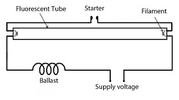
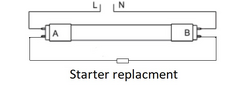
There were some lamps which only had a wire wound ballast, no starter, some had 4 pin starters, but the ones I worked on with wire wound ballast had two pin starters wired like this LED before converter.pngand it was easy enough to convert to this 1785006963659.pngwhere the problem lies is where an electronic driver is used as @flameport says, specially where there are multi-tubes.
 
Ballasts were called chokes long ago. In more recent decades such items were replaced with electronic drivers, no starter requried.
Yeah...I call them chokes...ahem...
My first experience with fluorescent fittings was in a Victorian mill where there were 1940s fittings with old bakelite BC lamp holders and tubes with BC endcaps.

The wiring used to be DC and was wired in conduit with porcelain roses and the colours (not sure why) were black and white. Unless they had red, black and white and stripped the red out for some reason.

Things sure have come a long way with lighting efficiency.
 
Last edited:
I enjoyed comments like “they are not fluorescents they are CFLs!” Until you asks what the “F” stands for in CFLs?
 
I enjoyed comments like “they are not fluorescents they are CFLs!” Until you asks what the “F” stands for in CFLs?
Yes, but I remember testing one, with the old fluorescent they were very voltage dependent and just a little over voltage, and they use way over the rated wattage, this was where the electronic ballast came into its own, never opened a CFL (compact fluorescent lamp) but I did put one on an energy meter, and an 11 watt lamp seemed to use 11 watt whatever the local voltage was, so assume an electronic ballast inside?

The one which got me, was, bulbs go into the ground, it's a lamp, but the lamp is the whole assembly, it could have a wick, mantel or bulb, inside, but I could not find another word to replace the bulb, even if technically not bulbous any more, so should not be shortened to bulb.

But this is repeated with transformer, ballast etc, at least called an electronic transformer, what is wrong with calling it a switched mode power supply I don't know. Driver is another one of the words, it was used for a current regulating unit to power LEDs, then same word used by manufacturers for a voltage regulated DC switched mode power supply.

I made the mistake of ordering a head lamp, instead of a head lamp bulb, and I got a head lamp, minus the bulb.
 

If you need to find a tradesperson to get your job done, please try our local search below, or if you are doing it yourself you can find suppliers local to you.

Select the supplier or trade you require, enter your location to begin your search.


Are you a trade or supplier? You can create your listing free at DIYnot Local

 
Back
Top