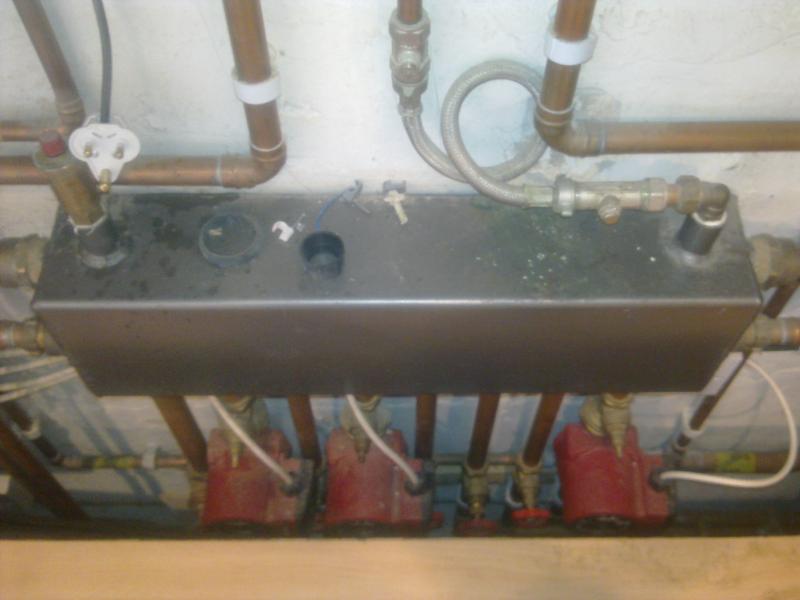
What's this silver thing??

i'd agree, but why go to a that trouble to fit state of the art kit and then put two crap boilers above it, beats me!! :lol: :lol:
 
That's what I thought! The house was beautiful, really plush fixtures and fittings, why not spend a little on the boilers.....

Since posting this i've been to www.dunsleyheat.co.uk which explains alot. Looks like a neutraliser isn't really necessary in this case, i think they're designed to connect different kinds of heat sources i.e. gas/oil and solid fuel, rather than two sealed system boilers. Might as well have just piped two regular boilers in parallel, there are 5 pumps involved here!!
 
That's what I thought! The house was beautiful, really plush fixtures and fittings, why not spend a little on the boilers.....

Since posting this i've been to www.dunsleyheat.co.uk which explains alot. Looks like a neutraliser isn't really necessary in this case, i think they're designed to connect different kinds of heat sources i.e. gas/oil and solid fuel, rather than two sealed system boilers. Might as well have just piped two regular boilers in parallel, there are 5 pumps involved here!!

a low loss is a way of combining/cacading boilers which seperates
them from the load.a bit similar to the principle
of the neutraliser but in your photo it deffinately the correct way of piping 2 boilers into 3 pumped circuits.
 
Ah I see, so piping two or more boilers in parallel then having multiple zone valves isn't really the best way of doing it? I assume all the load connections are on the bottom to prevent any gravity circulation then?

What's the benefits of this system over having boilers piped-up in parallel?
 
Guaranteed minimum flowrates through the boilers since each has its own pump regardless of load.

The boiler head loss can be dis-regarded when calculating index circuits so simplifying the process.

Zone valves not required (non-return valves fitted in each circuit).
 
Every heating circuit has a resistance which is boiler heat ex,pipework,valves and radiator.

Calculate each radiator in turn from boiler and back along the pipe run,the largest resistence is your index.

Pump is then sized accordingly.

Fitting a lowloss removes the resistance of the boiler heat exchanger and therefore means smaller pump.

It's not gravity circ your worried about,it's reverse circulation through a boiler that's not firing(effectively a short loop through a boiler that will in part act like a radiator)
 
Thanks for the info everyone. With this particular set-up both boilers share the same switched live so they will both fire at the same time anyway.

So on the set-up pictured above, there must be non-return valves on each circuit return to prevent reverse circulation?

I may need setting straight here but reverse circulation on a standard Y-plan system would occur when there are radiator returns piped up after the hot water coil return? I.E. those rads could potentially heat up when on hot water only?
 
I may need setting straight here but reverse circulation on a standard Y-plan system would occur when there are radiator returns piped up after the hot water coil return? I.E. those rads could potentially heat up when on hot water only?

Yes it happens if you don't put dhw return nearest boiler.
 

If you need to find a tradesperson to get your job done, please try our local search below, or if you are doing it yourself you can find suppliers local to you.

Select the supplier or trade you require, enter your location to begin your search.


Are you a trade or supplier? You can create your listing free at DIYnot Local

 
Back
Top