I would agree with
@Murdochcat that is how I would code it. However, the problem is it is up to the inspector. Code C1 is easy, dangerous, so exposed live part, but nearly every code C2 could be coded C3, as the inspector has to may the client aware of potential problems, I was going to say faults, but it is not really a fault, I have never seen the old plastic Wylex fuse box
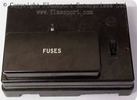
go on fire, the problem was the new type MCB had terminal clamps with some makes, where it was easy to get the tongue of the buss bar wrong side of the clamp, so it only pushed on the buss bar, it did not clamp it, good makes forced the clamp open so could not get it wrong, but not all, and instead of addressing the real problem, there was a knee jerk reaction by the London fire brigade. Which in turn caused the change to metal consumer units.
The Electrical Safety Standards in the Private Rented Sector (England) Regulations 2020 said:
“electrical safety standards” means the standards for electrical installations in the eighteenth edition of the Wiring Regulations, published by the Institution of Engineering and Technology and the British Standards Institution as BS 7671: 2018(
3); - (3) ISBN-13: 978-1-78561-170-4. Copies can be obtained from the Institution of Engineering and Technology, Michael Faraday House, Six Hill Way, Stevenage SG1 2AY.
This is the stumbling block. It is followed by
3.—(1) A private landlord(
1) who grants or intends to grant a specified tenancy must—
(a)ensure that the electrical safety standards are met during any period when the residential premises(
2) are occupied under a specified tenancy;
So we are looking at the statement I reported in #8 does the regulations say it needs upgrading? This has come up many times, where during a build, the regulations have changed, and to comply with the new, would require ripping out what has been installed before it was ever used, but the regulations are very careful to say "design" so it is down to date designed, not the date commissioned. Remember things like Heathrow T5 can take years to build. And they have the same regulations as ones house.
The problem arises where something is clarified, and it turns out the designer miss read the regulations, but that is not the case here. The inspector has to consider is any non compliance a potential danger to personal, not equipment, so lack of a surge protection device is not a danger to personal.
However what about loss of lighting? This has been argued about many times.
Every installation shall be divided into circuits, as necessary, to: (iii) take account of danger that may arise from the failure of a single circuit such as a lighting circuit
clearly if there is a general power cut, then one will loose lights, can't stop that, and use of simple plug in torches
can remove the danger, but to have lights on the same RCD as sockets for that room, can be argued as a potential danger. So if we group upstairs sockets with down stairs lights, this was considered as OK at one time, so a fault on a socket circuit will not plunge one into darkness, getting a shock is bad enough, without also loosing lights at the same time.
But the problem was, many homes the sockets are split side to side of the house, so any failure, one is not temped to run extension leads up/down stairs. But lights still split up/down, so it is impossible with just two RCD's to arrange that lights don't fail with sockets in the same room.
At the same time as we went for metal consumer units, we also started to fit RCBO's which is a RCD and MCB combined, this does stop the danger of a lighting circuit failing with the sockets circuit. And this is one of the items clarified in latter editions of BS7671, yes, if you altered the design of the system slightly by adding RCBO's to lighting circuits, this would get around the problem, but that means altering the design, so then it has to comply with todays regulations.
Sometimes one just has to accept easier to just do as the EICR says, to argue can make it worse.



