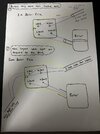
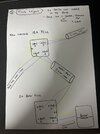
@pete01 - The supply came from one of the kitchen sockets into the 13A fcu. What left from that 13A fcu is two cables, one going to the shed, and the other going into another 3A fcu (boiler one)….obviously that supplies the boiler.
If it`s done as per Sunray`s diagram as per post 18 the personally I would not have a problem with it.
Thinking that one twin or one single socket is allowed then by the same thinking this would be pretty much the same as two single sockets and we believe that, perhaps, this modification to ring final discipline came about by likelihood of two single sockets becoming two twin sockets at a future date.
The same reasoning might be thought to apply.
If the two FCUs became one or two spurs to two adjacent FCUs mounted in one dual box (or two single sockets mounted in one dual box) then opinions might vary.
But one spur from the ring final circuit feeding one FCU (on the mains in terminals) and the mains out terminals feeding any number of radials with any number of points on each radial (such as a twin socket or another FCU say 3A boiler) should not bother anyone since it is one fused spur to a 13A max fused connection unit supply a number of points 13A max).
Of course the 3A fuse for the boiler would be better fed from its own dedicated circuit but over the years many thousands are like that and not usually much of a problem, the main one being the remainder of faults at other parts of the circuit not solely a problem with with boiler itself or up to it could cause a disconnection of the boiler and if that happens during icy conditions then burst pipes etc could result.
Yes but only for the short duration between it being installed and until the second FCU was fitted, which was a situation which needs no further attention as any error has already been corrected.
@pete01 - I just switched off the new installed 13A FCU which is spurred from a kitchen socket. When I turn this off, the FCU next to it (Boiler 3A) switches off as well as anything else in the shed – lights, saniflo etc.
Yes but only for the short duration between it being installed and until the second FCU was fitted, which was a situation which needs no further attention as any error has already been corrected.
@ SUNRAY - Sorry i'm not understanding what you mean? Would it help if i told you how things were wired before the new 13A FCU was installed...is that what you mean?
@pete01 - I just switched off the new installed 13A FCU which is spurred from a kitchen socket. When I turn this off, the FCU next to it (Boiler 3A) switches off as well as anything else in the shed – lights, saniflo etc.
@ SUNRAY - Sorry i'm not understanding what you mean? Would it help if i told you how things were wired before the new 13A FCU was installed...is that what you mean?
@pete01 - I just switched off the new installed 13A FCU which is spurred from a kitchen socket. When I turn this off, the FCU next to it (Boiler 3A) switches off as well as anything else in the shed – lights, saniflo etc.
Thanks for all your help, everyone. I went to the effort of drawing how it looked in terms of the wiring to help make everyone understand further but I guess reading all the latest comments I didn’t perhaps needed to. Excuse the poor drawing!
Yes.
To the OP.
Initially we needed to understand whether some of the connections were to the mains (in) side or the load (out) side.
Once we knew that we could say for certain.
Using the correct terminology and the your more detailed drawings allowed us to ascertain exactly what went on.
Knowing a lot of ordinary people and quite a few electricians too, have a habit of using incorrect terms for such as "spur", "FCU", "Ring Final circuit" and "Ring Main" can cloud things sometimes too - not in your case but it is common so we have to take account of that.
It is not helpful when a blanket statement with no clear meaning, such as "Spuring off a spur is not an approved way of doing this" throws such a comment into the mix.
I can think of at least one particular "Electrician" on such a forum as this who appears to think that just because he is "time served/qualified" that he is superior to at least one member who is not. The reality is completely different - the non qualified (in the electrics field) can and does run rings around this chap but he still berates him for his apparent lack of knowledge, he tends to make a complete idiot of himself at times again and again and again.
I reckon that we have all attempted to help you on your quest but we needed to know exactly what was what, that is why this thread went on and on, a helpful bunch on here including DIYers, practicing or retired partly/fully qualified electrical folk too.
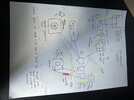
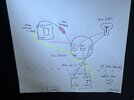
Thanks guys for your help on the previous query. I have another question regarding extending the light in the 2nd shed room. The picture shows the current layout of how electrics were done in the shed room. So inside the bathroom as mentioned previously the 1.5mm white flex comes from the 13A newly installed FCU and goes into the shed room into a double socket. From that double socket a 1.5mm cable goes into another FCU (3A), which is then used for the ceiling light, switch and extractor fan via a ceiling rose (wago connectors). I have another part of the shed joined to this current shed room which has a bike etc where I need a light and a switch.
Option 1- Can I just take a feed from the 3A FCU (the out part) and take it to the next part of the shed for the light and switch…Please see drawings.
Or
Option 2 - Between the 3A FCU and ceiling rose next part of shed, do I install another 3A FCU?
Or
Option 3 - or do I just take the feed from the wago connectors from the shed?
If you need to find a tradesperson to get your job done, please try our local search below,
or if you are doing it yourself you can find suppliers local to you.
Select the supplier or trade you require, enter your location to begin your search.
Please select a service and enter a location to continue...
Are you a trade or supplier? You can create your listing free at DIYnot Local