

delete

I'm sorry where above does it say anything about domestic situations.With copper prices expected to triple over the next few years watch out for the return to vogue of RFC
The ring final circuit has always used more copper than necessary. The original assumptions which brought about its introduction were quite simply incorrect.
But for socket outlets in a domestic installation, you will always use more copper if you install rings. (I never mentioned and would never use 4 sq mm, which appears to be the basis for your thesis.)
This is a house I rewired to the 17th edition.
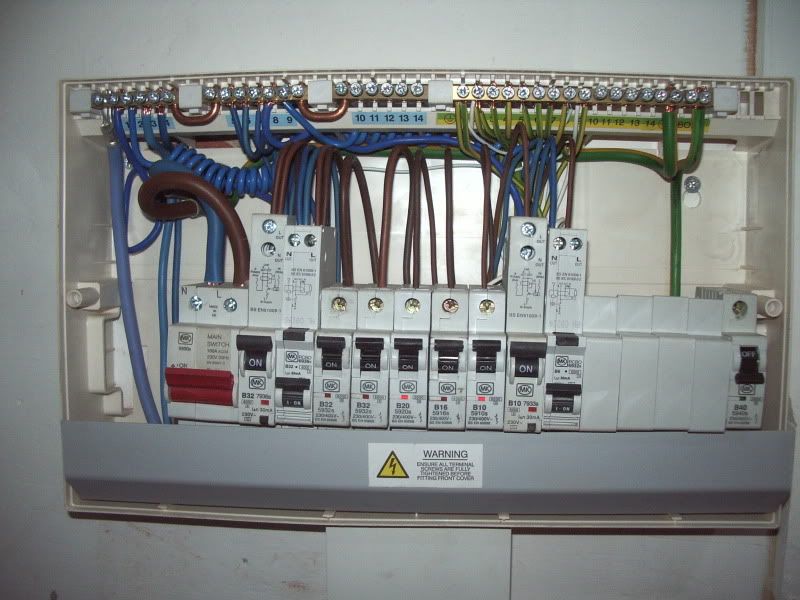
From the main switch:
(1)Upstairs ring final circuit. (13 points in 3 bedrooms, landing and loft)
(2)Downstairs ring final circuit. (12 points in hall, lounge and kitchen diner)
(3)6.0mm² radial for hob
(4)4.0mm² radial to kitchen gridswitch for washer, dryer, dishwasher.
(5)2.5mm² radial for oven and extractor hood.
(6)2.5mm² radial for fridge freezer
(7)Boiler
(8)Upstairs lights
(9)Downstairs lights
Whether or not you use 4mm T&E is immaterial, I have simply challenged your broad statement, outlined above, and demonstrated that there are circumstances where that statement may be correct but also there are circumstances where that statement is incorrect.
For a radial sub-main, or to supply fixed equipment, then whatever cable size most economically does an effective job. But to directly supply sockets, no.Would you not consider using 4.00mm on radials for supplying circuits to uttilities and the garage work shop, bearing in mind the protective device rating will offer you more current?
We will just have to agree to disgree then.As for the 'domestic' reference, the ring final circuit was devised expressly for the use of domestic socket-outlets. And as the thread is about a house rewire, my assertion still stands; to use rings will require more cable for the same outcome.
(To echo something that is also regularly aired here, from the same Wikepedia page: "It is also becoming very apparent that a majority of UK electricians are unfamiliar with the test requirements and, as a result, most ring circuits are not adequately tested, either at first installation or subsequently during the infrequent periodic inspections.")
Okay. Happy with that!We will just have to agree to disgree then.

Yes, indeed. The general standard is disappointing.Which just goes to highlight the incompetence on those people allegedly teaching and testing students.

So you would never use an A2 type circuit on socket-outlets then?For a radial sub-main, or to supply fixed equipment, then whatever cable size most economically does an effective job. But to directly supply sockets, no.Would you not consider using 4.00mm on radials for supplying circuits to uttilities and the garage work shop, bearing in mind the protective device rating will offer you more current?

can i ask a few questions?
i guess those large items are RCBO's? and they take the live and neutral wire from the circuit, also why are slightly different?

i would of thought a 32a on a 4.0mm2 was very close to the capacity of the cable, as its around 32amps anyways.
also why are the 2.5mm2 T&E for the oven and fridge, are protected by a 20a and a 16a MCB on different circuits.
im not picking holes in your work, im just a keen learner.
thanks.
i would of thought a 32a on a 4.0mm2 was very close to the capacity of the cable, as its around 32amps anyways.
4.0mm² installed to reference method C has a current carrying capacity of 37A which is well over the breaker rating.
Method C is clipped ditect etc, all info is in the BRB, get a copy, it makes for good bedtime reading.


If you need to find a tradesperson to get your job done, please try our local search below, or if you are doing it yourself you can find suppliers local to you.
Select the supplier or trade you require, enter your location to begin your search.
Are you a trade or supplier? You can create your listing free at DIYnot Local

