LED Bulbs - Warm Appear Cool White

  • Thread starter Thread starter BF
  • Start date Start date

BF

Joined
26 Oct 2003
Messages
106
Reaction score
0
Location
London
Country
United Kingdom
I have ordered two different sets of GU10 LED bulbs that purport to be warm white, but both sets give off what I would describe as a stark or cool white illumination.

They do not emulate the GU10 halogen bulbs I am replacing, and I am now wondering whether there are equivalents for these.

The latest batch of bulbs I bought are the Sylvania ES50 Dimmable 5W Warm White 3000K.

Has anyone found an LED GU10 bulb that provides a warm white illumination, and would the type of dimmer used make a difference?
 
Halogen bulbs tend to change colour to a warmer shade when dimmed. LEDs won't do that. If you are used to seeing the halogen bulbs in a dimmed state any LED is likely to look cool in comparison.
 
Dimmer won't make any difference to the colour but it will need to be suitable for LEDs, plenty of old dimmers are not.
I would say dimmers in the main won't make any difference, there are some bulbs which the warm LEDs are powered with non voltage dependent driver, but the cool is dependent on voltage, so dimming the bulb only dims the cool LED's so they appear to become warmer when dimmed, however in the main these have been replaced with smart LED bulbs, where the colour temperature and colour can be selected with the app etc.

Since the old halogen GU10 lamps could not be dimmed without reducing their life, I would not expect any halogen lamp to be dimmed, so any dimmer used with GU10 should be the modern type.

However, just because I got rid of all dimmers as I went to CFL does not mean everyone did, I could not believe how many tungsten bulbs there were in this house when I moved in, I note the Energy Performance certificate says "Low energy lighting in 23% of fixed outlets." I do question those certificates, mine says 3,670 kWh per year for hot water, since I have an iboost+ this is actually recorded, at around 12 kWh per week, so around 625 kWh per year, OK can see being a little out, but by a factor of 5.8 times out, where do they get their data from?
 
  • Thanks
Reactions: BF
Halogen bulbs tend to change colour to a warmer shade when dimmed. LEDs won't do that. .
The have to be specifically engineered to do so. Take a look at Megaman "Dim to Warm" or Philips Warmglow for example.

Dimmable LEDs that don't deliberately change colour tend to be much more unsatisfying in terms of the warmth and ambience they give; the light is the same colour, just less intense/bright, like turning the brightness down on a computer screen. Some people may be OK with that but at the outset of my new build I spend about 700 quid on mega man dim to warm bulbs and I'm generally pleased with the result, but not with the payback/ROI nor the reliability of the batch I ended up with :/

Since the old halogen GU10 lamps could not be dimmed without reducing their life
I've found the opposite; the halogens run at around half duty cycle on a phase cutting dimmer (Fibaro) in the bathroom never had issue and are all the original from new. Same brand in the kitchen more often burnt out (100%/no dimmer)
 
Last edited:
I've found the opposite; the halogens run at around half duty cycle on a phase cutting dimmer (Fibaro) in the bathroom never had issue and are all the original from new. Same brand in the kitchen more often burnt out (100%/no dimmer)
It must depend on how much dimmed, in general the dimmer switch gives a soft start which extends quartz life. One can see if they have been running too cool, as the tungsten deposits its self on the quartz, making the bulb look black, and bulbs can last a long time, if conditions are right, some fire house in the USA bulb it seems has lasted over 100 years, but that does not mean that is how the bulb should be treated, and I still have a GU10 cold cathode CFL, but the output is that low, it is not really of any use.
 
  • Thanks
Reactions: BF
some fire house in the USA bulb it seems has lasted over 100 years
I think I read that it's been on pretty much the entire time, and from what i saw it looked pretty dim; all in an easy life I'd say, having a steady state existence rather than huge temperature swings of on off cycles. Mostly my halogens blow on startup, which is understandable as that initial surge and rapid heating is going to quickly find any weak point..
 
Last edited:
  • Thanks
Reactions: BF
from what i saw it looked pretty dim
Yes, it does not really light the fire house, and it may pre-date tungsten?

My LED units seem to have a cold and warm LED, and setting the temperature changes the proportion of light from each, then there is a third LED which can change colour, most it seems I need to select white or colour, with the LED strip to light my book cases I can see the LED chips, but most of my bulbs the LED chips are behind a diffuser so you can't see what chip is active.

The dimming switch,
1756201142719.png
has to be programmed in, and it depends on what you select as to what turning the button does, and to be frank I do not have Tapo bulbs for the button to work with, I use the button as a doorbell push. So, as to how easy to program switch to bulb, I don't really know.

I tend to use voice control, which is why stopped using the button to control lights.
The latest batch of bulbs I bought are the Sylvania ES50 Dimmable 5W Warm White 3000K.
@BF does not say he is trying to dim the bulbs, just that the bulbs are dimmable, and I have no idea how that bulb is dimmed, he asks about warm and cool white light, and @flameport has already talked about colour temperature, and I have not looked at the packet for my bulbs, and don't tend to write it down.

But happen to have an unused GU10 dimmable bulb still in the box, and it says 2,700–6,000K no hub required, works with Siri alexa Google Home, bought as being sold off cheap in Pound Land but even full price only £5, I have not looked to see if there is an Eveready smart dimmer switch, I will use Google Home.

There are some cheap non smart bulbs,
1756202403589.png
and I know more lumen to the watt, 450 at 5 watt, v 345 at 4.8 watt, but if one wants a set colour temperature it must be worth the little extra.
 
  • Thanks
Reactions: BF
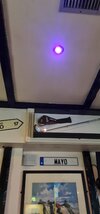
As an aside... the pub I am sitting in... the LED directly above me looks purple/pink. If I walk 1m to the side, it looks yellow.

What gives?
 
  • Thanks
Reactions: BF
Since the old halogen GU10 lamps could not be dimmed without reducing their life, I would not expect any halogen lamp to be dimmed, so any dimmer used with GU10 should be the modern type.
Utter nonsense.
I installed hundreds, if not thousands, of TV studio luminaire using Tungsten Halogen lamps. They were designed to be 3200K at full voltage 240V dimmer 10 and gave circa 2700K at dimmer fader 7 at which the cameras were lined up. I think it allowed +/- 2 stops of light variation from the nominal fader 7 from memory without undue colour variation.

If dimmed enough that the halogen scouring process (to remove evaporated tungsten deposits from the quartz/hard glass envelope stopped) there would be minimal evaporation of the tungsten anyway; and probably to dim for useful light output. Once at fuller brightness the process would restart. (It never gets re-deposited in the right place anyway).
See https://edisontechcenter.org/halogen.html

Running any incandescent lamp at reduced voltage extended the running time before failure. Failure is almost always due to the inrush current at switch on (circa 10x running current for a few cycles of the mains, reducing as an inverse square law as the filament got hotter and resistance increased) as a result of a thinned part of the filament from evaporation.

Domestic halogens are a lower max colour temperature to extend their life (and more closely match non-halogen tungsten lamps of the day. Internet says 3000K Tungsten-Halogen and 2700K for Tungsten... TV lighting lamps have a relatively short design life (a few hundreds of hours) vs domestic 2,000 hours being typical; but in a studio situation with dimmers that rated (240V) life was not an issue.
 
  • Thanks
Reactions: BF
Domestic halogens are a lower max colour temperature to extend their life (and more closely match non-halogen tungsten lamps of the day. Internet says 3000K Tungsten-Halogen and 2700K for Tungsten... TV lighting lamps have a relatively short design life (a few hundreds of hours) vs domestic 2,000 hours being typical; but in a studio situation with dimmers that rated (240V) life was not an issue.

Anyone remember the 3400K Photoflood bulbs?
 
  • Thanks
Reactions: BF
You should take more water with it, dear boy.

Hey... my pint of Kronenbourg is already 95.4% water... are you trying drown me?

purple light.jpg

Weirdly, white items under it look white. Not the best of photos. It has 4 round cells in the bulb.
 
  • Thanks
Reactions: BF

If you need to find a tradesperson to get your job done, please try our local search below, or if you are doing it yourself you can find suppliers local to you.

Select the supplier or trade you require, enter your location to begin your search.


Are you a trade or supplier? You can create your listing free at DIYnot Local

 
Back
Top