However, as I've said, despite often asking, I have yet to come across anyone who has seen a problem which was probably due to a (satisfactorily fitting and 'properly installed') device being of the 'wrong brand'.
The 'satisfactorily' is the main point, some clamp down on the bus bar, and some up, and I have seen where the bus bar tag went the wrong side of the clamp, so connection only by light pressure. However, seen this where the proper MCB was used as well as with wrong one. As to 'properly installed' it can't be properly installed if not type tested to fit that consumer unit.
There is of course the point DIN is a German standard, so if a device uses DIN rail, can any device designed to fit on DIN rail be wrong? We know it is because the terminals don't always match, and the cut-out for operation don't always match.
But the EICR does not any longer have a code "does not comply with current edition" code 4 was removed. We are looking for danger and potential danger, the latter is a bit stupid, as 230 volts is always potentially dangerous, but some MCB's are identical other than the name on the device, so we can't say in all cases it is C2, as clearly there are times when it's not, but there are also times when it is, so people who do EICR need to be trained to use their judgement as to which it is.
Since in a distribution unit, the devices do not need to be on the type list, in fact in a non-domestic there is nothing to stop me making my own units, which I have done many times, with PLC's, contactors, and overloads all in the same box,
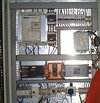
the question only arises with domestic, and I fail to see how something allowed in commercial becomes potentially dangerous when used in a domestic environment. There was a plastic cover over much seen, to allow the door to be opened to program the PLC, however I got a rap on hand from HSE for leaving the key in a door, he said the key could be used with any other door, so must be removed.
So if using the wrong make of MCB results in a potential danger, yes code C2, but it is not an automatic thing, there must be a potential danger, and that is a personal decision, not one made by a committee.
If the device fitted is not on the list, then the enclosure is no longer a consumer unit, it is only a distrubution unit, I have not found the rule to say domestic installations must use a consumer unit, since a CU has a max of 125 amp and single phase, to have a rule saying must be a CU would cause some problems with larger homes, and EV charging etc.

www.london-fire.gov.uk


