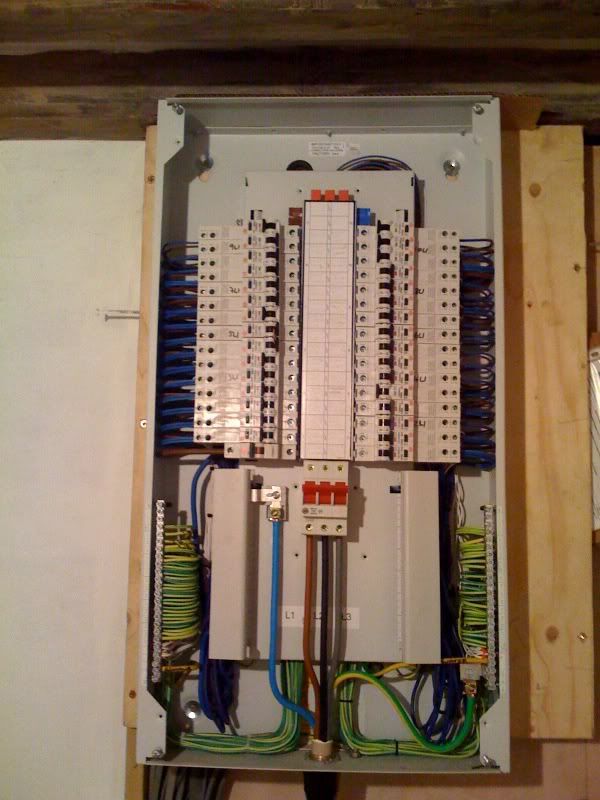
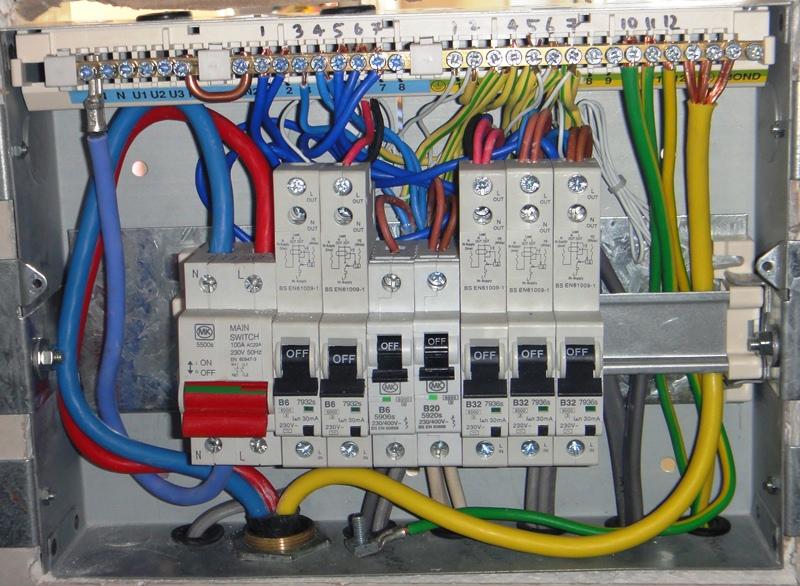
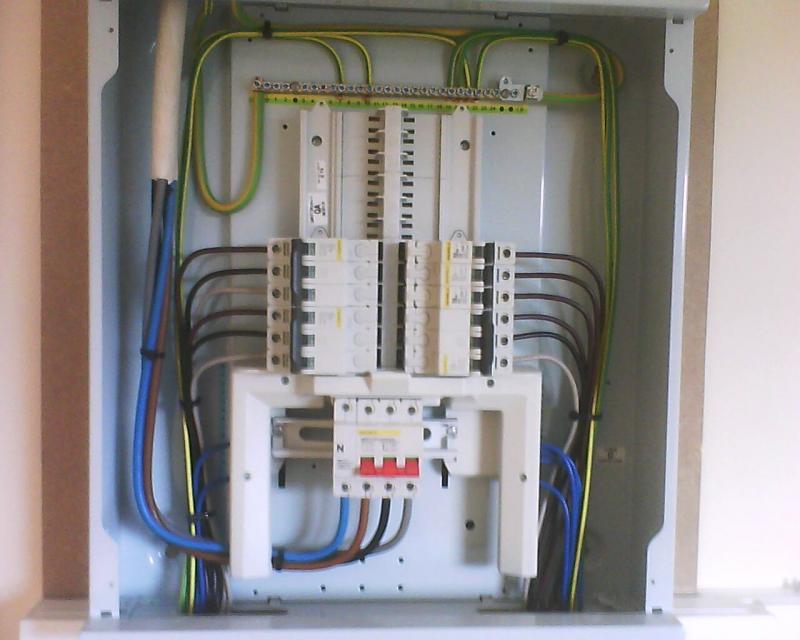
So the art of tidy installation isn't quite dead then

Here's one I did in a large domestic a couple of years ago

keithDB2.jpg

Bet that lot wasn't cheap!!


Yep, but he saved a bit on that gash bit of timber used to mount the panel and lost some marks for not using screw cups under the woodscrews. What's that bit of cardboard sitting on top for ... ?
 
Give me twin and earth on a consumer unit change any day - at least you can trace the cables. I just did a 26 way domestic fuse board upgrade - all wired in singles in plastic conduit (EH? - done by a plumber I was told) with not one circuit marked and the N and CPC's all out of order, including 'rings' in different terminals - what a pigging nightmare!

And you should have seen the bonding - no fewer than 8 earth clamps on the main incoming sheath - with 10mm bonding running all over the house to boiler, bathrooms, rads......

This week should be much easier - just a little 10 way to do. Although it is in the back of a kitchen cupboard, so I suspect I might have a few bumps on my head by the end of the job... the joys

SB
 
Give me twin and earth on a consumer unit change any day - at least you can trace the cables. I just did a 26 way domestic fuse board upgrade - all wired in singles in plastic conduit (EH? - done by a plumber I was told) with not one circuit marked and the N and CPC's all out of order, including 'rings' in different terminals - what a pigging nightmare!
Peut-être il était français, et il a été employé à l'utilisation gaines?


And you should have seen the bonding - no fewer than 8 earth clamps on the main incoming sheath - with 10mm bonding running all over the house to boiler, bathrooms, rads......
Ah - that would be Kai...

kaibondingearthot1.jpg


:wink:


This week should be much easier - just a little 10 way to do. Although it is in the back of a kitchen cupboard,
female_plumber_is633-058.jpg


:?:
 
Exactly, and I personally have absolutely no problem with the common sense approach - but what about 'the regs'?
What about the regs?
Where do the regs say that if an electrician (exercising common sense) deems that grouping occurs only a small length, in a reasonably ventilated area, then (s)he does not need to include a grouping factor in their cable calculations?

Kind Regards, John.

I was taught this on my 2360 and on-site. If any electricians on here have been taught differently, I'm happy to discuss. The rationale was that the grouping in conduit/trunking had the space restriction for heat dissipation. Cable grouped on trays had the impact of stacking.
Inside a board, there is sufficient space around the cable to allow heat to dissipate. This principle is also applied to joists, where there is often a group of cables passed through a single hole.
 
I was taught this on my 2360 and on-site.
If so, then, unless you can prove me wrong, you were taught very good common sense, but common sense that is probably not strictly compliant with BS7671.

The rationale was that the grouping in conduit/trunking had the space restriction for heat dissipation. Cable grouped on trays had the impact of stacking. Inside a board, there is sufficient space around the cable to allow heat to dissipate. This principle is also applied to joists, where there is often a group of cables passed through a single hole.
Sure, as I've said, that is total engineering common sense, and I'm sure that most/all of us have been known to invoke it (particularly with holes in joists, cables exiting from CUs, pairs of cables entering an accessory etc. etc.). However, I am not aware of BS7671 allowing any 'common sense discretion' in deciding not to apply grouping factors which it requires - so whether or not it's correct for people to teach on the basis of something which is probably technically non-compliant is another matter.

Kind Regards, John.

 
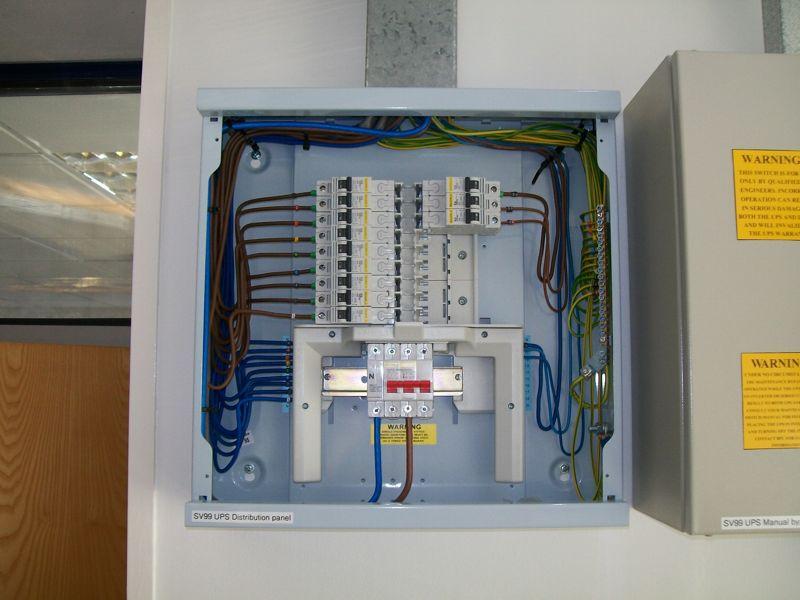
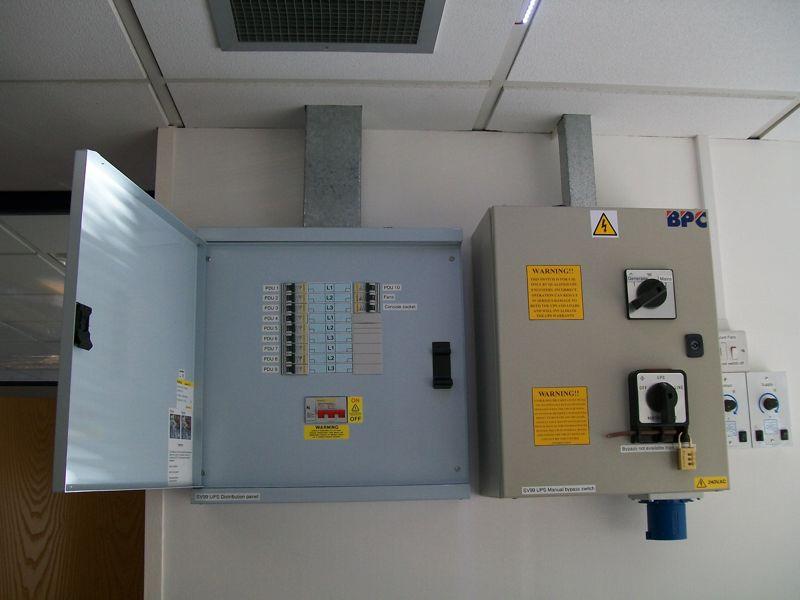
Here's another panel.
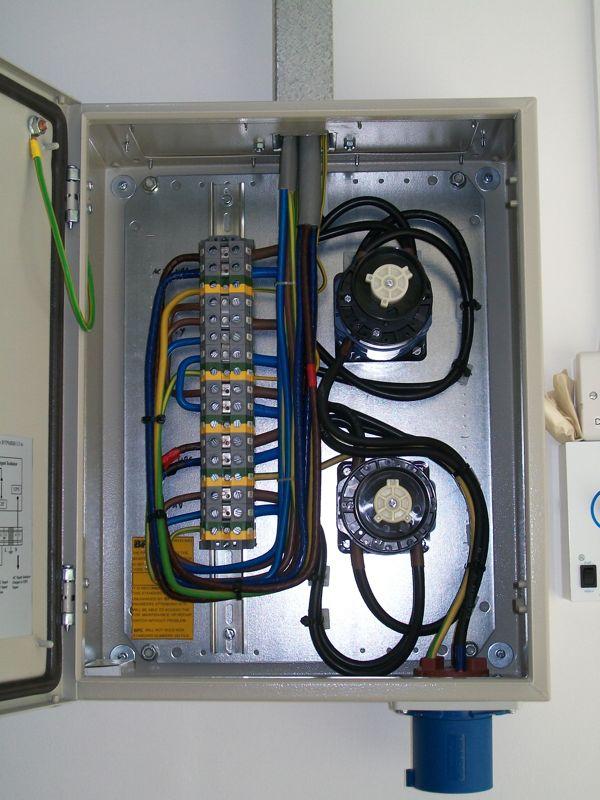
This is the power system for our server room at work. The dist board is fairly self explanatory, the beige box is a manual bypass for the UPS. The bottom switch* allows the load to be fed direct from the mains without going through the UPS, and the upper switch allows the UPS supply to be switched off - so the UPS can be completely powered down for maintenance without powering off the loads. From the labels on the upper switch, you may guess that it's been modified - the upper supply switch also selects input from the blue inlet on the bottom of the box**, originally it was just and on-off switch.
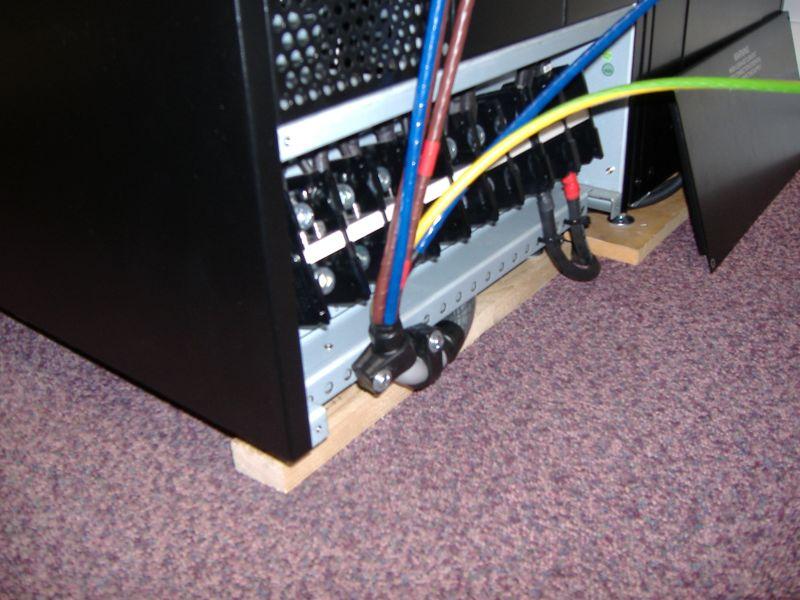
Feed from the supply is 16mm T&E, as is the feed from bypass switch to dist board. The UPS is connected with 5 core Armaflex, two cores taking mains out to, and two cores bring mains back from, the UPS.

The design of the terminations, or rather the space for cable management, on the UPS itself was a matter of "some discussion" with the manufacturer - who couldn't see any problem with having unsheathed cores loose underneath the unit (their expectation was for them to be wired in singles) :roll: This is just before our local sparks did the connections - it's the best any of us could think of.

* The main reason for the lock on it is that it's a make-before-break switch which will momentarily connect input and output of the UPS together while it's moved. Given that most of their UPSs are double conversion and hence the output is a different voltage and unsynced to the input, this would result in a "a bit of a pop" if operated by someone not familiar with the correct sequence of operations needed - the UPS itself needs to be put in local bypass mode first, so it's input and output are the same.

** We have had to use this. A while ago we had to rig up a temporary supply from the next unit while a burned (or rather burning out) switch was being replaced in our supply.
 
I was taught this on my 2360 and on-site.
If so, then, unless you can prove me wrong, you were taught very good common sense, but common sense that is probably not strictly compliant with BS7671.

The rationale was that the grouping in conduit/trunking had the space restriction for heat dissipation. Cable grouped on trays had the impact of stacking. Inside a board, there is sufficient space around the cable to allow heat to dissipate. This principle is also applied to joists, where there is often a group of cables passed through a single hole.
Sure, as I've said, that is total engineering common sense, and I'm sure that most/all of us have been known to invoke it (particularly with holes in joists, cables exiting from CUs, pairs of cables entering an accessory etc. etc.). However, I am not aware of BS7671 allowing any 'common sense discretion' in deciding not to apply grouping factors which it requires - so whether or not it's correct for people to teach on the basis of something which is probably technically non-compliant is another matter.

Kind Regards, John.

For clarification I posted a question on the IET site. The replies indicated, as I had guessed, that some of us tie and some don't. Not everything we do is taken straight from the book.
 
For clarification I posted a question on the IET site. The replies indicated, as I had guessed, that some of us tie and some don't. Not everything we do is taken straight from the book.
I'm sure that's right, and I personally am a great believer in common sense. Whether teachers should teach common sense, even when it deviates from 'what is in the book' is, I suppose, something that could be debated for ever.

Kind Regards, John.
 
For clarification I posted a question on the IET site. The replies indicated, as I had guessed, that some of us tie and some don't. Not everything we do is taken straight from the book.
I'm sure that's right, and I personally am a great believer in common sense. Whether teachers should teach common sense, even when it deviates from 'what is in the book' is, I suppose, something that could be debated for ever.

Kind Regards, John.

There is a minimal chance of cable overheating, when using cable ties, which is why it's not a great concern. Which regs are you reading to determine that this practice should not be allowed?
 
There is a minimal chance of cable overheating, when using cable ties, which is why it's not a great concern.
I agree totally. In common sense terms, it's ridculous to waste time even thinking about it.

Which regs are you reading to determine that this practice should not be allowed?
No-one has suggested that it's not allowed - grouping of cables is, in general, always allowed. However, the regulations do require that, when cables are grouped (with no common sense qualifications/exceptions to the requirements being stated in the regs) a grouping ('de-rating') factor be applied when working out the maximum permitted current carrying capacity of the cable. If the Iz of your tied cables are adequate, after allowance for grouping, then the cables are compliant with the regs, as well as obviously being OK in common sense terms.

Kind Regards, John.
 
One of my recent ones:-

Err can you run a live sub main cable through a distribution board?

Umm - how else does it reach the main switch and can you supply a regulation number that prevents it ?

Regulation? yeah probably could if i had the time and inclination to look.
Pretty sure that you cant use a d/b for a wire way. Why not swa down outside of d/b on tray then either header trunking or sweep underneath to its proper connection plate. But for now just merely an observation that when you de energise the main switch to work on the fuse board the swa would still be live which is why you should enter a dis board through the bottom not the top.

Are you saying that you would happily work on your fuse board the way it is in the photo with just the main switch off?

Pfft. I wouldn't.
 

If you need to find a tradesperson to get your job done, please try our local search below, or if you are doing it yourself you can find suppliers local to you.

Select the supplier or trade you require, enter your location to begin your search.


Are you a trade or supplier? You can create your listing free at DIYnot Local

 
Back
Top