You beat me to it! It would have been just as easy to give it a decent fall. But the sleeve on the flue, and the filled hole look nice.Does not look like much of a fall on condense pipe, no clips or insulation as per regs

You are using an out of date browser. It may not display this or other websites correctly.
You should upgrade or use an alternative browser.
You should upgrade or use an alternative browser.
Boiler installer left old flue hole open
- Thread starter Peter Rabbit
- Start date
-
- Tags
- boiler flue external wall

no clips
Hopefully, the photo was the unfinished job, with clips still to be fitted. If that pipe fills with water, the sheer weight pull it down.
That flue, on the floor below, looks awfully close to the window directly above it.

- Joined
- 5 Nov 2024
- Messages
- 5,462
- Reaction score
- 2,570
- Country

Well, the hole is fine. Did you ask about the distance from the soffit ventilation? The condensate pipe isn't insulated either.They seem to have come back today to finish the work. Does this now look compliant with regulations and a decent enough job (leaving aside the issue of distance between the flue and window)? Perhaps @CountryFan @Harry Bloomfield . Thanks again for your perspectives.
View attachment 402452
- Joined
- 26 Nov 2015
- Messages
- 42
- Reaction score
- 15
- Country
Thanks for the replies. I looked at the manufacturer's instructions here and they do say there should be a fall of at least 45mm/m and the pipe should be insulated. I will take that up with them. However there doesn't seem to be a requirement for supports along the length, nor in other regulations that I could find - is there a particular place that would stipulate that and apply here?
Not yet explicitly, but whenever I ask about anything I get the reply that they are Gas Safe certified and everything is in compliance, and I imagine that that is what they'd say until there's evidence to the contrary.Did you ask about the distance from the soffit ventilation?
- Joined
- 5 Nov 2024
- Messages
- 5,462
- Reaction score
- 2,570
- Country
Yet have tried to cut corners and left it unfinished without talking to you about it.Gas Safe certified and everything is in compliance, and I imagine that that is what they'd say until there's evidence to the contrary.
Also, if you have the manual and it's the same as I've just looked at, look at Q of the flue termination section and using a neutraliser for the condense (section 7).
Last edited:
Thanks for the replies. I looked at the manufacturer's instructions here and they do say there should be a fall of at least 45mm/m and the pipe should be insulated. I will take that up with them.
There is little, if any obvious fall.
However there doesn't seem to be a requirement for supports along the length, nor in other regulations that I could find - is there a particular place that would stipulate that and apply here?
Common sense, dictates that it needs to be adequately supported. Once that pipe gets condensate in it, it will be much heavier, and the heavier it gets, the greater the droop, the heavier it will become, with an eventual complete collapse.
Although its not right it is not going to collapse with around a litre of water an hour trickling through itThere is little, if any obvious fall.
Common sense, dictates that it needs to be adequately supported. Once that pipe gets condensate in it, it will be much heavier, and the heavier it gets, the greater the droop, the heavier it will become, with an eventual complete collapse.
- Joined
- 26 Nov 2015
- Messages
- 42
- Reaction score
- 15
- Country
I got a call back from the engineer who said:
- there is a significant fall and the photo is deceiving. I guess it's hard to verify...
- the pipe is 32mm, so it doesn't need insulation, and he claims it's generally uncommon for condensate pipes to be insulated. I can't see this stated in the manufacturer's instructions. Does that make sense to anyone?
I'm not near the property, so I can only think to get someone else to check it if it still seems dubious.
He seems to get very aggravated if I ask him questions...
- there is a significant fall and the photo is deceiving. I guess it's hard to verify...
- the pipe is 32mm, so it doesn't need insulation, and he claims it's generally uncommon for condensate pipes to be insulated. I can't see this stated in the manufacturer's instructions. Does that make sense to anyone?
I'm not near the property, so I can only think to get someone else to check it if it still seems dubious.
He seems to get very aggravated if I ask him questions...
If you follow the courses of bricks it's as near horizontal as makes no difference.- there is a significant fall and the photo is deceiving. I guess it's hard to verify...
- Joined
- 26 Nov 2015
- Messages
- 42
- Reaction score
- 15
- Country
I did wonder if perspective could be doing something, but I can't make that idea work...If you follow the courses of bricks it's as near horizontal as makes no difference.
- Joined
- 5 Nov 2024
- Messages
- 5,462
- Reaction score
- 2,570
- Country
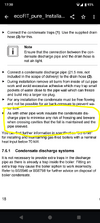
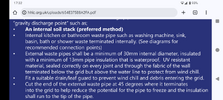
From mi's and hot water and heating installation council (second paragraph).I got a call back from the engineer who said:
- there is a significant fall and the photo is deceiving. I guess it's hard to verify...
- the pipe is 32mm, so it doesn't need insulation, and he claims it's generally uncommon for condensate pipes to be insulated. I can't see this stated in the manufacturer's instructions. Does that make sense to anyone?
I'm not near the property, so I can only think to get someone else to check it if it still seems dubious.
He seems to get very aggravated if I ask him questions...
Attachments
- Joined
- 26 Nov 2015
- Messages
- 42
- Reaction score
- 15
- Country
If it’s not sealed inside or out, then no it doesn’t. Should be sealed to the building fabric, but mi’s will stipulate what they want.
Any opening to the building, such as an air vent, ventilation, holes et al. The flue should be 25mm away, might be more from the soffits, again would be in the mi’s.
Coming back to the issue of the flue position, would could the consequences be if it were determined to be too close to the soffits, eaves or window? Can that be rectified without having to do major work? Or could it mean the flue must be moved again, and consequently probably the boiler as well? Would the boiler need to be deactivated immediately or would there be time allowed to arrange to do remedial work? Would I have recourse to recover the costs of any remedial work from the installers?
Given the disagreement about the condensate pipe as well, I'm wondering if it would make sense to get another gas engineer to survey the external fittings to verify things. But if it could result in the boiler having to be deactivated immediately, I'd be wary of that.
Thanks again for any replies, you've all given what seems like really valuable help to me to avoid being taken advantage of!
he is either lying or not up with the regsI got a call back from the engineer who said:
- there is a significant fall and the photo is deceiving. I guess it's hard to verify...
- the pipe is 32mm, so it doesn't need insulation, and he claims it's generally uncommon for condensate pipes to be insulated. I can't see this stated in the manufacturer's instructions. Does that make sense to anyone?
I'm not near the property, so I can only think to get someone else to check it if it still seems dubious.
He seems to get very aggravated if I ask him questions...
Given the disagreement about the condensate pipe as well, I'm wondering if it would make sense to get another gas engineer to survey the external fittings to verify things. But if it could result in the boiler having to be deactivated immediately, I'd be wary of that.
If you have concerns about any part of the installation, Gas Safe, are the ones to contact.
AFAIR that particular flue position is not shown on the building regs. or manufacturers diagrams.
Gas-Safe tend to suggest we use our "engineering judgement" and of course the unscrupulous installers will not care less whether it's actually safe.
It's possible a plume management kit might be an option if deemed unsafe.
A vertical flue below a rooflight has a 2m clearance but that's very different to this situation.
I would email all concerns to Gas-Safe requesting their opinion. If there are any issues they will force to installers to correct them at their own expense.
Gas-Safe tend to suggest we use our "engineering judgement" and of course the unscrupulous installers will not care less whether it's actually safe.
It's possible a plume management kit might be an option if deemed unsafe.
A vertical flue below a rooflight has a 2m clearance but that's very different to this situation.
I would email all concerns to Gas-Safe requesting their opinion. If there are any issues they will force to installers to correct them at their own expense.

DIYnot Local
Staff member
If you need to find a tradesperson to get your job done, please try our local search below, or if you are doing it yourself you can find suppliers local to you.
Select the supplier or trade you require, enter your location to begin your search.
Please select a service and enter a location to continue...
Are you a trade or supplier? You can create your listing free at DIYnot Local
Similar threads
- Replies
- 1
- Views
- 3K

- Replies
- 16
- Views
- 13K


- Replies
- 37
- Views
- 10K